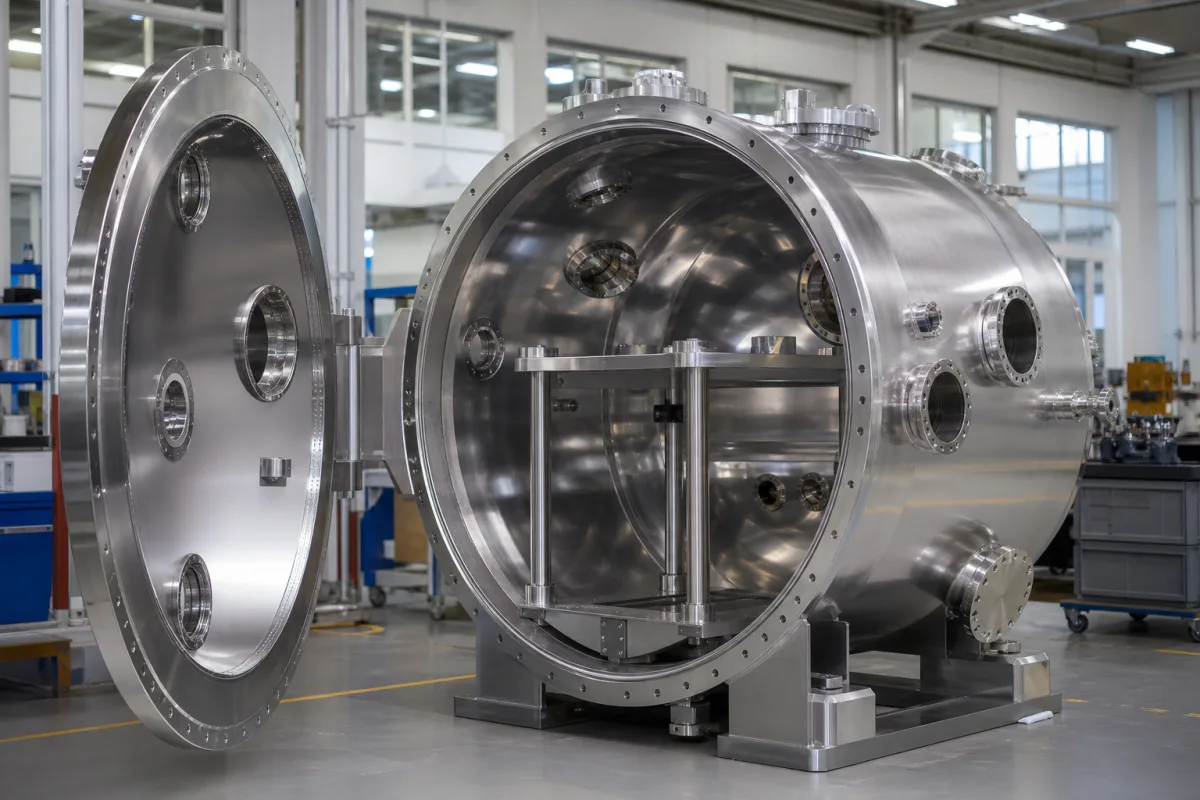
Vacuum chamber body: the welded stainless shell, door and port flanges, built to carry atmospheric load and take CF ports
The welded stainless shell, door and port flanges that make up a chamber before any pump or instrument is fitted · about 100 kN of atmospheric load per square metre of wall, stainless grades from 175 to 280 N/mm² yield, welds placed on the vacuum side, and CF ports from DN16 with six M4 screws to DN400 with thirty-six M10
Before a vacuum chamber is a process tool, it is a fabricated vessel: a rolled and welded shell, a door or end plate large enough to load work through, and a pattern of port flanges welded in for pumps, gauges, feedthroughs and windows. Evacuated, every square metre of that body carries about 100 kN of air pressure; the welds have to be tight without trapping gas; and each port has to match the flange of the pump, gauge or window that bolts to it.
The fabricated body of process and test vacuum chambers: cylindrical, box and spherical shells, doors and end plates, saddles and frames, and the CF and other port flanges welded into them, specified by material grade, atmospheric load, weld design and port sizes. Material choice for low outgassing, surface finish, bakeout and helium leak acceptance of complete chambers are covered on the Vacuum chamber page; door hinge assemblies on the Vacuum chamber door hinge system page; vacuum tank degassers for liquid steel on their own page.
CNFX editorial research · Sources checked October 12, 2026 · 3 sources
About 100 kN on every square metre: atmospheric load and the stainless grades that carry it
Pfeiffer Vacuum's knowledge book states the load an evacuated chamber must carry: about 10 N/cm² of atmospheric pressure, or 100,000 N on an area of 1 m², and adds that besides structural integrity, functional surfaces must not deform enough to affect their function. Its table of chamber stainless steels: [1]
Editorial calculation: a full-diameter door 1.2 m across has an area of about 1.13 m², so it is pressed onto its seal with roughly 113 kN once the chamber is evacuated; a blank on a DN100 CF port with a 108 mm tube sees about 0.9 kN. The 300 °C yield values are 40 % to 45 % lower than at 20 °C, which matters for a body that will be baked.
Pfeiffer notes that 1.4301 may be slightly magnetic in the quenched condition and that magnetisability rises with strain hardening, while 1.4404, 1.4429 and 1.4435 are hardly magnetic; European and AISI grades are only approximately comparable, and where 1.4301 is required it must be backed by the material certificate. [1]
State the chamber diameter or box size, door size, bakeout temperature and any magnetic-permeability limit, so the maker can choose grade and wall thickness and show the calculation.
02
Welds on the vacuum side, intermittent welds outside, and keeping sealing faces flat
Pfeiffer's guidance on welded vacuum vessels concerns where the weld sits as much as how it is made: [1]
Among methods, Pfeiffer describes TIG welding as spatter- and slag-free and usable on stainless steel, aluminium and copper; laser welding as fast with low thermal distortion, able to weld flange rings to tube ends by deep penetration without reworking the sealing geometry, but costly to set up; orbital welding as mechanised with steady seam quality for round parts; and electron-beam welding as carried out in high vacuum, which also allows reactive materials to be welded, at a high system and preparation cost. Welding austenitic stainless steel can raise its magnetisability. [1]
Rule
Reason given
Interior welds wherever the design allows; otherwise full penetration through to the vacuum side [1]
Avoids vacuum-side gaps and cracks that act as virtual leaks [1]
Any supplementary atmosphere-side weld for strength must not be continuous [1]
Keeps leak detection possible and avoids trapped air [1]
Qualified welders, welding procedure tests per material and weld geometry, supervision by welding engineers or technicians [1]
Limit residual stress and distortion; rework sealing surfaces if affected [1]
Distorted sealing faces can scrap the workpiece [1]
Ask for the weld map showing which seams are inside, which are full-penetration, where any outside stitch welds are, and how flange faces are machined after welding.
03
CF ports welded into the shell: DN16 with 6 × M4 to DN400 with 36 × M10, bakeable to 450 °C
Metallicflex tabulates the CF flange series under ISO/TS 3669-2 dimensions, from which the port pattern of a chamber body is laid out: [2]
Neyco's CF catalogue gives the same series in 304L (1.4306) or 316LN (1.4429), both low-carbon to avoid intergranular corrosion after welding; 316LN adds lower magnetic permeability, a harder knife edge and hydrogen degassing at up to 950 °C. The captured OFHC copper gasket allows bakeout to 450 °C and vacuum to 10⁻¹² mbar. [3] Pfeiffer gives the CF standards as ISO 3669 for DN16 to DN250 and ISO/TS 3669-2 for DN10 to DN400, notes that larger manufacturer variants can differ considerably and should be compared before mixing, and recommends 1.4429 ESR where strength or low magnetisability matter. Copper gaskets cannot be reused; FKM seals can be reused on CF flanges for pressures up to about 10⁻⁸ hPa. [1]
Where elastomer seals are used on large ports or the door, Pfeiffer gives the permeation of a DN500 ISO-K FKM seal as about 4 × 10⁻⁷ Pa·m³/s for air at 60 % humidity, and limits aluminium seals between stainless flanges to about 150 °C because of differing expansion. [1] Editorial note: the port schedule on the drawing, with DN, orientation, tapped or clear holes and fixed or rotatable flanges for each port, is what lets pumps, gauges and windows bolt on without adapters.
Provide a port schedule: DN and flange type for each port, position and orientation on the shell or door, tapped or through holes, fixed or rotatable, and the seal type for the door.
04
What to send when ordering a vacuum chamber body
Paste it into your enquiry below or into an email to a maker, then replace every bracket.
Geometry: [cylinder / box / sphere; inside diameter or size; length; door size and hinge side]
Material: [304L / 316L / 316LN; certificates; magnetic limit]
Loads: [external pressure only or also internal overpressure; bakeout temperature; mounted loads]
Welds: [inside welds; full penetration; stitch welds outside; procedure qualification]
Ports: [schedule of DN, flange type, position, orientation]
Seals: [door seal type; CF copper or FKM on ports]
Supports: [saddles or frame; anchoring]
Explore company information and manufacturing capabilities, then discuss the scope of your project with a relevant supplier.
Share this page
Compiled and source-reviewed by the CNFX editorial team.
Each manufacturer above links to the page on that company's own website where the product is listed, with the date we checked it. How we source and review
· Page last updated 13 October 2026
Buyer questions
How much force does atmospheric pressure put on a vacuum chamber?
Pfeiffer gives about 10 N/cm², or 100,000 N on 1 m² of wall or door. [1]
Why are vacuum chamber welds made on the inside?
To avoid vacuum-side gaps and cracks that act as virtual leaks; any outside reinforcing weld should be intermittent so leaks can still be found. [1]
How many bolts does a DN100 CF port have?
Sixteen M8 screws on a 130.3 mm bolt circle, with a 152 mm flange 19.8 mm thick, in Metallicflex's table. [2]
What bakeout temperature do CF ports allow?
Up to 450 °C with the captured OFHC copper gasket, according to Neyco and Pfeiffer. [3][1]
Sources and what still needs a direct check
Sources checked 2026-10-12. Atmospheric load, stainless grades, welding rules and seal limits come from Pfeiffer Vacuum's vacuum technology knowledge book; CF port dimensions from Metallicflex's CF components catalogue; flange materials and bakeout from Neyco's CF catalogue.