Industry-Verified Manufacturing Data (2026)

Vacuum Gripper/End-Effector

Based on aggregated insights from multiple verified factory profiles within the CNFX directory, the standard Vacuum Gripper/End-Effector used in the Computer, Electronic and Optical Product Manufacturing sector typically supports operational capacities ranging from standard industrial configurations to heavy-duty production requirements.

Technical Definition & Core Assembly

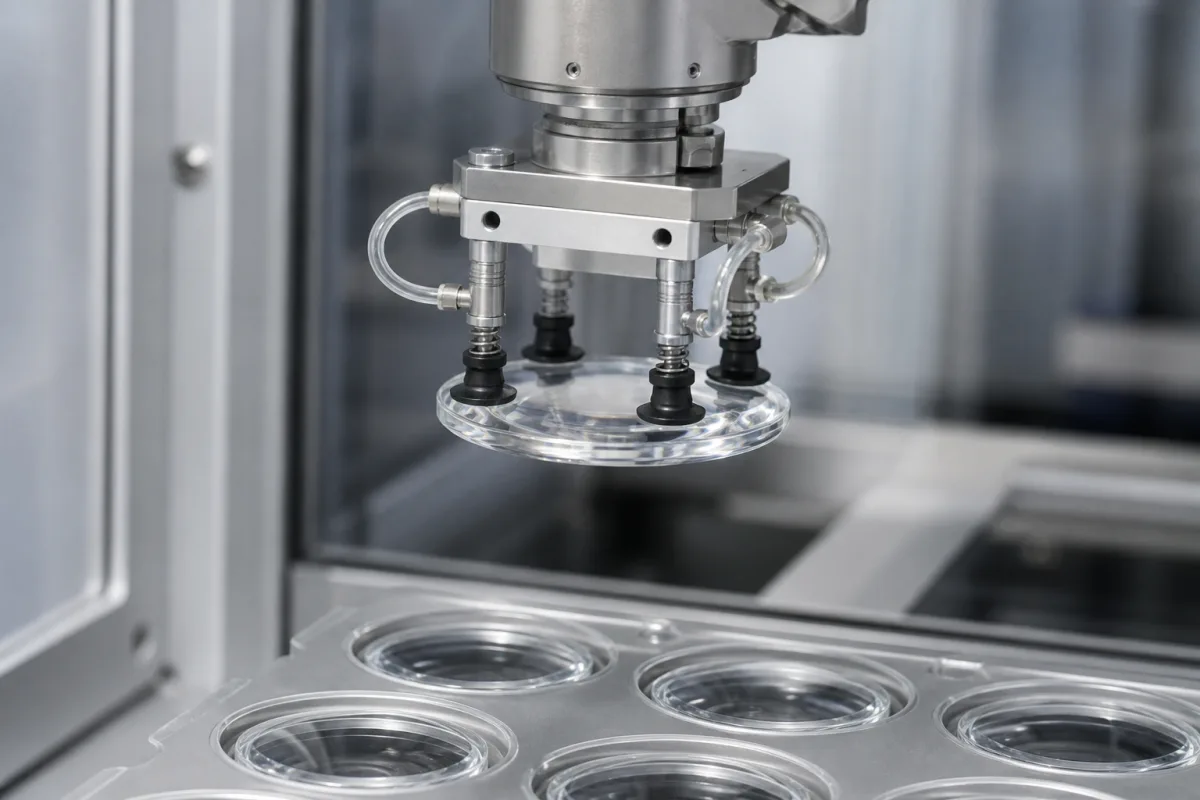
A canonical Vacuum Gripper/End-Effector is characterized by the integration of Gripper Body / Mounting Plate and Suction Cup (Pad). In industrial production environments, manufacturers listed on CNFX commonly emphasize Aluminum alloy (body/structure) construction to support stable, high-cycle operation across diverse manufacturing scenarios.

A robotic end-effector that uses vacuum suction to securely grip and manipulate optical lenses during automated loading processes.

Product Specifications

Technical details and manufacturing context for Vacuum Gripper/End-Effector

Definition
A specialized robotic end-effector component within an Automated Lens Loader system, designed to precisely pick, hold, position, and place delicate optical lenses (such as camera lenses, microscope lenses, or spectacle lenses) using controlled vacuum pressure. It serves as the critical interface between the robotic arm and the lens, ensuring secure, non-marring handling throughout the loading, unloading, or transfer sequence within manufacturing or assembly lines.
Working Principle
Operates by creating a pressure differential. An internal vacuum pump or ejector generates suction, which is channeled to one or more suction cups (pads) on the gripper's contact surface. When the gripper is positioned against a lens, the suction cups form a seal. Activating the vacuum creates negative pressure (a partial vacuum) inside the cups, causing atmospheric pressure to push the lens firmly against them, enabling a secure grip. Releasing the vacuum (by venting to atmosphere) breaks the seal and releases the lens.
Common Materials
Aluminum alloy (body/structure), Polyurethane or silicone (suction cups), Stainless steel (fittings/connectors)
Technical Parameters
  • Diameter or footprint of the suction cup(s); critical for matching lens surface area and curvature. (mm) Customizable
Components / BOM
  • Gripper Body / Mounting Plate
    Provides structural integrity and interface for mounting to the robot arm flange.
    Material: Aluminum alloy
  • Suction Cup (Pad)
    Flexible sealing element that contacts the lens surface; creates the vacuum seal.
    Material: Polyurethane or silicone
  • Vacuum Port / Connector
    Interface for connecting the vacuum supply line (tube) from the pump or valve.
    Material: Stainless steel or brass
  • Vacuum Sensor Port (optional)
    Port for connecting a pressure sensor to monitor vacuum level and detect grip failures.
    Material: Stainless steel
Engineering Reasoning
0.6-0.9 bar vacuum pressure, 0.1-0.3 mm seal compression, 40-80 mm/s approach velocity
Vacuum pressure > 0.95 bar (suction loss), seal compression < 0.05 mm (leak initiation), approach velocity > 100 mm/s (seal deformation)
Design Rationale: Bernoulli's principle failure at pressure differential < 0.05 bar, elastomer seal plastic deformation at compression > 0.35 mm, laminar flow breakdown at Reynolds number > 2300
Risk Mitigation (FMEA)
Trigger Particulate contamination > ISO 14644-1 Class 5 (≥ 0.5 μm particles)
Mode: Vacuum seal leakage at 0.02 bar/min pressure decay rate
Strategy: Integrate HEPA H14 filtration with 99.995% efficiency at 0.3 μm
Trigger Electrostatic discharge > 15 kV from lens surface tribocharging
Mode: Piezoelectric vacuum generator failure at 150 mA surge current
Strategy: Implement ionizing air curtain with 5000 ions/cm³ neutralization rate

Industry Taxonomies & Aliases

Commonly used trade names and technical identifiers for Vacuum Gripper/End-Effector.

Applied To / Applications

This component is essential for the following industrial systems and equipment:

Industrial Ecosystem & Supply Chain DNA

Complementary Systems
Downstream Applications
Specialized Tooling

Application Fit & Sizing Matrix

Operational Limits
pressure: Vacuum: -80 kPa to -95 kPa (typical), Max positive pressure: 0.5 bar
flow rate: 0.5 to 2.0 L/min per suction cup
temperature: 0°C to 60°C
slurry concentration: Not applicable (dry handling only)
Media Compatibility
✓ Optical glass lenses ✓ Polycarbonate lenses ✓ Coated optical elements
Unsuitable: High particulate or abrasive environments
Sizing Data Required
  • Lens diameter and curvature radius
  • Required lifting force/safety factor
  • Robot interface and mounting constraints

Reliability & Engineering Risk Analysis

Failure Mode & Root Cause
Suction seal degradation
Cause: Wear from repeated contact with surfaces, contamination buildup, or material incompatibility leading to air leaks
Vacuum generator failure
Cause: Clogging from particulate ingress, diaphragm fatigue from cyclic operation, or electrical/control system faults
Maintenance Indicators
  • Audible hissing or whistling during operation indicating air leaks
  • Visual observation of workpiece slippage or inconsistent gripping force
Engineering Tips
  • Implement regular preventive maintenance including seal inspection/replacement and filter cleaning to prevent contamination
  • Optimize operating parameters (vacuum level, cycle time) to minimize mechanical stress and energy consumption

Compliance & Manufacturing Standards

Reference Standards
ISO 9283:1998 - Manipulating industrial robots - Performance criteria and related test methods ANSI/RIA R15.06 - Industrial Robots and Robot Systems - Safety Requirements CE Marking - Directive 2006/42/EC on machinery safety
Manufacturing Precision
  • Suction cup mounting surface flatness: ≤0.1mm
  • Vacuum port thread concentricity: ±0.05mm
Quality Inspection
  • Vacuum leak test at 80% of rated vacuum level
  • Dynamic load capacity verification with 150% rated payload

Factories Producing Vacuum Gripper/End-Effector

Verified manufacturers with capability to produce this product in China

✓ 93% Supplier Capability Match Found

P Project Engineer from Germany Feb 26, 2026
★★★★★
"The Vacuum Gripper/End-Effector we sourced perfectly fits our Computer, Electronic and Optical Product Manufacturing production line requirements."
Technical Specifications Verified
S Sourcing Manager from Brazil Feb 23, 2026
★★★★★
"Found 43+ suppliers for Vacuum Gripper/End-Effector on CNFX, but this spec remains the most cost-effective."
Technical Specifications Verified
P Procurement Specialist from Canada Feb 20, 2026
★★★★★
"The technical documentation for this Vacuum Gripper/End-Effector is very thorough, especially regarding technical reliability."
Technical Specifications Verified
Verification Protocol

“Feedback is collected from verified sourcing managers during RFQ (Request for Quote) and factory evaluation processes on CNFX. These reports represent historical performance data and technical audit summaries from our B2B manufacturing network.”

11 sourcing managers are analyzing this specification now. Last inquiry for Vacuum Gripper/End-Effector from UAE (1h ago).

Supply Chain Compatible Machinery & Devices

Industrial IoT Gateway

Edge computing device connecting industrial equipment to cloud platforms.

Explore Specs →
Modular Industrial Edge Computing Device

Rugged computing platform for industrial data processing at the network edge

Explore Specs →
Industrial Smart Camera Module

Embedded vision system for industrial automation and quality inspection.

Explore Specs →
Industrial Wireless Power Transfer Module

Wireless power transfer module for industrial equipment applications

Explore Specs →

Frequently Asked Questions

What materials are used in this vacuum gripper for optical lens handling?

The gripper features an aluminum alloy body for lightweight durability, polyurethane or silicone suction cups to prevent lens damage, and stainless steel fittings for reliable vacuum connections.

How does this vacuum end-effector ensure secure grip on optical lenses?

It uses precisely engineered suction cups that create consistent vacuum pressure, with optional vacuum sensors to monitor grip integrity during automated loading processes.

Is this gripper compatible with standard robotic systems in electronics manufacturing?

Yes, it features a universal mounting plate and standard vacuum connectors for seamless integration with most industrial robotic arms and automation systems.

Can I contact factories directly on CNFX?

CNFX is an open directory, not a transaction platform. Each factory profile provides direct contact information and production details to help you initiate direct inquiries with Chinese suppliers.

Get Quote for Vacuum Gripper/End-Effector

Request technical pricing, lead times, or customized specifications for Vacuum Gripper/End-Effector directly from verified manufacturing units.

Your business information is encrypted and only shared with verified Vacuum Gripper/End-Effector suppliers.

Thank you! Your message has been sent. We'll respond within 1–3 business days.

Need to Manufacture Vacuum Gripper/End-Effector?

Connect with verified factories specializing in this product category

Add Your Factory Contact Us
Previous Product
Vacuum Chamber Body
Next Product
Vacuum Processing Chamber