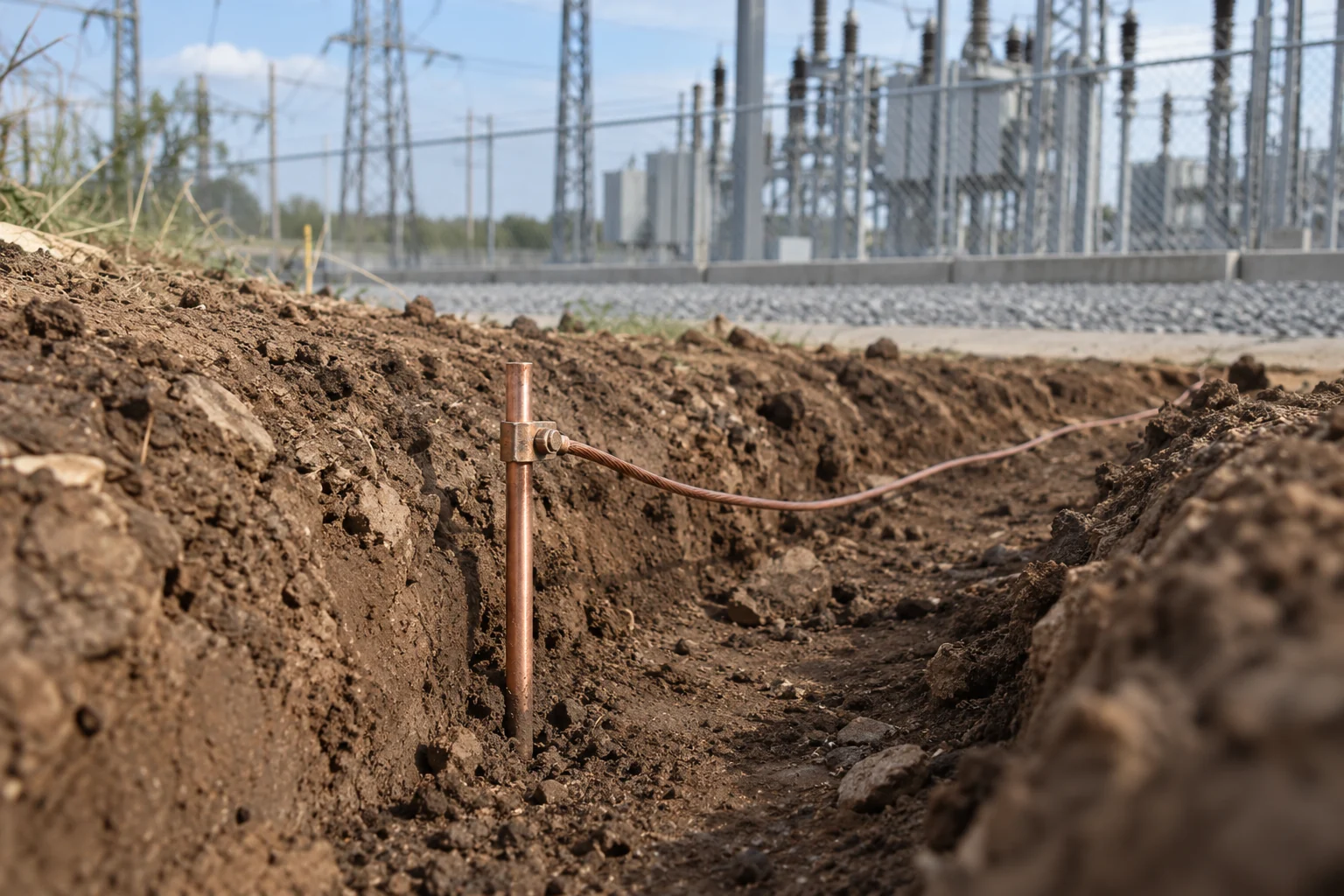
For a sectional ground-rod order, specify the actual rod diameter, coating, thread and compatible connection hardware together. Copper thickness and a test-standard name describe the product; resistance to earth also depends on the installation and soil. The catalogue examples below keep those two acceptance questions separate.
CNFX editorial research · Sources checked October 9, 2026 · 10 sources
IEC 62561-2:2025 edition 3 covers conductors and metallic earth electrodes for lightning-protection systems. Its public preview shows the scope, references and test headings below, but not the numerical acceptance clauses. It also introduces an annex on applicability of previous tests; an older test report cannot simply be relabelled as a 2025 result [1].
Check the exact catalogue row, not only the family heading
nVent’s threaded-rod catalogue states a minimum 8 ft length for its UL 467 listed rods and a minimum 10 mil copper coating. Its 635840 row is 4 ft with IEC EN 62561-2 in the compliance column and no UL entry; 635880 is 8 ft and lists UL. These are manufacturer catalogue entries, not CNFX verification of an active UL listing or a quotation from UL 467 itself [2].
The report’s edition can differ from the latest standard
The current nVent resource list includes declarations or certificates citing IEC 62561-2:2018. The 2025 preview includes an annex about previous tests, whose acceptance details are not provided in the preview. Request the report, exact SKU and invoked edition; neither a newer catalogue date nor “IEC compliant” proves a full retest to 2025 [2][1].
Test in IEC 62561-2 (edition 3.0)
What it checks for a coated rod
Coating thickness
Thickness of the coating on earth rods; the standard references ISO 2178 magnetic measurement [1]
Bending test for copper-coated steel earth rods [1]
Environmental
Environmental test for coated rods; the standard references cyclic salt mist testing (IEC 60068-2-52) [1]
Electrical
Electrical resistance of coated rods and resistivity of earth rods [1]
Mechanical
Tensile strength and yield-to-tensile ratio for copper-coated steel rods [1]
Material and cross-section
Material, configuration and cross-sectional area; couplers are tested separately [1]
02
A rod-to-conductor connector is not a rod-extension coupler
The original three assembly groups below distinguish the electrode body, electrical connection and optional driving point. A sectional extension also needs its own coupler. This is a functional assembly reference, not a model manufacturing BOM.
Component
Function
Material and compatibility evidence
Electrode rod
Places a conductive electrode in contact with the soil.
nVent’s threaded example has a steel core and electrolytic copper coating. TuAn separately names Q235 and 99.95% copper; that is a supplier claim, not the confirmed material of every copper-bonded rod [2][3].
Clamp / conductor connector
Joins the earthing conductor to the rod.
nVent Hammerlock is an irreversible copper connector with separate rod-diameter and conductor-size rows. It is not evidence that all clamps are bronze, brass or stainless, or that any 5/8-inch clamp fits any nominal 5/8-inch rod [4].
Driving point, where specified
Helps drive a compatible threaded rod; it is separate from the conductor connection.
nVent’s driving-point range specifies steel and SDT58/SDT34 thread sizes. The related-product description limits it to internally threaded rods. Verify the rod-end configuration; a pointed rod may not need this separate part, and “hardened steel” was not established [6][2].
For sectional rods, nVent’s CR58 coupler is bronze with 5/8-inch UNC threads and a nominal length of 2.4 inches. It joins rods; Hammerlock instead joins a conductor to a rod. Match drawings and product instructions rather than substituting one for the other [5][4].
03
Check copper thickness and the actual diameter
Catalogue names describe a nominal size, not the measured rod.
Nominal vs actual diameter
In one leading range a 5/8 in rod measures 0.56 in, a 3/4 in rod 0.68 in and a 1 in rod 0.91 in [2]. If your design or a code requires a minimum diameter, specify the actual diameter.
Copper coating
nVent has 10 and 13 mil options, equal to 0.254 and 0.3302 mm by conversion. TuAn’s same page gives ≥0.25 mm in prose, >0.3 mm average in a feature list and 0.254 mm in its specification block and 10 mil model table. Minimum and average are different measures; obtain the actual model’s minimum and measurement report [2][3].
Strength
nVent specifies a minimum 80,000 lbf/in² and shows 552 MPa in its page data. TuAn says “up to 600 N/mm²” in prose and 570 N/mm² in the specification block. An upper claim is not a minimum guarantee; request the offered rod’s test value and acceptance basis [2][3].
Depth and couplers
nVent describes cold-rolled threads that preserve the coating; its couplers have specific UNC thread sizes. TuAn’s 35 m depth statement is a supplier claim, not a site-specific driving plan or resistance guarantee. Check mating threads, coupler tests and local geology [2][5][3][1].
04
Keep diameter, coating and connection size on the same order line
These are nVent catalogue examples, not specifications of TuAn or the other suppliers below. The manufacturer’s certifications column has not been independently checked in a listing registry [2].
SKU
Actual diameter / length
Coating / thread
Catalogue certification entry
635840
0.56 in / 4 ft
10 mil / 5/8 in UNC
No UL entry
635880
0.56 in / 8 ft
10 mil / 5/8 in UNC
UL, RUS
635883
0.56 in / 8 ft
13 mil / 5/8 in UNC
UL, RUS
634400
0.91 in / 10 ft
10 mil / 1 in UNC
CSA-US, UL, cUL, CSA
nVent’s EHL58C1V Hammerlock row pairs a 0.56-inch copper-bonded rod with #4–#2 stranded or 25 mm² stranded conductors. Its EHL58G1V galvanized-rod row instead uses a 0.63-inch actual diameter. The nominal 5/8-inch label is shared; the catalogue’s fit dimensions are not [4].
05
Ask how the copper is bonded to the steel
The bond between copper and steel is what stops the coating peeling when the rod is driven or bent.
One supplier page describes two different processes
The same Chinese product page describes a nano alkaline pre-plating (electrodeposition) process and, in its feature list, a cold-rolling and hot-drawing process creating a metallurgical bond [3]. Ask the supplier which process makes the rods you are buying and for the adhesion and bending test results to IEC 62561-2 [1].
Treat service-life claims as claims
The Chinese page claims a service life of more than 50 years [3]. Corrosion depends on soil; ask for environmental test results to the standard rather than a life figure.
06
A compliant rod does not guarantee the installed resistance to earth
Schneider Electric’s installation guide links resistance to installation and soil, with moisture, frost and ageing affecting the result. Agree site data, design and an installed-system measurement; a rod catalogue cannot promise the same resistance everywhere [7].
Record soil conditions and the electrode arrangement with the resistance test. Changes in moisture or frozen soil can change the result [7].
Keep accessible joints and test provisions in the agreed inspection scope. Periodic resistance testing and connection condition are installation questions; “maintenance-free” supplier wording does not replace them [7][3].
Use the approved test and isolation procedure through qualified personnel. This category page does not instruct a user to disconnect protective earthing on an energised installation.
07
Separate rod properties from system acceptance values
A quotation should identify the rod and hardware, then identify the installation tests separately. Unknown ratings below require the offered product’s evidence.
Field
How to specify it
Rated current capacity
Define the duty, current waveform and relevant tested assembly. IEC’s preview separately lists a lightning-current test for couplers; that heading does not establish an arbitrary kA rating for every rod [1].
Resistance to earth
Specify installed-system acceptance and test conditions. Soil and arrangement matter; do not present an ohm value as an unconditional rod property [7].
Material grade
Name core and coating separately, plus connector and coupler materials. TuAn Q235/copper and nVent copper-bonded steel are different supplier descriptions [3][2][5].
Diameter
Specify minimum actual diameter, nominal label and mating hardware. nVent 5/8-inch examples are 0.56-inch actual; its galvanized clamp examples need another actual fit size [2][4].
Length
Order a named SKU and section length, with total assembly depth separately. The catalogue’s UL entries are model-specific; actual installability needs site confirmation [2].
Tensile strength
Request a minimum and test basis, not “up to” strength. nVent minimum 80,000 lbf/in² differs from TuAn’s 600 prose and 570 specification statements [2][3].
Corrosion resistance
Name coating minimum and environmental test evidence. A supplier’s >50-year claim is not a verified installed lifetime [3][1].
Operating temperature
Request limitations for the selected rod, joint and any ancillary equipment; the adopted rod sources do not establish a universal operating range.
Weight
Use the exact model’s unit weight and packaging. nVent635880 lists6.7lb; TuAnTGRCS142-2440 lists3.1kg. These are separate catalogue values, not an interchangeable item confirmation [2][3].
IP rating
No rod IP rating is established in the adopted sources. If the order includes an enclosure or monitoring device, request its own identified rating; do not attach an invented enclosure rating to bare metal.
08
Ask rod and accessory suppliers for the same identified drawing
The linked Chinese records have different published supply scopes. Product listings establish an offer, not independent certification or the accuracy of every statement on a manufacturer page.
TuAn — copper-clad rods
TGRCS142-2440 is shown as14.2mm actual diameter,2440mm length,10mil coating and3.1kg. Resolve the page’s differing process, coating and strength statements in the model quotation [3].
Epicor — galvanized rods
The product is zinc-coated carbon steel. The part table gives EIP-GDD12 through EIP-GDD20 diameters12–20mm, but another block states14.2–25mm. Neither block supports calling this a copper-bonded rod [8].
Powertelcom — rods and couplings
The rod table gives GR5/8 as 14.2 mm, with 0.254 mm copper thickness. The separate coupling table gives GRC5/8 for 14.2 mm rods, with brass/galvanized-steel material alternatives. Confirm mating threads and chosen material [9][10].
09
Documents to request
Ask for evidence tied to the rod size and length you order.
Test report to IEC 62561-2 naming the edition, covering coating thickness, adhesion, bending and environmental tests [1].
UL 467 listing for each length and diameter, if you need it [2].
Measured actual diameter and minimum copper thickness [2][3].
Statement of the bonding process (electroplated or clad) [3].
Coupler and driving-accessory specifications and test evidence [1].
10
Copy this RFQ and fill in the brackets
Paste it into your enquiry below or into an email to a maker, then replace every bracket.
Product: copper-bonded steel earth rod, quantity [pieces]
Standard: [IEC 62561-2 edition __ / UL 467 / both]
Size: nominal [5/8" / 3/4" / 14.2 mm / other], minimum actual diameter [mm]; length [m or ft]
Copper: minimum thickness [µm or mil], purity [ ], bonding process [state]
Ends: [pointed / threaded both ends / chamfered]; threads [rolled], thread size [ ]
Accessories: couplers [n], driving heads [n], clamps or exothermic connections [ ]
Soil: resistivity [Ω·m] or corrosive conditions [ ]
Documents: test report (thickness, adhesion, bending, environmental), listing certificates, mill certificate for steel core
Delivery to [country], target date [date]
3 companies list this product among what they make. Company figures are quoted from each
company's own website; every card states where the relationship came from.
Xinchang TuAn Machinery Co., Ltd.
Xinchang, Shaoxing, Zhejiang (per official site), CN
the rod page offers copper-clad steel models, but the same page gives electrodeposition and cold-rolling/hot-drawing process descriptions, differing coating measures and 600 versus 570 N/mm² strength statements. Confirm the actual ordered model, minimum coating, bond process and report. No active certification listing or 50-year life was verified.
Product scope checked 2026-10-09
Listed on the company's own website · profile compiled by CNFX from public sources
its Galvanized Ground Rod page offers zinc-coated carbon-steel rods, a different material route from the copper-bonded reference above. Its part table lists 12–20 mm while another specifications block states 14.2–25 mm; require the exact part drawing. No certificate was verified.
Product scope checked 2026-10-09
Listed on the company's own website · profile compiled by CNFX from public sources
Listed there as: “Galvanized Ground Rod” View source page ↗epicorpower.com · recorded 2026-08-27
Publishes separate Ground Rod and Ground Rod Coupling pages. The rod table gives GR5/8 diameter 14.2 mm and coating 0.254 mm. The prose contains material/approval statements without test evidence; obtain a named model and test report.
Product scope checked 2026-10-09
Listed on the company's own website · profile compiled by CNFX from public sources
Listed there as: “Ground Rod Coupling” View source page ↗powertelcom.com · recorded 2026-09-17
Explore company information and manufacturing capabilities, then discuss the scope of your project with a relevant supplier.
Share this page
Compiled and source-reviewed by the CNFX editorial team.
Each manufacturer above links to the page on that company's own website where the product is listed, with the date we checked it. How we source and review
· Page last updated 13 October 2026
Buyer questions
Is a 5/8 inch ground rod really 5/8 inch?
Not necessarily: in one leading range the 5/8 in rod measures 0.56 in. Specify the actual diameter if a minimum is required. [2]
How thick should the copper be?
Rods listed to UL 467 in one range have at least 10 mil (0.254 mm) of copper, with 13 mil options. Ask suppliers for the minimum thickness and how it is measured. [2]
Are short rods UL listed?
In one leading range only rods of 8 ft and longer carry a UL listing; shorter lengths are offered to IEC EN 62561-2 or without a listing. [2]
What tests does IEC 62561-2 require for copper-coated rods?
The 2025 edition lists coating-thickness, adhesion, electrical resistance, bending, environmental, resistivity, tensile and yield-to-tensile ratio tests, plus material and cross-section checks. [1]
Can rods be joined for deep earthing?
Sectional rods can use compatible threaded couplers. nVent’s CR58 is a bronze 5/8-inch UNC example; TuAn’s 35 m depth is a supplier claim, not confirmation that a particular site can be driven to that depth. Match threads and obtain the installed-system design. [5][3]
Sources and what still needs a direct check
Sources checked 2026-10-09. Standards bodies and regulations define the requirements; manufacturer pages show published ranges for those models only. CNFX does not certify products or suppliers.