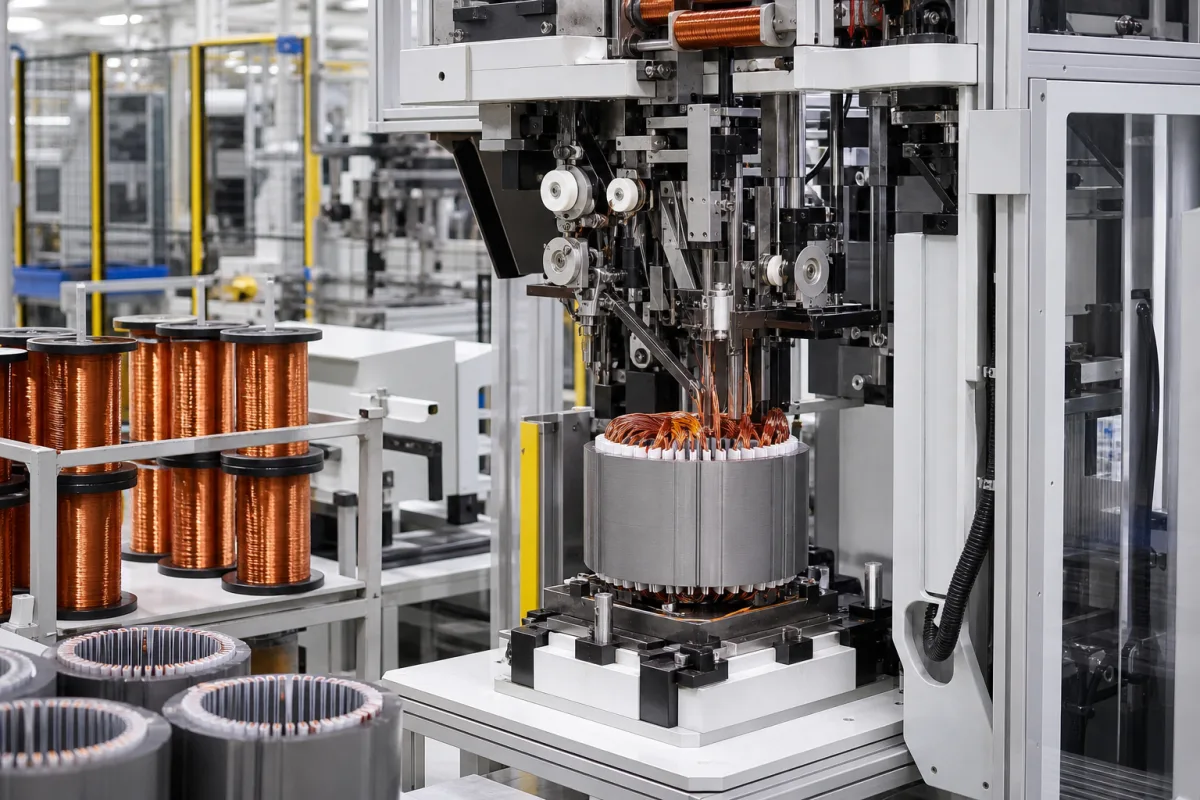
Stator winding · Wire tension limits by gauge, winding and inserting methods, fill factor, wire heating
A stator winding machine lays insulated magnet wire into the slots or onto the teeth of an electric motor stator, either by winding coils directly with a needle or flyer, or by winding coils on forms and inserting them into the slots. Ask three things first: which winding method suits your stator and wire, how the machine controls wire tension within the wire maker's limits, and what slot fill and coil quality it can demonstrate on your stator.
Machines for winding and inserting coils into stators of three-phase and other induction and permanent-magnet motors, including needle, flyer and coil-insertion types. Transformer winding machines, hairpin forming lines, rewinding services and magnet wire itself are outside this page.
CNFX editorial research · Sources checked October 12, 2026 · 4 sources
MWS Wire Industries publishes recommended winding tensions for round copper and aluminium magnet wire by AWG size, with maximums based on the yield strength of fully annealed copper wire. It warns that tensions above the maximum may cause higher resistance and that the values are recommendations to be checked by your own validation tests that the wire is not stretched in production. [1]
For copper, its table gives AWG 18 a minimum of 4.3 kg and maximum of 5.8 kg, AWG 20 2.7–3.6 kg and AWG 22 1.7–2.3 kg; aluminium wire of the same size has much lower limits, for example AWG 20 at 0.6–1 kg. [1]
Editorial calculation: the AWG 20 copper maximum of 3.6 kg is about 35 N of pull, and aluminium AWG 20's 1 kg maximum about 10 N; a machine running both materials needs tension control that reaches down to the lower range. [1]
Give the supplier the stator drawings (outer and inner diameter, stack height, slot count and shape), wire material, size and grade, number of parallel strands, winding scheme, coils per phase, target fill factor, cycle time, tension range, and how coils are inserted, laced and formed.
02
Choose the winding or inserting method and target fill
Johannes Zerbe's doctoral thesis at TU Berlin (2019) develops needle winding with supporting winding caps, a modification of conventional needle winding in which a changed needle path and specially adapted winding heads allow improved fill factors, and derives design recommendations from feasibility experiments. [2]
The thesis also investigates winding with inductively preheated wire, which softens the copper and uses reversible thermal expansion to reduce cavities under non-circular windings, improving thermal conductivity while allowing reduced wire tension. It further examines how element sizes and scattered material properties affect the accuracy of winding-process simulation. [2]
Editorial note: suppliers on this page offer needle winding, flyer winding and winding-plus-inserting machines; ask each to wind and, if relevant, insert coils on your own stator and report fill factor, wire resistance before and after, and insulation test results.
BBS Automation, a winding machine maker, describes needle winding as the process of choice for internally or externally wound stators and rotors with complex winding schemes, with the needle (nozzle) feeding the wire into the slots. For its vertical needle winders it lists winding speeds up to 600 rpm and wire diameters of 0.1–1.8 mm, with different stator types and winding patterns wound at the same time; its cam-driven needle winders move the stroke mechanically instead of by servomotors, for high quantities with low variance. [3]
Editorial calculation: at 600 rpm a needle lays up to 10 turns per second, so a 60-turn coil on one tooth needs at least 6 seconds of winding time before indexing, terminating and changeover are added. The turn count is an assumed example. [3]
03
Needle, flyer and winding-and-inserting machines from five listed makers
The five makers split by method: Shanghai Wind lists needle winders, Xiamen Sipu flyer winding and inserting machines, Ningbo Nide combined three-winding, one-inserting machines, Xingte single- and multi-station winders, and Grewin winding and inserting machines.
Listings include needle winding machines, single- and multi-station stator winders, flyer winders and combined winding-and-inserting machines.
04
Ask whether coils are compacted after winding, and what it costs
Karlsruhe Institute of Technology (KIT) researchers simulated the compaction of round-wire stator windings, a step that presses wound coils so the round wires are formed towards rectangular shapes and the fill factor rises. They define fill factor as the ratio of the conductor area to the available slot area in the stator stack. [4]
The finite element study used wire of 0.71 mm diameter with five wires per layer, 2, 4 or 8 layers, wild, layer-precise or orthocyclic layer structures, and punch strokes of 7, 14 and 21% of the initial winding height. The 21% maximum comes from converting a round wire into a rectangle of equal area and width, whose height is the diameter scaled by 0.785. The layer-precise winding with 2 layers and a 21% stroke gave the best fill factor, 0.95, but 4% of the original cross-sectional area was pressed out of the slot. At a 21% stroke the wire cross-section shrank about 1.5% more in orthocyclic than in layer-precise windings. [4]
Editorial note: if a supplier offers coil compaction or quotes fill factors near these values, ask for fill factor, resistance and insulation test results on your own stators; the KIT model left out the wire insulation.
05
Pay-off tensioner, needle or flyer head, winding caps and inserting station
In the TU Berlin work, fill factor comes from the needle path and the winding caps that guide the coil, with wire heating as an option that lowers tension. [2]
Wire diameter, winding speed and tension limit for a stator winder
Set tension from the wire side: MWS gives 3.6 kg (about 35 N) as the maximum for AWG 20 copper. The needle-winder example covers 0.1–1.8 mm wire at up to 600 rpm. [1][3]
5 companies list this product among what they make. Company figures are quoted from each
company's own website; every card states where the relationship came from.
Shanghai Wind Automation Equipment Co., Ltd.
Manufacturing site to be confirmed for the order
Lists needle winding and other stator winding machines.
Explore company information and manufacturing capabilities, then discuss the scope of your project with a relevant supplier.
Share this page
Compiled and source-reviewed by the CNFX editorial team.
Each manufacturer above links to the page on that company's own website where the product is listed, with the date we checked it. How we source and review
· Page last updated 13 October 2026
Buyer questions
How much tension can magnet wire take while winding?
MWS Wire's table gives copper AWG 20 2.7–3.6 kg and AWG 18 4.3–5.8 kg, based on annealed copper's yield strength; exceeding the maximum may raise resistance. [1]
How can stator fill factor be improved?
A TU Berlin thesis shows needle winding with supporting winding caps and adapted heads achieving improved fill factors. [2]
Why heat the wire during winding?
The same thesis found preheated wire reduces cavities under non-circular windings and allows lower wire tension. [2]
How fast do needle winding machines run?
BBS Automation lists vertical needle winders at up to 600 rpm for wire of 0.1–1.8 mm. [3]
How much can compacting a wound coil raise the fill factor?
In a KIT simulation, a layer-precise winding of 0.71 mm wire with 2 layers pressed by 21% of its height reached a fill factor of 0.95, but 4% of the wire area was pressed out of the slot. [4]
Sources and what still needs a direct check
Sources checked 2026-10-12. MWS Wire Industries is a magnet wire maker; its tensions are recommendations to validate. The TU Berlin thesis is open-access doctoral research.