Vitreous (porcelain) enamel frit and powders for appliance parts · Ground coat versus cover coat frit, how frit is smelted, quenched and milled, electrostatic powder with organosilicon encapsulation, firing onto steel, and US enameling and frit plant rules
Ceramic coating powder for ovens, cooktops and other appliance parts here means porcelain (vitreous) enamel: a glass frit, ground to powder or slip, applied to steel or cast iron and fired so it fuses into a hard glass layer. A ground coat bonds to the metal and a cover coat gives colour and surface. Ask three things first: whether you need a ground coat, cover coat or one-coat system, how it will be applied (wet slip or electrostatic powder), and the base metal, its preparation and the firing conditions.
Porcelain (vitreous) enamel frits and enamel powders and slips for coating steel and cast iron appliance parts such as oven cavities, burner parts and cooktops, including electrostatic enamel powders. Thermal spray ceramic powders, organic powder coatings (see automated powder coating system), ceramic glazes for pottery and high-temperature paints are outside this page except where compared.
CNFX editorial research · Sources checked October 11, 2026 · 4 sources
US EPA's AP-42 Section 11.14 (Frit Manufacturing) defines frit as a homogeneous melted mixture of inorganic materials used in enameling iron and steel and in glazing porcelain and pottery. Its raw charge depends on whether it is a ground coat or a cover coat: for cover coats AP-42 names silica, fluorspar, soda ash, borax, feldspar, zircon, aluminium oxide, lithium carbonate, magnesium carbonate and titanium oxide, and says ground coats contain the same compounds plus smaller amounts of metal oxides such as cobalt, nickel, copper and manganese oxide. [1]
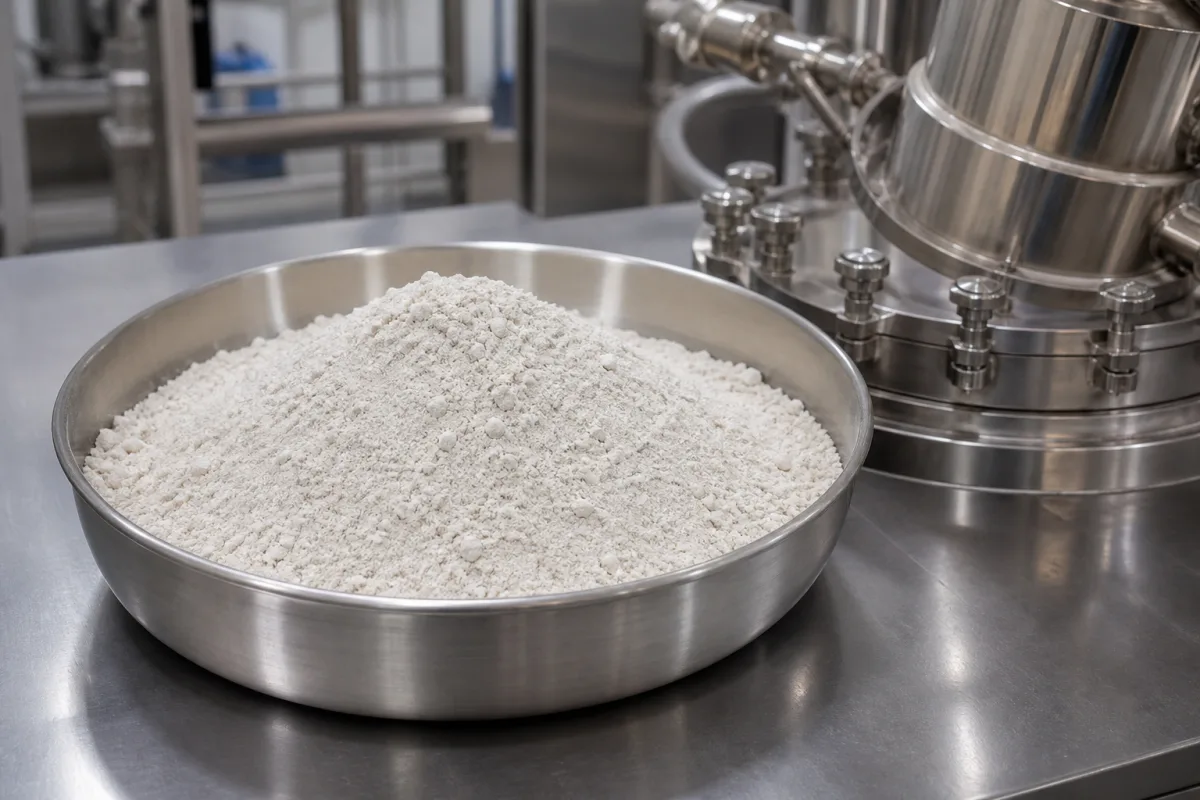
Frit is made by weighing and dry-mixing the raw batch, smelting it in furnaces that AP-42 puts at 930–1480°C (1090–1430°C for continuous furnaces), passing the melt between water-cooled rollers and quenching it with water spray into small glass particles. It is then dry or wet milled, dried if needed, magnetically separated to remove iron-bearing material, finely ground in a ball mill with clays and electrolytes, screened and stored. For electrostatic spraying, now the preferred application method, the frit is instead ground with an organic silicon encapsulating agent. [1]
Editorial note: tell the supplier whether you need frit for your own milling, a ready-to-use slip, or an electrostatic powder, and for which coat.
Give the supplier the parts and base metal (steel grade or cast iron), coat system (ground coat, cover coat, one-coat, two-coat/one-fire), colour and surface requirements, application method (dip, flow, wet spray, electrostatic powder), metal preparation available, furnace type and firing temperature and time, required properties (acid resistance, cleanability, thermal shock), particle size and electrostatic properties for powder, packaging and lot certification.
02
Plan application, firing and plant rules
US effluent guidelines for porcelain enameling (40 CFR Part 466) define porcelain enameling as the entire process of applying a fused vitreous enamel coating to a metal basis material, and describe metal preparation (cleaning, pickling and applying a nickel flash or chemical coating) and coating operations (ball milling, slip transport, applying slip, cleaning and recovering faulty parts, and firing or fusing the enamel) within that process. [2]
The rule applies to porcelain enameling facilities discharging to US waters or public sewers; existing facilities preparing or coating less than 1600 m² per day and sending less than 60,000 L per day to a public sewer are not covered by its pretreatment standards for existing sources but must comply with 40 CFR Part 403. [2]
AP-42 notes that frit smelting gives off particulate dust and fumes of condensed metal oxides, mineral dust and sometimes hydrogen fluoride, and names venturi scrubbers and fabric filters as control devices on smelting furnaces, with fabric filters on grinding. [1] Editorial note: ask the frit supplier for the composition basis relevant to your workplace and environmental permits, and for firing and adherence test results on your base metal.
03
Name the adherence test and steel gauge in the enamel order
Adherence to the steel is the property a buyer can test and hold a supplier to. ASTM B916 is the standard test method for adherence of porcelain enamel coatings to sheet metal: it deforms a coated specimen under standardised deformation parameters, measures quantitatively how much enamel remains, and gives an adherence rating scale for comparison with reference standards. ASTM states that the method applies to ground coat, ground coat/cover coat and direct-on cover-coat systems, and that it is used to monitor metal preparation, enamel application thickness, steel selection and enamel selection, as well as final product quality. [3]
Check the gauge before relying on the method: ASTM limits B916 to coatings on substrates from 18 to 24 gauge, that is 1.214 to 0.654 mm (0.0478 to 0.025 in.), with inch-pound values as the standard. For thicker oven or burner parts outside that range, agree a different adherence test and its acceptance criteria with the frit supplier in writing. [3]
04
Ask for the firing schedule behind any adherence result
In NACA Technical Note 2934 (April 1953), the US National Bureau of Standards applied ground-coat enamels by dipping to 4 × 4 in. blanks of 20-gauge enameling iron for a fired coating 5 ± 1 mils thick, fired at 1,575 °F for 4 minutes. The Porcelain Enamel Institute adherence test rated the metal exposed by a standard deformation as a percentage of the deformed area; the authors treated an index below 50 as commercially unacceptable, 50 to 75 as fair, 75 to 90 as good and 90 or above as excellent. [4]
The highest adherence came with 0.8 percent cobalt oxide in the frit: 90.5 on polished, 93.9 on pickled and 90.7 on sandblasted metal. With that enamel, adherence peaked at a firing time between 4 and 6 minutes, and specimens fired for 2 minutes adhered poorly. [4]
Editorial calculation: 1,575 °F is about 857 °C and 5 ± 1 mils is about 100 to 150 µm; 20 gauge lies inside the 18 to 24 gauge range that ASTM B916 covers. [4][3] Editorial note: ask the frit supplier for the firing schedule, thickness, gauge and metal preparation behind each adherence result.
05
Coat, composition, form, milling, preparation and firing in one order
Powder and fired-coat properties to agree with the frit maker
AP-42 describes how frit is dried, magnetically cleaned and screened but gives no limits; expansion, density, particle size and fired-coat values have to come from the supplier's test data.
Hunan Noli Enamel lists ground-coat frits for steel in high, mid and low temperature grades and Co-Ni and Ni types, for cookware, stove grills and panels.
Hunan Noli Enamel Co., Ltd.
Manufacturing site to be confirmed for the order
Lists ground-coat enamel frits for steel (high, mid and low temperature, Co-Ni and Ni types) for cookware, stove grills and panels.
Explore company information and manufacturing capabilities, then discuss the scope of your project with a relevant supplier.
Share this page
Compiled and source-reviewed by the CNFX editorial team.
Each manufacturer above links to the page on that company's own website where the product is listed, with the date we checked it. How we source and review
· Page last updated 13 October 2026
Buyer questions
What is the difference between ground coat and cover coat enamel?
AP-42 says ground coat frit adds small amounts of cobalt, nickel, copper and manganese oxides to the cover coat ingredients. [1]
How is enamel frit made?
Raw materials are smelted at about 1090–1430°C in continuous furnaces, rolled, water-quenched into glass particles, then milled and screened (AP-42 11.14). [1]
What is porcelain enameling?
40 CFR 466 defines it as applying a fused vitreous enamel coating to metal, including metal preparation, slip application and firing. [2]
How is enamel adherence to steel tested?
ASTM B916 deforms a coated sheet-metal specimen, measures the amount of enamel remaining and rates it against reference standards; ASTM limits it to 18 to 24 gauge substrates (1.214 to 0.654 mm). [3]
Does firing time affect porcelain enamel adherence?
Yes. In a National Bureau of Standards study for NACA (TN 2934), a ground coat with 0.8 percent cobalt oxide reached peak adherence at 4 to 6 minutes' firing, and specimens fired for 2 minutes adhered poorly. [4]
Sources and what still needs a direct check
Sources checked 2026-10-11. AP-42 Section 11.14 is US EPA emission-factor guidance (1997); 40 CFR Part 466 is a US federal effluent regulation for porcelain enameling.