Industry-Verified Manufacturing Data (2026)

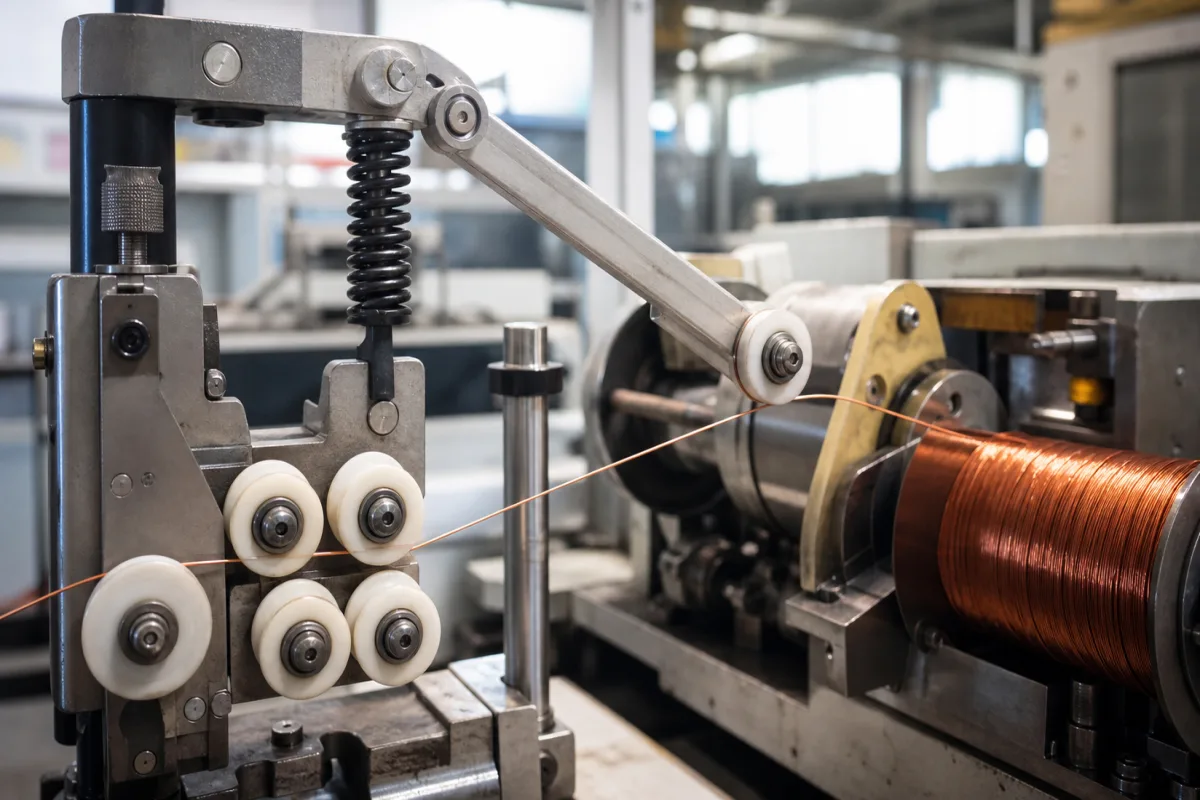
Wire Tensioner

Based on aggregated insights from multiple verified factory profiles within the CNFX directory, the standard Wire Tensioner used in the Electrical Equipment Manufacturing sector typically supports operational capacities ranging from standard industrial configurations to heavy-duty production requirements.

Technical Definition & Core Assembly

A canonical Wire Tensioner is characterized by the integration of Tension Brake Assembly and Tension Adjustment Mechanism. In industrial production environments, manufacturers listed on CNFX commonly emphasize Stainless steel construction to support stable, high-cycle operation across diverse manufacturing scenarios.

A device that applies and maintains precise tension on electrical wire during the winding process of transformers.
Product Specifications

Technical details and manufacturing context for Wire Tensioner

Definition
A critical component of transformer winding machines that ensures uniform wire tension during coil winding operations. It prevents wire slack, maintains consistent layering, and contributes to the electrical performance and mechanical stability of the finished transformer windings by controlling the tension force applied to the conductor as it's wound onto the core.
Working Principle
The tensioner typically uses friction-based mechanisms (such as brake pads or magnetic brakes) or spring-loaded systems to apply controlled resistance to the wire as it unwinds from the spool. This resistance creates the necessary tension, which is often adjustable to accommodate different wire gauges and winding requirements. Some advanced models incorporate sensors and feedback loops to maintain constant tension despite variations in wire speed or diameter.
Common Materials
Stainless steel, Aluminum alloy, Carbon steel, Engineering plastics
Technical Parameters
  • Tension force range (typically 0.1-50N for fine wire winding) (N) Standard Spec
Components / BOM
  • Tension Brake Assembly
    Applies controlled friction to create tension force
  • Tension Adjustment Mechanism
    Allows operators to set desired tension level
  • Wire Guide Rollers
    Directs wire path and prevents tangling
  • Mounting Bracket
    Secures tensioner to winding machine frame
Engineering Reasoning
5-200 N tension force, 0.1-2.0 mm/s wire feed rate
Tension force exceeds 250 N causing wire yield strength breach at 350 MPa for copper wire
Design Rationale: Plastic deformation due to exceeding material yield strength (Hooke's Law violation: σ = F/A > σ_yield)
Risk Mitigation (FMEA)
Trigger Spring fatigue from 10^6+ cyclic loading cycles
Mode: Tension force decay below 5 N minimum threshold
Strategy: Replace helical spring with Belleville washer stack for constant force characteristics
Trigger Capstan coefficient of friction reduction below μ=0.15 due to lubricant contamination
Mode: Wire slippage causing tension instability exceeding ±10% variance
Strategy: Implement diamond-pattern knurling on capstan surface maintaining μ=0.25-0.35

Industry Taxonomies & Aliases

Commonly used trade names and technical identifiers for Wire Tensioner.

Applied To / Applications

This component is essential for the following industrial systems and equipment:

Industrial Ecosystem & Supply Chain DNA

Complementary Systems
Downstream Applications
Specialized Tooling

Application Fit & Sizing Matrix

Operational Limits
pressure: 0 to 50 bar
other spec: Wire diameter range: 0.5 mm to 10 mm, Tension range: 0.1 N to 500 N
temperature: -20°C to 80°C
Media Compatibility
✓ Copper wire ✓ Aluminum wire ✓ Enamel-coated wire
Unsuitable: Corrosive chemical environments (e.g., acid mist, salt spray)
Sizing Data Required
  • Wire diameter (mm)
  • Required tension force (N)
  • Winding speed (rpm)

Reliability & Engineering Risk Analysis

Failure Mode & Root Cause
Wire Slippage or Inconsistent Tension
Cause: Worn or contaminated friction surfaces, improper initial tension setting, or degradation of tensioning components (e.g., springs, hydraulic/pneumatic systems) leading to loss of grip or calibration drift.
Mechanical Fatigue or Fracture of Components
Cause: Cyclic loading exceeding design limits, material defects, corrosion (especially in harsh environments), or misalignment causing stress concentrations in critical parts like levers, bolts, or the tensioner frame.
Maintenance Indicators
  • Audible squeaking, grinding, or irregular clicking noises during operation, indicating friction issues, misalignment, or component wear.
  • Visible wire misalignment, excessive vibration, or observable slack/fluctuation in wire tension during normal use, suggesting imminent failure.
Engineering Tips
  • Implement regular calibration and tension verification using calibrated tools (e.g., tension meters) to ensure settings remain within specified tolerances, adjusting for environmental factors like temperature changes.
  • Establish a preventive maintenance schedule that includes cleaning of friction surfaces, lubrication of moving parts (if applicable), and inspection for signs of wear, corrosion, or fatigue, especially in high-stress areas.

Compliance & Manufacturing Standards

Reference Standards
ISO 9001:2015 - Quality management systems ANSI/ASME B107.400 - Hand tools - Wire rope and strand grips DIN 1480 - Wire rope clips
Manufacturing Precision
  • Thread pitch: +/-0.05mm
  • Load capacity tolerance: +/-5% of rated value
Quality Inspection
  • Proof load test to 150% of rated capacity
  • Visual and dimensional inspection per drawing specifications

Factories Producing Wire Tensioner

Verified manufacturers with capability to produce this product in China

✓ 97% Supplier Capability Match Found

P Project Engineer from Canada Jan 17, 2026
★★★★★
"The technical documentation for this Wire Tensioner is very thorough, especially regarding technical reliability."
Technical Specifications Verified
S Sourcing Manager from United States Jan 14, 2026
★★★★★
"Reliable performance in harsh Electrical Equipment Manufacturing environments. No issues with the Wire Tensioner so far."
Technical Specifications Verified
P Procurement Specialist from United Arab Emirates Jan 11, 2026
★★★★★
"Testing the Wire Tensioner now; the technical reliability results are within 1% of the laboratory datasheet."
Technical Specifications Verified
Verification Protocol

“Feedback is collected from verified sourcing managers during RFQ (Request for Quote) and factory evaluation processes on CNFX. These reports represent historical performance data and technical audit summaries from our B2B manufacturing network.”

7 sourcing managers are analyzing this specification now. Last inquiry for Wire Tensioner from UAE (1h ago).

Supply Chain Compatible Machinery & Devices

Circuit Breaker Trip Unit

Protective control module for electrical circuit breakers

Explore Specs →
Circuit Breaker Arc Chute

Electrical component that extinguishes arcs in circuit breakers

Explore Specs →
Medium Voltage Switchgear Assembly Line

Automated production system for assembling medium voltage electrical switchgear.

Explore Specs →
Motor Terminal Block

Electrical connection interface for motor windings

Explore Specs →

Frequently Asked Questions

What materials are used in your wire tensioners for electrical equipment manufacturing?

Our wire tensioners are constructed from premium materials including stainless steel for corrosion resistance, aluminum alloy for lightweight durability, carbon steel for structural components, and engineering plastics for wear-resistant parts.

How does the tension adjustment mechanism work in your wire tensioners?

The tension adjustment mechanism features precise calibration controls that allow operators to set and maintain specific tension levels during transformer winding, ensuring consistent wire placement and optimal coil performance.

What maintenance is required for wire tensioners in continuous manufacturing operations?

Regular maintenance includes lubrication of moving parts, inspection of wire guide rollers for wear, calibration checks of the tension brake assembly, and cleaning of the mounting bracket to ensure optimal performance and longevity.

Can I contact factories directly on CNFX?

CNFX is an open directory, not a transaction platform. Each factory profile provides direct contact information and production details to help you initiate direct inquiries with Chinese suppliers.

Get Quote for Wire Tensioner

Request technical pricing, lead times, or customized specifications for Wire Tensioner directly from verified manufacturing units.

Your business information is encrypted and only shared with verified Wire Tensioner suppliers.

Thank you! Your message has been sent. We'll respond within 1–3 business days.

Need to Manufacture Wire Tensioner?

Connect with verified factories specializing in this product category

Add Your Factory Contact Us
Previous Product
Wire Guide System
Next Product
Wire Tensioning System