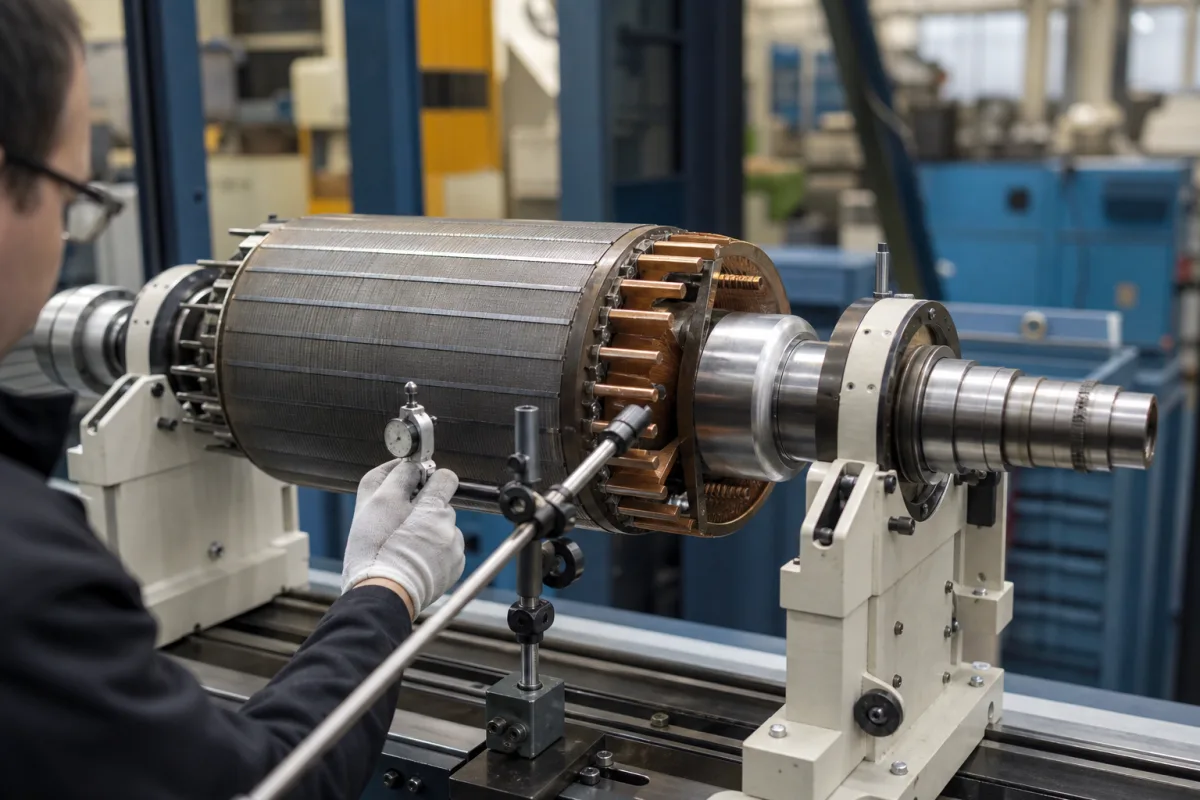
Motor rotor assembly (laminated core, cage or magnets, and shaft) bought as a component
Motor component · Balance grade and permissible unbalance, die-cast cage conductor, rotor length and shaft stiffness
A rotor assembly is the rotating part of an electric motor delivered as a finished sub-assembly: stacked electrical-steel laminations on a shaft, with either a die-cast squirrel cage (bars and end rings) or permanent magnets, machined and balanced so that a motor builder can fit it into a stator. Ask three things first: what balance grade it is balanced to at what speed, what conductor or magnet material it carries and how that was tested, and the rotor and shaft dimensions that set fit, stiffness and air gap.
Rotor assemblies for induction, permanent-magnet and actuator motors supplied as components: die-cast aluminium or copper cage rotors, magnet rotors and wound armatures with their shafts. Complete motors — induction, permanent-magnet and DC motors ready to drive a load — are covered on the Electric motor page. Loose laminations, stator assemblies, magnetising equipment, rotor production lines and turbocharger rotors are outside this page.
CNFX editorial research · Sources checked October 12, 2026 · 3 sources
Set the balance grade and work out the permissible unbalance
Miki Pulley's technical note, quoting JIS B 0153 and the JIS B 0905-1992 table of recommended grades, defines the balance grade as the product of the specific unbalance and the angular velocity, with ω = 2πn/60 = n/9.55, and the permissible residual unbalance as U_per = e_per × m in g·mm. To set it you need the maximum service speed, the rotor mass, the bearing positions and the balancing planes; the lower the grade number, the finer the balance. [1]
In that table, G6.3 covers medium- and large-sized armatures for motors with a shaft centre height of at least 80 mm without special requirements, and small mass-produced armatures in vibration-insensitive or isolated applications. G2.5 covers medium- and large-sized armatures with special requirements and small armatures not meeting the G6.3 or G1 conditions; G1 covers small electronic machines with special requirements, and G0.4 armatures in precision grinding machines. [1]
Editorial calculation: for a G2.5 rotor at a maximum speed of 3,000 min⁻¹, e_per = 2.5 × 9.55 ÷ 3,000 ≈ 0.0080 mm, or about 8.0 g·mm per kg; a 10 kg rotor may then carry about 80 g·mm of residual unbalance in total, to be split between the two balancing planes. At G6.3 the same rotor would be allowed 6.3 × 9.55 ÷ 3,000 × 10 ≈ 201 g·mm. [1]
Give the supplier the motor type and frame, maximum service speed, required balance grade and balancing planes, rotor mass, lamination grade and stack length, cage material or magnet grade, shaft drawing with bearing seats and tolerances, runout limits, and the test reports you need (balance record, conductivity or magnet test).
02
Choose the cage conductor: die-cast aluminium, treated aluminium or copper
Zeybek, Kayış and Diler (Materials, 2025) state that 15–25% of induction motor losses occur in the rotor and that over 90% of induction motors use squirrel-cage rotors, which consist of laminations, conductor bars, end rings and a shaft. In their work the cage was made by high-pressure die-casting into the stacked laminated core. [2]
Adding 0.05 wt% boron through an AlB8 master alloy to 99.7% aluminium and heat-treating the rotors at 550 °C for 10 h raised the cage aluminium's conductivity from 60.62% IACS to 63.1% IACS, and the efficiency of the motor from 90.35% to 91.53%. The authors give 100% IACS as 58 MS/m at 20 °C under ASTM E1004. [2]
The same authors report that copper cages, though more conductive, are harder and costlier to die-cast because of copper's higher melting point, thermal conductivity, density and unit cost; thermal shock can short bars to the laminations and cause inter-bar currents, and molten copper can form cuprous oxide or pick up impurities from the die and laminations, lowering conductivity. [2] Editorial calculation: 60.62% × 58 MS/m ≈ 35.2 MS/m and 63.1% × 58 MS/m ≈ 36.6 MS/m. Editorial note: ask for the cage alloy, its measured conductivity in % IACS and any post-casting heat treatment.
03
Check rotor length, shaft length and stiffness
An open-hardware redesign of a 2 kW poultry-house fan motor (HardwareX, 2026) started from a rotor of Ø100 mm, 190 mm axial length and 44 slots. The redesign cut rotor length from 190 mm to 110 mm (about 42%) and shaft length from 354 mm to 304 mm (about 14%), keeping the materials, to raise stiffness and critical speed and lower vibration, while the stator outer diameter grew from 160 to 190 mm. [3]
The authors report rear-section vibration reduced by up to 5.5 mm/s and full-load input power falling from 3,420 W to 2,632 W for the whole redesign, which also rewound the stator and replaced the housing and endcaps; the published files include rotor, shaft and 6206 ball-bearing models. [3] Editorial note: those gains came from the whole motor redesign, not the rotor alone; when you change rotor length, recheck the balance grade and permissible unbalance for the new mass. [1]
04
Aluminium cage, copper cage, permanent-magnet and wound rotors
Type
Built from
Check
Die-cast aluminium cage rotor
Laminated core with high-pressure die-cast bars and end rings. [2]
Alloy, % IACS, porosity, balance grade.
Die-cast copper cage rotor
Copper cage; higher conductivity, harder to cast. [2]
Inter-bar insulation, oxide inclusions.
Permanent-magnet rotor
Core with surface or embedded magnets.
Magnet grade, retention, magnetisation pattern.
Wound armature
Core with copper windings and commutator or slip rings.
4 companies list this product among what they make. Company figures are quoted from each
company's own website; every card states where the relationship came from.
AIC Magnetics
Manufacturing site to be confirmed for the order
Lists a permanent-magnet motor rotor among its magnetic devices.
Explore company information and manufacturing capabilities, then discuss the scope of your project with a relevant supplier.
Share this page
Compiled and source-reviewed by the CNFX editorial team.
Each manufacturer above links to the page on that company's own website where the product is listed, with the date we checked it. How we source and review
· Page last updated 13 October 2026
Buyer questions
What balance grade does a motor rotor need?
Miki Pulley's JIS B 0905 table lists G6.3 for medium and large armatures without special requirements and G2.5 where special requirements apply. [1]
Does the cage alloy affect efficiency?
In a 2025 study, raising cage aluminium from 60.62% to 63.1% IACS raised motor efficiency from 90.35% to 91.53%. [2]
Why shorten a rotor?
A HardwareX fan-motor redesign shortened the rotor from 190 to 110 mm to raise stiffness and critical speed and lower vibration. [3]
Sources and what still needs a direct check
Sources checked 2026-10-12. Miki Pulley is a Japanese drive-component maker summarising the JIS balance-grade tables; the Materials and HardwareX papers are peer-reviewed open-access studies of cage rotors and a rotor redesign.