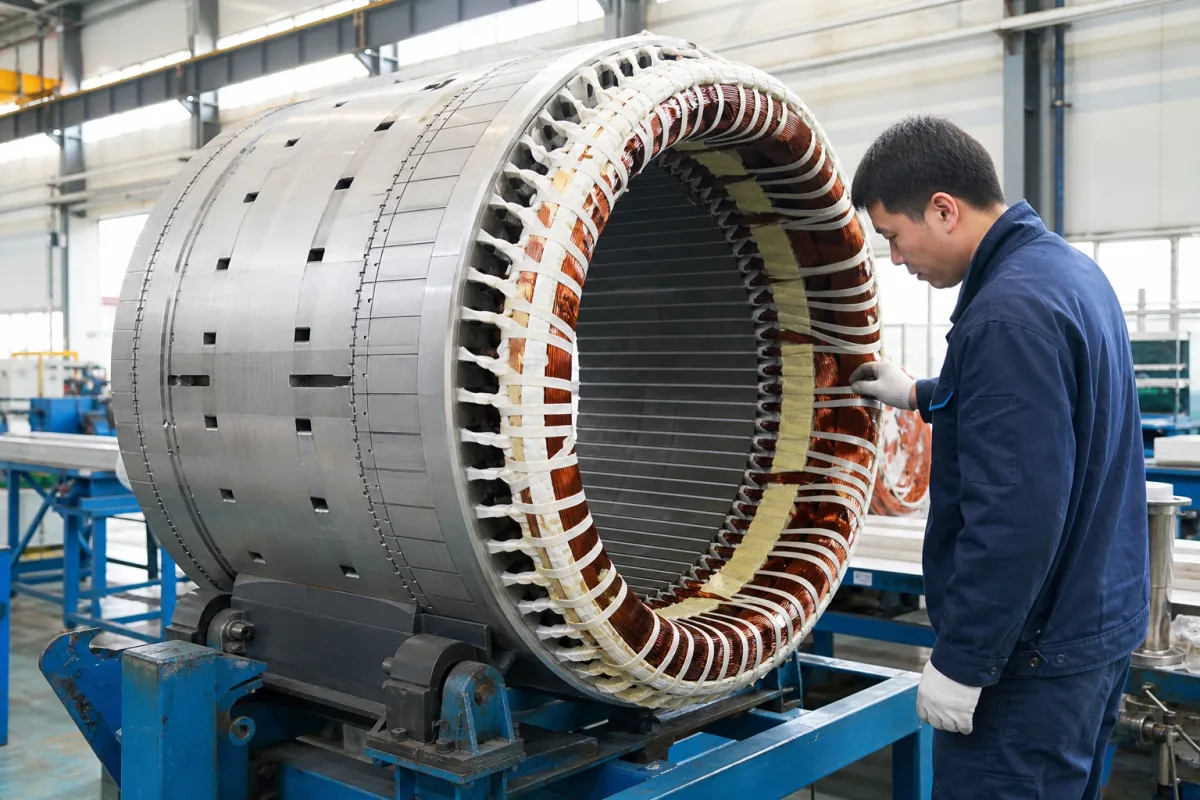
Stator assembly: wound stator with windings, insulation and electrical acceptance tests
Wound stators · Round-wire, hairpin and form-wound windings, slot insulation and varnish, hi-pot, insulation resistance and core tests
A stator assembly, in the sense used on this page, is a wound stator: the laminated core with its coils inserted in insulated slots, slot wedges, end-winding shaping and bracing, phase connections and leads, impregnated with varnish or resin and electrically tested before it goes into a motor or generator frame. Buyers ordering wound stators should settle three things first: which winding construction suits the machine (round wire, flat-wire hairpin or form-wound coils), how slots and end windings are insulated and impregnated, and which electrical tests the supplier runs and reports before shipping.
Wound stators for motors and generators, from small round-wire BLDC and induction stators to hairpin traction stators and large form-wound machines, including slot insulation, coils, wedges, connections, impregnation and electrical tests. Bare stator and rotor lamination stacks before winding are covered on the Electric motor stator lamination stack page. Complete motors, rotors and winding machines are outside this page.
CNFX editorial research · Sources checked October 12, 2026 · 5 sources
Lam365 lists copper wire of 0.29 to 1.2 mm diameter for its round-wire stator windings, and aluminium wire of 0.35 to 0.85 mm in some cases, with concentrated windings around single teeth or windings divided into sections across the stator; after winding, coils are shaped, electrically tested and impregnated with varnish. [2] Lamistacks lists four flat-wire technologies (hairpin, I-pin, X-pin and S-winding) and gives its hairpin sequence as slot paper, hairpin forming, hairpin insertion, end shaping, end welding, star-point connection and insulation of the welds. [3]
Motorneo states a stator outer diameter range of 50 to 720 mm for its winding work, a pin-winding range of 150 to 400 mm with 2 to 8 layers, and output of 5 to 80 sets per day depending on the specification. [5]
For large high-voltage machines, Iris Power describes stator windings made of form-wound bars or multi-turn coils in the core slots, with copper conductors and mica-based insulation among the types used. Within the slots a top wedge, and sometimes side wedging, holds the coils; in the end windings, the paper names non-magnetic brackets, braces, support rings and spacer blocks as the preferred way to limit movement while allowing axial thermal expansion. [1]
Give the supplier the core drawing or lamination stack, slot count and shape, winding diagram (poles, phases, turns per coil, parallel paths, connection), wire size and grade or hairpin cross-section, insulation class, slot liner and wedge material, impregnation method, lead length and terminals, rated voltage, and the test list with pass limits.
02
Specify the electrical tests and how results are reported
Lamnow lists its manual winding process as coil winding, slot insulation (epoxy coating, insulation paper or 3D-printed parts), coil insertion, layer insulation, slot wedges, end shaping, welding of the U, V and W leads, binding, varnish impregnation and testing of end height, hi-pot and resistance. [4]
Iris Power describes the hi-pot test, AC or DC, as pass or fail with limited diagnostic value, carried out as described in IEEE 95 and IEC 60034 for DC and IEEE C50.10 and IEEE 43 for power frequency. Insulation resistance is measured with DC between 500 V and 10,000 V, with acceptance guidance in IEEE 43; it notes that some experiments have indicated a temperature change of 5 to 20 °C can cause a 50% reduction in the resistance of modern polyester and epoxy insulation, so correction to 40 °C is not very reliable. The polarization index (PI) is the ratio of the resistance after ten minutes to that after one minute. [1]
For large stator cores, Iris Power contrasts a ring flux test at 80 to 100% of rated flux, which can need a 3 to 4 MVA source for a 500 MW generator, with an EL CID test at 4% of rated flux needing about 3 kVA; a 100 mA quadrature-current threshold corresponds to roughly a 5 to 10 °C core temperature rise. [1]
Editorial calculation: a winding reading 2,000 MΩ after one minute and 5,000 MΩ after ten minutes has PI = 5,000 / 2,000 = 2.5. Readings are an assumed example; agree the test voltage, temperature and minimum values with the supplier. [1]
03
Round wire, hairpin or form-wound: stator builds on offer
Windings on offer cover round and flat copper or aluminium wire, concentrated and partitioned layouts, and hairpin, I-pin, X-pin and S-winding flat-wire stators, one service quoting 50–720 mm stators; slot insulation, wedges, varnish impregnation and hi-pot and resistance tests are listed as process steps.
Lammotor
Manufacturing site to be confirmed for the order
Lists stator coil winding services: slot insulation, coil insertion, single- and double-layer, round and flat wire.
Explore company information and manufacturing capabilities, then discuss the scope of your project with a relevant supplier.
Share this page
Compiled and source-reviewed by the CNFX editorial team.
Each manufacturer above links to the page on that company's own website where the product is listed, with the date we checked it. How we source and review
· Page last updated 13 October 2026
Buyer questions
What is the difference between a stator assembly and a lamination stack?
The stack is the bare core; the assembly adds slot insulation, coils, wedges, connections and varnish, then is tested. [4]
What tests should a wound stator pass?
One winder lists end-height, hi-pot and resistance tests; Iris Power describes hi-pot, insulation resistance at 500–10,000 V DC and polarization index. [4][1]
What wire sizes are used in round-wire stators?
One supplier lists copper of 0.29–1.2 mm and aluminium of 0.35–0.85 mm. [2]
Sources and what still needs a direct check
Sources checked 2026-10-12. Iris Power is a maker of insulation test and monitoring equipment writing on high-voltage machine diagnostics; Lam365, Lamistacks, Lamnow and Motorneo are stator suppliers describing their own winding work.