Industry-Verified Manufacturing Data (2026)

Individual Capacitor Bank

Based on aggregated insights from multiple verified factory profiles within the CNFX directory, the standard Individual Capacitor Bank used in the Electrical Equipment Manufacturing sector typically supports operational capacities ranging from standard industrial configurations to heavy-duty production requirements.

Technical Definition & Core Assembly

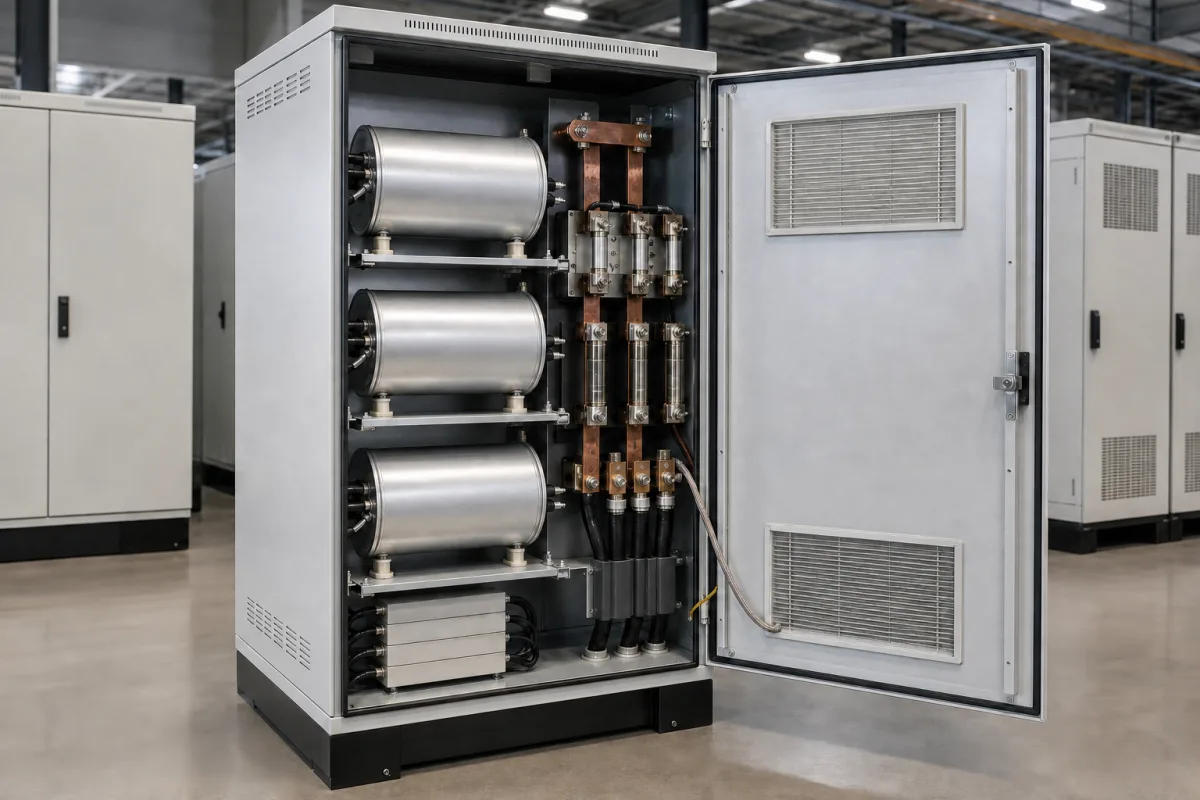
A canonical Individual Capacitor Bank is characterized by the integration of Capacitor Elements and Discharge Resistors. In industrial production environments, manufacturers listed on CNFX commonly emphasize Aluminum electrolytic capacitors construction to support stable, high-cycle operation across diverse manufacturing scenarios.

A discrete unit within a capacitor bank array that stores electrical energy and provides reactive power compensation.
Product Specifications

Technical details and manufacturing context for Individual Capacitor Bank

Definition
An individual capacitor bank is a self-contained electrical component that forms part of a larger capacitor bank array. It consists of multiple capacitors connected in series and/or parallel configurations, housed within a protective enclosure with necessary switching, protection, and monitoring devices. Within the array, each individual bank operates independently or in coordination with others to regulate power factor, improve voltage stability, and reduce energy losses in electrical distribution systems.
Working Principle
The individual capacitor bank stores electrical energy in an electrostatic field between its conductive plates separated by a dielectric material. When connected to an AC power system, it draws leading current that counteracts the lagging current from inductive loads, thereby improving the power factor. Each bank can be switched on or off independently based on system requirements to provide graduated reactive power compensation.
Common Materials
Aluminum electrolytic capacitors, Polypropylene film capacitors, Steel enclosure, Copper busbars, Ceramic insulators
Technical Parameters
  • Reactive power rating of the individual capacitor bank (kVAR) Standard Spec
Components / BOM
  • Capacitor Elements
    Store electrical energy through electrostatic charge separation
    Material: Aluminum/polypropylene/paper dielectric
  • Discharge Resistors
    Safely discharge stored energy when bank is disconnected
    Material: Ceramic/metal alloy
  • Protective Fuses
    Isolate faulty capacitor elements to prevent cascade failure
    Material: Silver/silver alloy
  • Switching Contactor
    Connect/disconnect the bank from the power system
    Material: Copper contacts, steel enclosure
  • Enclosure
    Protect internal components from environmental factors
    Material: Galvanized steel
Engineering Reasoning
415-690 VAC, 50-60 Hz, 25-100 kVAR per unit, -25°C to +55°C ambient temperature
Dielectric breakdown at 1.5 kV/mm for polypropylene film, thermal runaway at 85°C internal temperature, voltage surge exceeding 1.8× rated voltage for >100 ms
Design Rationale: Electrochemical degradation of metallized film due to partial discharge at >500 V/μm electric field strength, thermal expansion mismatch between aluminum electrodes and polypropylene dielectric causing delamination at ΔT > 60°C
Risk Mitigation (FMEA)
Trigger Harmonic resonance at 150-250 Hz causing 40% current amplification
Mode: Capacitance loss >10% due to metallized electrode erosion
Strategy: Series reactor with 7% impedance tuned to 189 Hz detuning frequency
Trigger Overpressure from gas generation at >2.5 W/kg specific power loss
Mode: Case rupture at >1.5 bar internal pressure
Strategy: Pressure-sensitive disconnector with 0.8 bar activation threshold and 3 ms response time

Industry Taxonomies & Aliases

Commonly used trade names and technical identifiers for Individual Capacitor Bank.

Applied To / Applications

This component is essential for the following industrial systems and equipment:

Industrial Ecosystem & Supply Chain DNA

Complementary Systems
Downstream Applications
Specialized Tooling

Application Fit & Sizing Matrix

Operational Limits
pressure: Atmospheric to 1.5 bar (sealed units), altitude up to 5000m
other spec: Humidity: 5-95% non-condensing, Vibration: 5-2000 Hz at 10g max, Dielectric withstand: 2.5-3.0 kV RMS
temperature: -40°C to +85°C (operating), -55°C to +105°C (storage)
Media Compatibility
✓ Indoor electrical rooms with climate control ✓ Outdoor substations with proper enclosures ✓ Industrial facilities with clean, dry air
Unsuitable: High humidity or salt spray environments without IP65+ protection
Sizing Data Required
  • Required reactive power (kVAR)
  • System voltage and frequency (V/Hz)
  • Harmonic distortion levels (THD%)

Reliability & Engineering Risk Analysis

Failure Mode & Root Cause
Dielectric breakdown
Cause: Overvoltage, insulation degradation from heat, moisture ingress, or manufacturing defects leading to internal arcing and short circuits.
Capacitor element swelling/rupture
Cause: Electrolyte decomposition from excessive temperature, overcurrent, or aging, generating internal gas pressure that exceeds casing limits.
Maintenance Indicators
  • Audible humming, buzzing, or popping sounds indicating internal arcing or loose connections
  • Visible bulging, leaking, or discoloration of capacitor casings, especially at seals or vents
Engineering Tips
  • Implement infrared thermography scans during operation to detect abnormal heating from poor connections, overloads, or failing capacitors before catastrophic failure.
  • Install and maintain proper ventilation/cooling, ensure voltage and harmonic levels are within specifications, and use protective devices like fuses or surge suppressors to prevent electrical stress.

Compliance & Manufacturing Standards

Reference Standards
IEC 60831-1:2014 - Shunt power capacitors of the self-healing type for a.c. systems having a rated voltage up to and including 1000 V ANSI/IEEE 18-2012 - IEEE Standard for Shunt Power Capacitors DIN EN 60831-1:2014 - Shunt power capacitors of the self-healing type for a.c. systems having a rated voltage up to and including 1000 V
Manufacturing Precision
  • Capacitance tolerance: +/-5% of rated value at 20°C
  • Case dimensions: +/-2mm on length/width/height
Quality Inspection
  • High-potential (Hi-Pot) dielectric withstand test
  • Capacitance and dissipation factor measurement at rated frequency and voltage

Factories Producing Individual Capacitor Bank

Verified manufacturers with capability to produce this product in China

✓ 98% Supplier Capability Match Found

S Sourcing Manager from Singapore Feb 01, 2026
★★★★★
"Impressive build quality. Especially the technical reliability is very stable during long-term operation."
Technical Specifications Verified
P Procurement Specialist from Germany Jan 29, 2026
★★★★☆
"As a professional in the Electrical Equipment Manufacturing sector, I confirm this Individual Capacitor Bank meets all ISO standards. (Delivery took slightly longer than expected, but technical support was excellent.)"
Technical Specifications Verified
T Technical Director from Brazil Jan 26, 2026
★★★★★
"Standard OEM quality for Electrical Equipment Manufacturing applications. The Individual Capacitor Bank arrived with full certification."
Technical Specifications Verified
Verification Protocol

“Feedback is collected from verified sourcing managers during RFQ (Request for Quote) and factory evaluation processes on CNFX. These reports represent historical performance data and technical audit summaries from our B2B manufacturing network.”

8 sourcing managers are analyzing this specification now. Last inquiry for Individual Capacitor Bank from Mexico (28m ago).

Supply Chain Compatible Machinery & Devices

Circuit Breaker Trip Unit

Protective control module for electrical circuit breakers

Explore Specs →
Circuit Breaker Arc Chute

Electrical component that extinguishes arcs in circuit breakers

Explore Specs →
Medium Voltage Switchgear Assembly Line

Automated production system for assembling medium voltage electrical switchgear.

Explore Specs →
Motor Terminal Block

Electrical connection interface for motor windings

Explore Specs →

Frequently Asked Questions

What is the primary function of an individual capacitor bank?

An individual capacitor bank stores electrical energy and provides reactive power compensation to improve power factor, reduce energy losses, and enhance voltage stability in electrical systems.

What materials are used in the construction of this capacitor bank?

This unit utilizes aluminum electrolytic or polypropylene film capacitors for energy storage, a durable steel enclosure for protection, copper busbars for efficient current conduction, and ceramic insulators for electrical isolation.

What safety features are included in the capacitor bank design?

Safety features include protective fuses to prevent overcurrent, discharge resistors to safely dissipate stored energy, and a switching contactor for controlled operation, all housed in a grounded steel enclosure.

Can I contact factories directly on CNFX?

CNFX is an open directory, not a transaction platform. Each factory profile provides direct contact information and production details to help you initiate direct inquiries with Chinese suppliers.

Get Quote for Individual Capacitor Bank

Request technical pricing, lead times, or customized specifications for Individual Capacitor Bank directly from verified manufacturing units.

Your business information is encrypted and only shared with verified Individual Capacitor Bank suppliers.

Thank you! Your message has been sent. We'll respond within 1–3 business days.

Need to Manufacture Individual Capacitor Bank?

Connect with verified factories specializing in this product category

Add Your Factory Contact Us
Previous Product
Indicator Lights
Next Product
Induction Coil Assembly