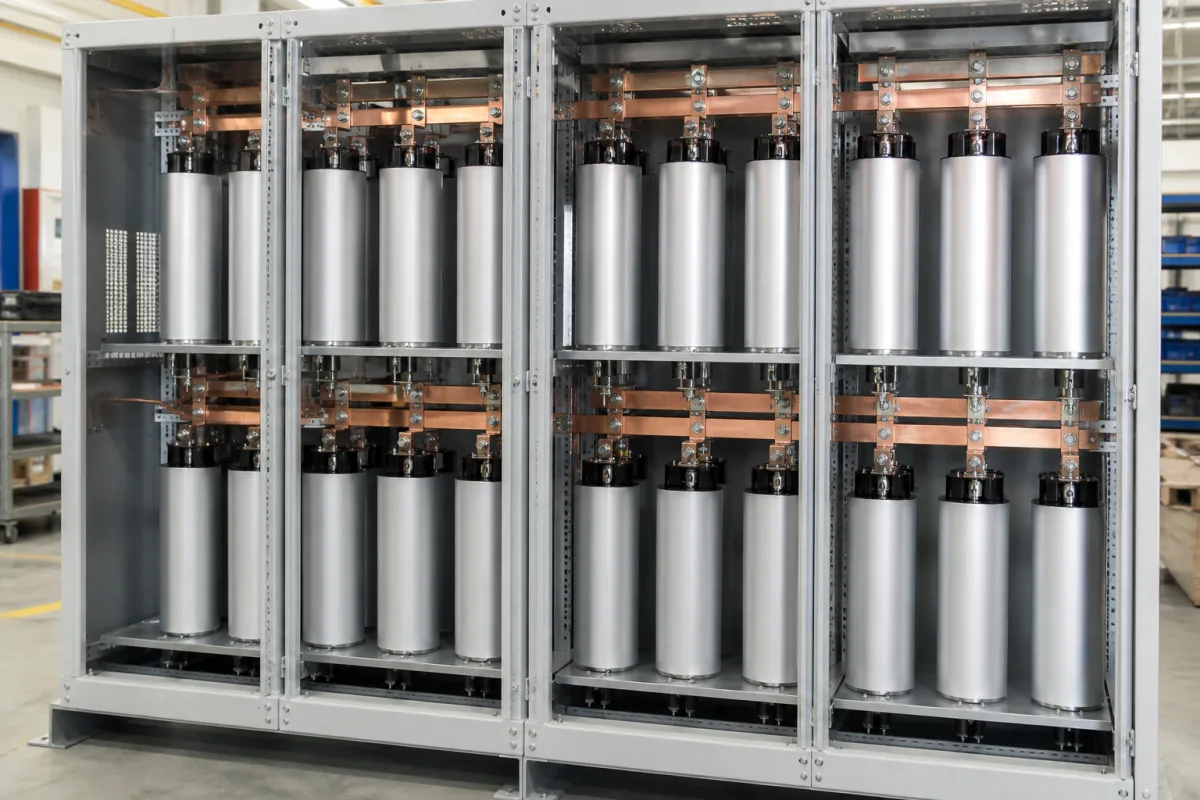
Capacitor bank array: arranging capacitor units in series groups and parallel strings, choosing external, internal or no fuses, and detecting a failed element
How single-phase capacitor units are wired into series groups and parallel strings for medium- and high-voltage shunt banks · fusing scheme, the 110 % rule, the parallel-energy limit and unbalance protection
A shunt capacitor bank above distribution voltage is not one capacitor. It is an array of single-phase units, each itself a series-parallel group of elements, wired into series groups and parallel strings until the voltage and kvar add up. How that array is arranged decides what happens when one element shorts: whether a fuse clears it, how much extra voltage the survivors see, and whether the protection can tell which part of the bank to open up.
The internal arrangement of shunt capacitor banks built from multiple single-phase capacitor units (18 to 264 in the examples below): series groups and parallel units or strings per phase, single-wye, double-wye and H-bridge layouts, externally fused, internally fused, fuseless and unfused designs, the limits that size each group, and the unbalance protection and fault location that depend on them. Sizing the kvar and steps of a power factor correction bank, detuning and switching are covered on the Capacitor bank for power factor correction page; the low-voltage cabinet's cooling, discharge and re-switching on the Power capacitor bank cabinet page; and the controller that switches the steps on the Intelligent controller page.
CNFX editorial research · Sources checked October 12, 2026 · 3 sources
Four modelled banks from 33 kV to 345 kV: how many units in series, how many in parallel, and what each unit is rated
Florida Power & Light and Schweitzer Engineering Laboratories modelled these banks on a real-time digital simulator to test fault location. [1]
Editorial calculation: the bank rating is the nameplate kvar scaled by the square of the ratio of applied to rated voltage. For the 88 kV bank, 96 × 318 = 30,528 kvar at nameplate; 8 × 6.7 = 53.6 kV of units per phase against 88 / √3 ≈ 50.8 kV applied gives (50.8 / 53.6)² × 30,528 ≈ 27,430 kvar, matching the 27.43 Mvar stated. For the 230 kV bank, 192 × 650 = 124,800 kvar and (132.8 / 142.4)² × 124,800 ≈ 108,520 kvar, matching 108.53 Mvar. [1] The same check does not close for the 345 kV and 33 kV entries from the figures given, so those arrangements should be confirmed with the bank designer before being reused.
GE Multilin gives the range of building blocks: capacitor units from 240 V to 24,940 V and from 2.5 kvar to about 1,000 kvar, each with an internal discharge resistor that brings residual voltage to 50 V or less in 5 minutes. [2]
Bank
Connection and fusing
Array per phase
Unit rating and inside the unit
88 kV, 27.43 Mvar
Single wye, grounded, tap at the midpoint; internally fused; 96 units [1]
8 series groups of 4 parallel units (32 units) [1]
6.7 kV, 318 kvar; 3 series groups of 12 parallel elements [1]
230 kV, 108.53 Mvar
Single wye, ungrounded, neutral PT; fuseless; 192 units [1]
8 parallel strings of 8 units in series (64 units) [1]
17.8 kV, 650 kvar; one string of 8 elements in series [1]
10.987 kV, 705 kvar; 5 series groups of 15 parallel elements [1]
Specify system voltage, Mvar, connection (single or double wye, grounded or not, H-bridge) and fusing, and ask for the array drawing with units per group and elements per unit.
02
External fuses, internal element fuses or none: what each scheme does to the array
Goodarzi and colleagues (Shiraz University and TU Delft) used three banks in their element-failure study; multiplying out their arrangements shows how differently the elements are distributed. [3]
With external fuses, a fuse between each unit and the fuse bus clears a unit after successive element failures and shows which one failed; units can be rated for a relatively high voltage, giving the fewest series groups, but enough units must sit in parallel for the bank to stay in service with one fuse out. Internal fuses, a wire in each element, remove only the failed element, so banks using them have fewer units in parallel, more series groups and larger units. [2]
Fuseless banks connect units in series strings between phase and neutral and rely on a failed element welding shut. GE's example: 6 units of 8 element groups give 48 groups in series, and one shorted element raises the voltage on the others by 48/47, about 2 %. The design needs more than 10 elements in series and is not applied below about 34.5 kV; because no units are directly in parallel the discharge energy into a fault is small, and unbalance protection need not wait for fuses. Unfused banks use series-parallel units without fuses, below 34.5 kV or at higher voltage with modest parallel energy. [2] Editorial calculation: the fuseless bank in the table above has 6 × 12 = 72 elements in series per string, so one shorted element raises the rest by 72/71, about 1.4 %. [3][2]
The trade-off appears at repair time: with external fuses the blown fuse marks the failed unit, while internally fused, fuseless and unfused banks give no visual indication of which unit failed. [1]
Scheme
Series sections in each unit × parallel elements per section
Units in series × units in parallel × branches per phase
Ask which scheme is offered and why, the number of element failures the bank tolerates before alarm and before trip, and how a failed unit will be found.
03
What sets the size of each group: 110 % voltage on the survivors, and about 4,650 kvar of energy in parallel
GE Multilin states the sizing rules as follows. The minimum number of units in parallel is the number at which losing one unit in a group does not put more than 110 % of rated voltage on the rest of the group; likewise the minimum number of series groups is the number at which bypassing a whole group does not leave the others at a permanent overvoltage above 110 %. [2] The maximum in parallel is set by the charge that dumps from healthy parallel units into a failed unit and its fuse: the paper quotes a standards limit on the energy in one parallel group of 4,659 kvar in one passage and 4,650 kvar in two others, and gives more series groups with fewer units in parallel, a split into a double wye, or current-limiting fuses as the ways round it. [2]
The units themselves, under IEEE Std 18 and 1036 as summarised in the same paper, must run continuously at up to 110 % of rated rms voltage with crest voltage up to 1.2 × √2 of rated rms, carry 135 % of nominal current, deliver between 100 % and 115 % of rated kvar, and run at up to 135 % of rated kvar from the combined effect of overvoltage, harmonics and tolerance. [2]
Ask the designer to show the voltage on the remaining units after one unit or one element is lost in each group, and the stored energy in the largest parallel group.
04
Unbalance protection and finding the failed unit: neutral or phase quantities, a ±15° blinder, and 50 to 92 % less searching
Because a single failure changes bank voltages and currents only slightly, it is detected from unbalance against a healthy bank, not from current or voltage levels. [2] SEL and FPL list four unbalance methods: phase voltage, neutral voltage, phase current and neutral current. The magnitude of the unbalance quantity indicates how many elements or units have failed; the authors use its phase angle against a reference (bus or bank phase quantities, or positive-sequence quantities for neutral methods), with a ±15° blinder to reject unbalance from instrument transformer errors, to name the phase and section that holds the fault. [1]
Their replacement sequence runs: take the bank out of service, isolate and ground it, disconnect each unit, measure the capacitance of every unit, balance the spare unit's capacitance in a spreadsheet, replace, move other units if needed and re-energise. Narrowing the search to a phase and section reduced the investigation by 50 to 92 % across the configurations tested. [1] In a double-wye bank, GE notes that system zero-sequence components affect both wyes equally while a failed unit shows as neutral unbalance, so a simple uncompensated relay can be used. [2]
Specify the unbalance method and instrument transformers, the alarm and trip levels in failed elements, and whether fault location by phase and section is required.
05
What to send when specifying a capacitor bank array
Paste it into your enquiry below or into an email to a maker, then replace every bracket.
System: [voltage; frequency; required Mvar; harmonic content]
Connection: [single or double wye; grounded or ungrounded; H-bridge]
Fusing: [externally fused, internally fused, fuseless or unfused]
Array: [units in series per phase; units or strings in parallel; elements per unit]
Limits: [voltage on remaining units after one failure; energy in the largest parallel group]
Protection: [unbalance method; instrument transformers; alarm and trip levels; fault location]
Mounting: [open rack or metal-enclosed; spare units]
Explore company information and manufacturing capabilities, then discuss the scope of your project with a relevant supplier.
Share this page
Compiled and source-reviewed by the CNFX editorial team.
Each manufacturer above links to the page on that company's own website where the product is listed, with the date we checked it. How we source and review
· Page last updated 13 October 2026
Buyer questions
How are capacitor units arranged in a high-voltage shunt bank?
In series groups of parallel units, or in parallel strings of series units; for example, an 88 kV, 27.43 Mvar bank used 8 series groups of 4 units per phase, and a 230 kV, 108.53 Mvar fuseless bank 8 strings of 8 units. [1]
What limits the number of capacitor units in parallel?
At least enough that losing one unit leaves no more than 110 % of rated voltage on the rest; at most enough that the energy in one parallel group stays within about 4,650 kvar. [2]
When is a fuseless capacitor bank used?
GE Multilin says it is not applied below about 34.5 kV because it needs more than 10 elements in series; one shorted element in 48 series groups raises the rest by about 2 %. [2]
How is a failed unit found in an internally fused or fuseless bank?
From the phase angle of the unbalance quantity, which can identify the faulted phase and section; in the SEL and FPL tests this cut the search by 50 to 92 %. [1]
Sources and what still needs a direct check
Sources checked 2026-10-12. Array layouts and fault location come from a Florida Power & Light and Schweitzer Engineering Laboratories paper; fusing schemes, sizing rules and unit capabilities from a GE Multilin paper; element arrangements by fusing scheme from a Shiraz University and TU Delft study.