Capacitor switching contactors · Inrush peak by single or multi-step banks, 1.5 × In thermal current, damping resistors, AC-6b kvar ratings
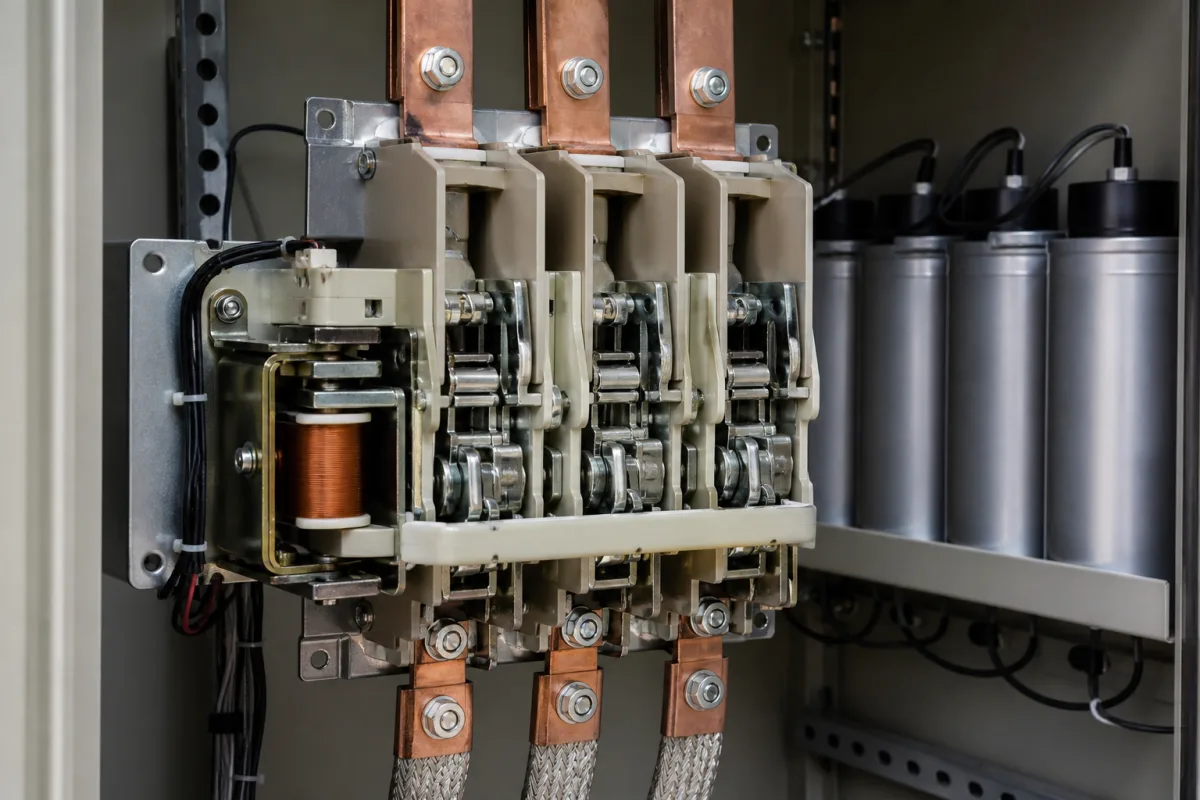
A capacitor switching contactor connects and disconnects capacitor steps in power factor correction banks, as in the panel pictured where a three-pole contactor on copper bars sits beside a row of capacitors. Ask three things first: how high the inrush current peak will be when a step is switched in with others already on, what continuous current the contactor must carry with harmonics and capacitor tolerance, and whether it limits inrush with damping resistors or needs added inductance.
Low-voltage contactors for switching power factor correction capacitor banks (utilisation category AC-6b), including contactors with early-make damping resistor blocks. Capacitors themselves (see capacitor banks), reactive power controllers, detuning reactors and motor-starting contactors are outside this page.
CNFX editorial research · Sources checked October 12, 2026 · 5 sources
ABB's application guide on contactors for capacitor switching (AC-6b to IEC 60947-4-1) says energising capacitors causes high-amplitude, high-frequency currents (3 to 15 kHz) for 1 to 2 ms. In fixed (single-step) correction the inrush peak can reach 30 times the bank's nominal current; in automatic multi-step correction it depends on the steps already on and can reach 100 times the nominal current of the step being switched. If the peak exceeds what the contactor accepts, its main poles can weld and stay closed. [1]
For a fully discharged bank (residual voltage ≤ 50 V) the guide gives Î = k₁ × √(Q ÷ (L + Lt)) for a single step and Î = k₁ × (n − 1)/n × √(Qn ÷ Ln) for n identical steps, with Q in kvar, inductances in µH, and k₁ = 1457 at 50 Hz or 1330 at 60 Hz; L is the line inductance, Lt the transformer inductance and Ln the inductance per step. [1]
Editorial calculation: a single 50 kvar step at 400 V has a nominal current of 50,000 ÷ (√3 × 400) ≈ 72 A; with an assumed L + Lt of 20 µH the peak is 1457 × √(50 ÷ 20) ≈ 2,300 A, about 32 times nominal. Switching the sixth of six 50 kvar steps with an assumed 5 µH per step gives 1457 × 5/6 × √(50 ÷ 5) ≈ 3,840 A, about 53 times nominal. The inductances are assumed examples; use measured or calculated values for your installation.
ETI's catalogue page for its CEM CK..N capacitor duty contactors (AC-6b) describes the same method: on closing, integrated early-make auxiliary contacts close first and force the inrush current through precharge resistors, and the main contacts close a few milliseconds later. Its 2.5, 5 and 7.5 kVAr models have no auxiliary contacts or precharge resistors because of their small capacitor powers. [3]
Give the supplier the network voltage and frequency, step sizes in kvar and number of steps, fixed or automatic correction, transformer rating and short-circuit voltage, any detuning reactors, ambient temperature in the panel, coil voltage, switching frequency, fuse type and the standards required (IEC or UL/CSA).
02
Size continuous current and choose the contactor type
The guide notes that harmonics and network voltage tolerance can raise the circulating current to 1.3 times the capacitor's nominal current, and manufacturing tolerance can raise capacitor power to 1.15 times nominal, so IEC 60831-1 gives a maximum thermal current of 1.3 × 1.15 × In ≈ 1.5 × In; contactors must carry this permanently as well as withstand the peak on closing. ABB offers standard A/AF contactors for peaks below 30 × In, UA contactors for peaks below 100 × In, and UA..RA contactors for unlimited peaks. [1]
The UA..RA contactors have a front-mounted block whose early-making auxiliary poles connect the capacitor through three damping resistors, attenuating the first peak and precharging the capacitor to limit the second peak when the main poles close; the auxiliary poles then open automatically. They must be used without additional inductances, with capacitors discharged to 50 V or less before re-energising, and have an electrical durability of 250,000 cycles below 500 V and 100,000 cycles from 500 to 690 V. At 400/415 V and 40 °C the selection table rates the UA 16..RA at 12.5 kvar, UA 63..RA at 50 kvar and UA 110..RA at 80 kvar, falling at 55 and 70 °C, with gG fuses of 80 to 250 A for type 1 coordination. [1]
Editorial calculation: for the 50 kvar, 400 V step above, 1.5 × In ≈ 108 A of continuous thermal current must be within the contactor and cable ratings, which is why capacitor duty is rated in kvar per voltage and ambient rather than by motor current.
Schneider Electric's data sheet for the TeSys Deca capacitor contactor LC1DTKM7 (AC-6b, 3 NO main poles) gives reactive power ratings at 60 °C of 22 kvar at 230 V, 40 kvar at 400 V, 43 kvar at 440 V and 67 kvar at 690 V, 50 Hz, and 40 kvar at 460 V, 60 Hz; electrical durability of 300,000 cycles at 400 V and 200,000 cycles at 690 V; a maximum operating rate of 100 cycles per hour; and an operating ambient of −5 to 60 °C. It lists line or inside-delta interruption as device locations. [2]
Editorial calculation: the 40 kvar, 400 V rating of LC1DTKM7 corresponds to a capacitor current of 40,000 ÷ (√3 × 400) ≈ 58 A, and 1.5 × that ≈ 87 A. [2]
ETI recommends over-sized contactors (contactor nominal power above the capacitor rated power) for group and centralised compensation systems without detuning reactors, for longer life; its CEM CK..N range covers 2.5 to 70 kVAr at 400/440 V with a standard 230 V AC coil and an operating ambient up to +55 °C. [3]
03
Check a fourth maker's ratings: CHINT CJ19 and NXCC
CHINT publishes its CJ19 contactors for capacitor switching as AC-6b devices built to IEC/EN 60947-4-1, with a pre-charge resistor circuit to suppress inrush current. Its product page lists rated operational voltage up to 690 V, rated insulation voltage 690 V, rated impulse withstand voltage 6 kV and AC-6b operating currents from 25 A to 170 A. Controlled capacitor capacity is 7.2–52.1 kvar at 220/230 V, 12.5–90 kvar at 380/400 V and 21.7–156.3 kvar at 660/690 V. CHINT states inrush current suppression of 20 × Ie using the resistor pre-charge circuit, electrical life of at least 100,000 operations, mechanical life of 3–10 million operations depending on rating, coil inrush of 70–1000 VA and holding of 9.5–91.2 VA, IP20 front protection and an operating ambient of −5 °C to +40 °C up to 2000 m. [4]
The NXCC page gives AC-6b operational currents per frame — 19 A for NXCC-25, 52.5 A for NXCC-63 and 136.8 A for NXCC-170 — with the same kvar ranges, coil pick-up at 85–110% Us and release at 20–75% Us. [5] Editorial calculation: at 400 V, 12.5 kvar draws 12,500 ÷ (√3 × 400) ≈ 18 A and 90 kvar about 130 A, so the AC-6b current of 19 A and 136.8 A sits just above the capacitor's nominal current; it is not the 1.5 × In thermal current of about 27 A and 195 A that ABB's guide asks the contactor to carry. [5][1] Ask the supplier which frame covers 1.5 × In for your step, and note that CHINT's −5 to +40 °C operating ambient is lower than the 60 °C at which Schneider rates the LC1DTKM7. [4][2]
The makers' documents reviewed here express capacitor duty in different terms. ABB classes its ranges by permissible peak current (below 30 × In, below 100 × In, unlimited) and gives kvar per temperature band. [1] Schneider's LC1DTKM7 data sheet gives kvar at four voltages at 60 °C, cycles of electrical durability and an operating-rate limit. [2] ETI gives kVAr at 400/440 V per model and states which models carry precharge resistors. [3]
When comparing quotations, convert each offer to the same basis: kvar at your voltage, frequency and panel temperature, permissible peak or presence of damping resistors, electrical durability at your switching rate, and the fuse required for coordination.
The supplier linked to this page lists capacitor switching contactors; its card links to the page reviewed.
05
Trace the contactor parts
This is a functional reference built from the sources cited; it is not one maker's specification.
Fill the specification fields with values for your bank
A capacitor contactor quotation needs values for your correction bank. The table explains each field, gives published values where a reviewed source states them, and says what to obtain from the supplier.
Field
What it means and published values
Ask the supplier for
Rated Capacitor Power (kvar)
Examples 12.5–80 kvar at 400/415 V, 40 °C [1]; 40 kvar at 400 V, 60 °C [2]; 2.5–70 kVAr at 400/440 V. [3] CHINT CJ19: 12.5–90 kvar at 380/400 V. [4]
Explore company information and manufacturing capabilities, then discuss the scope of your project with a relevant supplier.
Share this page
Compiled and source-reviewed by the CNFX editorial team.
Published product pages show what a company offers, not tested performance. Confirm the legal seller, factory and scope for your order. How we source and review
· Page last updated 13 October 2026
Buyer questions
How high is capacitor inrush current?
ABB's guide says up to 30 times nominal for a single-step bank and up to 100 times for a step switched into a multi-step bank. [1]
Why size capacitor contactors at 1.5 × In?
Harmonics and voltage tolerance (1.3) and capacitor tolerance (1.15) give a maximum thermal current of about 1.5 × In under IEC 60831-1. [1]
What do damping resistors on a capacitor contactor do?
In ABB's UA..RA design, early-make poles switch the capacitor through three resistors to limit the peak and precharge it before the main poles close. [1]
How many switching cycles does a capacitor contactor last?
Published examples are 250,000 cycles below 500 V for ABB's UA..RA, and 300,000 cycles at 400 V and 200,000 at 690 V for Schneider's LC1DTKM7, which is limited to 100 cycles per hour. [1][2]
How much does a resistor pre-charge circuit limit inrush current?
CHINT states that its CJ19 capacitor contactors limit inrush current to 20 × Ie with a resistor pre-charge circuit, across 25–170 A frames rated 12.5–90 kvar at 380/400 V. [4]
Sources and what still needs a direct check
Sources checked 2026-10-12. Sources are one maker's application guide and product data from Schneider Electric, ETI and CHINT for capacitor duty contactors; none endorses a supplier.