Industry-Verified Manufacturing Data (2026)

Induction Coil Assembly

Based on aggregated insights from multiple verified factory profiles within the CNFX directory, the standard Induction Coil Assembly used in the Electrical Equipment Manufacturing sector typically supports operational capacities ranging from standard industrial configurations to heavy-duty production requirements.

Technical Definition & Core Assembly

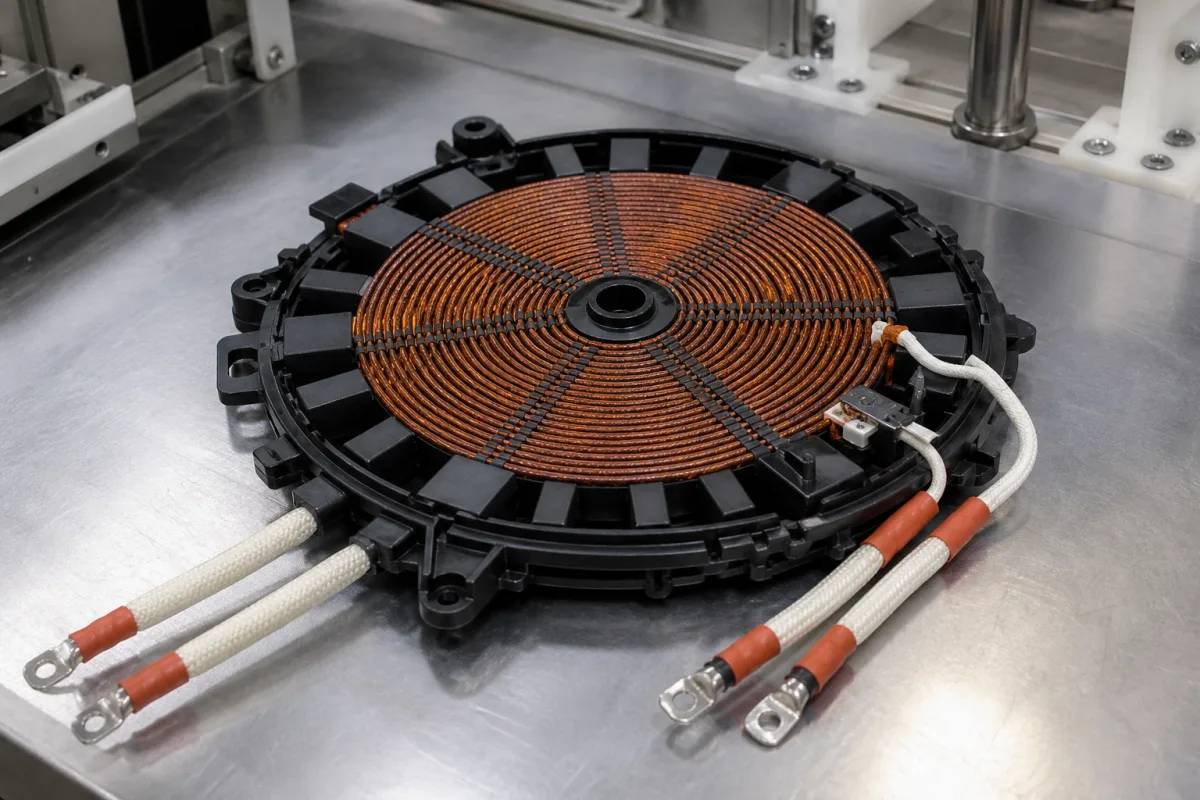
A canonical Induction Coil Assembly is characterized by the integration of Copper Wire Winding and Ferrite Core/Plate. In industrial production environments, manufacturers listed on CNFX commonly emphasize Copper wire construction to support stable, high-cycle operation across diverse manufacturing scenarios.

A critical electromagnetic component that generates alternating magnetic fields to induce eddy currents in cookware for heating.
Product Specifications

Technical details and manufacturing context for Induction Coil Assembly

Definition
The induction coil assembly is the core electromagnetic component within a programmable induction cooktop. It consists of tightly wound copper wire coils arranged in a flat spiral pattern, typically mounted on a ferrite core or backing plate. When powered by high-frequency alternating current from the inverter circuit, it generates a rapidly oscillating magnetic field that penetrates compatible ferromagnetic cookware, inducing eddy currents that produce resistive heating directly in the cookware material.
Working Principle
Operates on electromagnetic induction principles. When high-frequency alternating current (typically 20-50 kHz) flows through the copper coils, it creates a rapidly changing magnetic field. This field penetrates ferromagnetic cookware placed above the assembly, inducing circulating eddy currents within the cookware material. The electrical resistance of the cookware converts these currents into heat through Joule heating, while the coil assembly itself remains relatively cool.
Common Materials
Copper wire, Ferrite core/backing plate, Insulation materials, Thermal interface materials
Technical Parameters
  • Coil diameter typically ranges from 150-250mm for standard cooktop applications (mm) Per Request
Components / BOM
  • Copper Wire Winding
    Conducts high-frequency alternating current to generate magnetic field
    Material: Litz wire or enameled copper wire
  • Ferrite Core/Plate
    Concentrates and directs magnetic flux toward cookware, reduces electromagnetic interference
    Material: Ferrite ceramic material
  • Insulation Layer
    Provides electrical insulation between coil turns and thermal protection
    Material: Polyimide film or ceramic coating
  • Thermal Interface
    Transfers heat away from coil to heat sink or cooling system
    Material: Thermal paste or pad
  • Mounting Frame
    Secures coil assembly in position within cooktop housing
    Material: Plastic or metal frame
Engineering Reasoning
20-100 kHz frequency, 1200-1800 A current, 200-400 V voltage, 50-150°C temperature
Copper winding temperature exceeds 180°C (Class H insulation limit), magnetic flux density surpasses 1.8 T (saturation threshold), insulation resistance drops below 100 MΩ at 500 V DC
Design Rationale: Thermal degradation of polyimide insulation at >180°C causes dielectric breakdown; magnetic saturation above 1.8 T reduces permeability by 95% and increases core losses exponentially; eddy current heating in ferrite core exceeds 5 W/cm³ at >100 kHz causing thermal runaway
Risk Mitigation (FMEA)
Trigger Litz wire insulation breakdown due to partial discharge at >500 V/mm electric field
Mode: Inter-turn short circuit causing 300% current surge and immediate coil burnout
Strategy: Triple-layer polyimide-alumina-polyimide insulation with 0.2 mm minimum spacing, impregnated with silicone thermal compound
Trigger Ferrite core microcracking from thermal shock exceeding 50°C/min gradient
Mode: Core fragmentation increasing magnetic reluctance by 400% and reducing efficiency to <70%
Strategy: Mn-Zn ferrite composition with 12 ppm/°C CTE matching copper, stress-relieved annealing at 850°C for 2 hours

Industry Taxonomies & Aliases

Commonly used trade names and technical identifiers for Induction Coil Assembly.

Industrial Ecosystem & Supply Chain DNA

Complementary Systems
Downstream Applications
Specialized Tooling

Application Fit & Sizing Matrix

Operational Limits
pressure: Atmospheric only (non-pressurized component)
other spec: Power input: 1-5 kW typical, Frequency: 20-100 kHz, Insulation class: H (180°C)
temperature: -20°C to 200°C (ambient operating range, coil surface up to 150°C)
Media Compatibility
✓ Ferromagnetic cookware (cast iron, carbon steel) ✓ Magnetic stainless steel (430 grade) ✓ Enamel-coated induction-compatible vessels
Unsuitable: Conductive slurry or liquid media (risk of eddy current interference and corrosion)
Sizing Data Required
  • Required heating power (kW)
  • Cookware base diameter (mm)
  • Supply voltage and frequency (V/Hz)

Reliability & Engineering Risk Analysis

Failure Mode & Root Cause
Insulation breakdown
Cause: Thermal cycling and overheating leading to degradation of insulating materials, often due to inadequate cooling or excessive power loads.
Coil deformation or warping
Cause: Mechanical stress from electromagnetic forces combined with thermal expansion, typically from rapid heating/cooling cycles or improper mounting.
Maintenance Indicators
  • Audible arcing or buzzing sounds during operation
  • Visible discoloration, charring, or hotspots on coil surfaces
Engineering Tips
  • Implement strict thermal management with regular cooling system inspections and temperature monitoring to prevent insulation degradation.
  • Use proper mounting hardware with thermal expansion allowances and conduct periodic torque checks on fasteners to maintain mechanical integrity.

Compliance & Manufacturing Standards

Reference Standards
ISO 9001:2015 - Quality Management Systems IEC 60529 - Degrees of Protection Provided by Enclosures (IP Code) ASTM E1444/E1444M - Standard Practice for Magnetic Particle Testing
Manufacturing Precision
  • Coil Bore Diameter: +/-0.05mm
  • Coil Flatness: 0.15mm across entire surface
Quality Inspection
  • Electrical Resistance Testing (Ohmmeter)
  • High-Potential (Hi-Pot) Dielectric Strength Test

Factories Producing Induction Coil Assembly

Verified manufacturers with capability to produce this product in China

✓ 92% Supplier Capability Match Found

P Project Engineer from United States Jan 13, 2026
★★★★★
"Found 57+ suppliers for Induction Coil Assembly on CNFX, but this spec remains the most cost-effective."
Technical Specifications Verified
S Sourcing Manager from United Arab Emirates Jan 10, 2026
★★★★★
"The technical documentation for this Induction Coil Assembly is very thorough, especially regarding technical reliability."
Technical Specifications Verified
P Procurement Specialist from Australia Jan 07, 2026
★★★★★
"Reliable performance in harsh Electrical Equipment Manufacturing environments. No issues with the Induction Coil Assembly so far."
Technical Specifications Verified
Verification Protocol

“Feedback is collected from verified sourcing managers during RFQ (Request for Quote) and factory evaluation processes on CNFX. These reports represent historical performance data and technical audit summaries from our B2B manufacturing network.”

10 sourcing managers are analyzing this specification now. Last inquiry for Induction Coil Assembly from Turkey (34m ago).

Supply Chain Compatible Machinery & Devices

Circuit Breaker Arc Chute

Electrical component that extinguishes arcs in circuit breakers

Explore Specs →
Medium Voltage Switchgear Assembly Line

Automated production system for assembling medium voltage electrical switchgear.

Explore Specs →
Motor Terminal Block

Electrical connection interface for motor windings

Explore Specs →
PLC Control System

A digital industrial computer control system that monitors inputs, makes decisions based on a custom program, and controls outputs to automate industrial processes.

Explore Specs →

Frequently Asked Questions

What materials are used in this induction coil assembly?

This assembly uses high-conductivity copper wire windings, a ferrite core/backing plate for magnetic efficiency, insulation materials for safety, and thermal interface materials for heat management.

How does the induction coil assembly generate heat in cookware?

The coil creates alternating magnetic fields that induce eddy currents in compatible cookware, generating heat through electrical resistance without direct contact or flame.

What are the key components in the BOM for this assembly?

The bill of materials includes copper wire winding, ferrite core/plate, insulation layer, mounting frame, and thermal interface materials for optimal performance and durability.

Can I contact factories directly on CNFX?

CNFX is an open directory, not a transaction platform. Each factory profile provides direct contact information and production details to help you initiate direct inquiries with Chinese suppliers.

Get Quote for Induction Coil Assembly

Request technical pricing, lead times, or customized specifications for Induction Coil Assembly directly from verified manufacturing units.

Your business information is encrypted and only shared with verified Induction Coil Assembly suppliers.

Thank you! Your message has been sent. We'll respond within 1–3 business days.

Need to Manufacture Induction Coil Assembly?

Connect with verified factories specializing in this product category

Add Your Factory Contact Us
Previous Product
Individual Capacitor Bank
Next Product
Inductor/Transformer