Industry-Verified Manufacturing Data (2026)

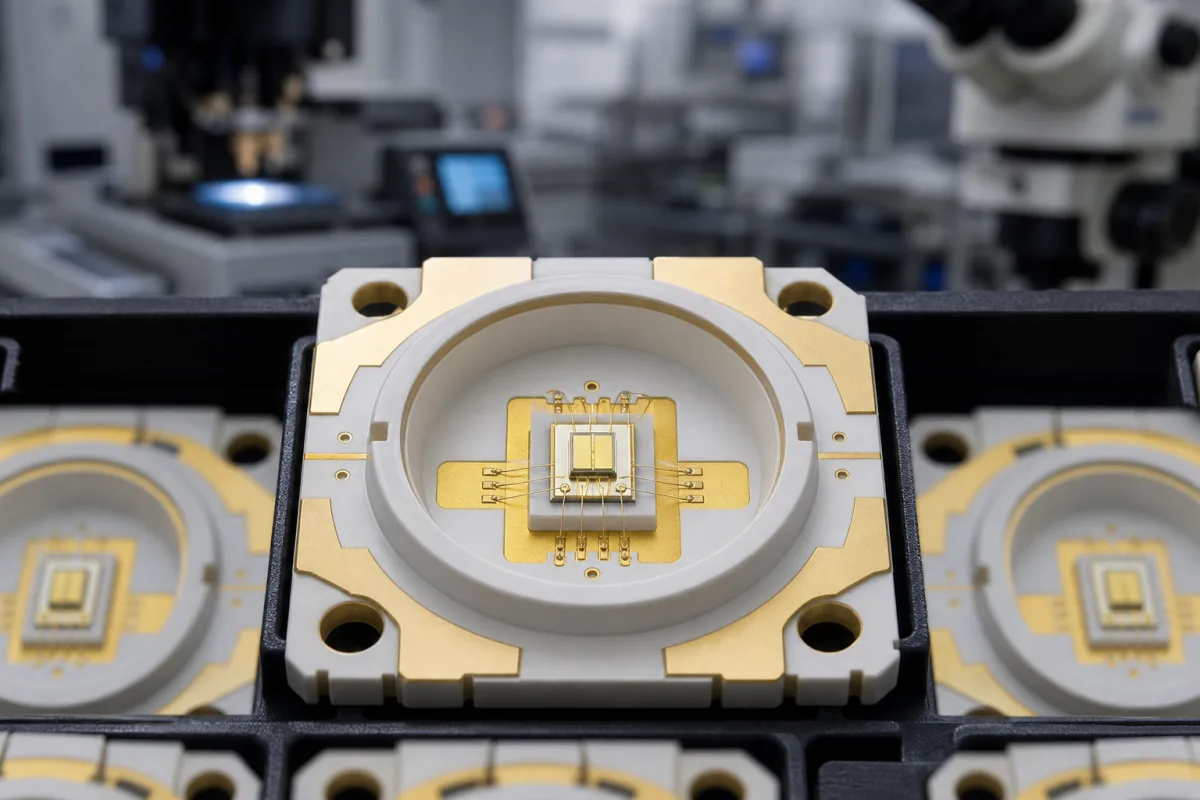
Precision LED Chip Carrier

Based on aggregated insights from multiple verified factory profiles within the CNFX directory, the standard Precision LED Chip Carrier used in the Electrical Equipment Manufacturing sector typically supports operational capacities ranging from standard industrial configurations to heavy-duty production requirements.

Technical Definition & Core Assembly

A canonical Precision LED Chip Carrier is characterized by the integration of Ceramic Substrate and Conductive Trace. In industrial production environments, manufacturers listed on CNFX commonly emphasize Aluminum Nitride (AlN) Ceramic construction to support stable, high-cycle operation across diverse manufacturing scenarios.

Mechanical substrate for mounting and thermally managing individual LED semiconductor dies
Product Specifications

Technical details and manufacturing context for Precision LED Chip Carrier

Definition
A precision-engineered component designed to securely mount individual LED semiconductor dies within a lighting assembly. It provides critical electrical connectivity between the die and the circuit while efficiently dissipating heat to maintain optimal operating temperatures. The carrier ensures precise optical alignment and protects the fragile semiconductor from mechanical stress. It serves as the fundamental building block in LED package assembly for various lighting applications.
Working Principle
The carrier physically supports the LED die, with conductive traces providing electrical paths for power input. Its material and design facilitate heat transfer from the die to a larger heat sink or the surrounding structure, preventing thermal degradation of the semiconductor.
Common Materials
Aluminum Nitride (AlN) Ceramic, Copper-Molybdenum-Copper (CMC) Composite
Technical Parameters
  • Resistance to heat flow from die junction to carrier base (K/W) Per Request
  • Precision surface area for semiconductor bonding (mm²) Per Request
Components / BOM
  • Ceramic Substrate
    Provides electrical insulation and thermal conduction
    Material: Aluminum Nitride Ceramic
  • Conductive Trace
    Forms electrical connection path for LED anode/cathode
    Material: Copper or Gold
  • Die Attachment Pad
    Precision surface for semiconductor die bonding
    Material: Gold-plated or Solder
  • Thermal Interface Layer Optional
    Enhances heat transfer to external heat sink
    Material: Thermal Grease or Phase Change Material
Engineering Reasoning
25-150°C junction temperature, 0-3.5 MPa compressive stress
175°C junction temperature (silicon-gold eutectic formation), 4.2 MPa compressive stress (ceramic substrate fracture)
Design Rationale: Thermal expansion coefficient mismatch (CTE) between silicon die (2.6 ppm/°C) and alumina substrate (6.5 ppm/°C) causing shear stress exceeding 48 MPa at 175°C
Risk Mitigation (FMEA)
Trigger Thermal cycling (ΔT > 125°C) during power cycling
Mode: Solder joint fatigue cracking (Coffin-Manson exponent n=1.9)
Strategy: Copper-tungsten composite substrate (CTE 5.8 ppm/°C) with SAC305 solder (creep resistance 12.3 MPa at 125°C)
Trigger Electrostatic discharge (ESD) > 1000V HBM
Mode: GaN epitaxial layer breakdown (critical field 3.3 MV/cm)
Strategy: Zener diode array (breakdown voltage 5.6V) integrated into carrier metallization

Industry Taxonomies & Aliases

Commonly used trade names and technical identifiers for Precision LED Chip Carrier.

Industrial Ecosystem & Supply Chain DNA

Complementary Systems
Downstream Applications
Specialized Tooling

Application Fit & Sizing Matrix

Operational Limits
pressure: Atmospheric to 1.5 MPa (for hermetic sealing applications)
temperature: -40°C to +150°C (operating), up to +300°C (peak during soldering)
flatness tolerance: ≤10 μm across mounting surface
thermal resistance: 0.5-5 K/W (junction-to-case, depending on design)
Media Compatibility
✓ High-brightness LED dies (GaN, InGaN) ✓ Thermally conductive adhesives (epoxy, silicone) ✓ Gold/tin solder alloys for die attach
Unsuitable: High-vibration environments without additional mechanical damping
Sizing Data Required
  • LED die dimensions (X,Y) and power dissipation (W)
  • Required thermal resistance target (K/W)
  • Electrical connection pattern (pad layout and pitch)

Reliability & Engineering Risk Analysis

Failure Mode & Root Cause
Thermal degradation of LED chip bonding
Cause: Excessive operating temperature due to inadequate heat dissipation or overdriving current, leading to solder joint fatigue or delamination.
Optical lens/carrier material yellowing or cracking
Cause: UV exposure and thermal cycling causing polymer degradation, reducing light output and compromising structural integrity.
Maintenance Indicators
  • Significant, sudden drop in luminous output or color shift (e.g., from white to blue-ish or yellow-ish tint) indicating chip or phosphor degradation.
  • Audible buzzing or high-pitched whine from the driver circuit, or visible flickering at stable power, suggesting imminent driver or connection failure.
Engineering Tips
  • Tip 1: Implement strict thermal management by ensuring proper heat sink contact, maintaining clean airflow paths, and using thermal interface materials with appropriate conductivity and longevity.
  • Tip 2: Adhere to manufacturer-specified current and voltage limits, avoiding overdriving, and use surge protection devices to shield against electrical transients that accelerate chip and driver aging.

Compliance & Manufacturing Standards

Reference Standards
ISO 9001:2015 - Quality Management Systems IEC 60747-5-3 - Semiconductor devices - Discrete devices and integrated circuits - Part 5-3: Optoelectronic devices - Light emitting diodes DIN 58141-1 - Optical systems - Part 1: Terms and definitions
Manufacturing Precision
  • Bore diameter: +/-0.01mm
  • Surface flatness: 0.05mm across 10mm span
Quality Inspection
  • Coordinate Measuring Machine (CMM) dimensional verification
  • Thermal cycling test (-40°C to +125°C, 1000 cycles)

Factories Producing Precision LED Chip Carrier

Verified manufacturers with capability to produce this product in China

✓ 95% Supplier Capability Match Found

P Project Engineer from Brazil Feb 19, 2026
★★★★★
"Found 41+ suppliers for Precision LED Chip Carrier on CNFX, but this spec remains the most cost-effective."
Technical Specifications Verified
S Sourcing Manager from Canada Feb 16, 2026
★★★★★
"The technical documentation for this Precision LED Chip Carrier is very thorough, especially regarding Thermal Conductivity (W/m·K)."
Technical Specifications Verified
P Procurement Specialist from United States Feb 13, 2026
★★★★★
"Reliable performance in harsh Electrical Equipment Manufacturing environments. No issues with the Precision LED Chip Carrier so far."
Technical Specifications Verified
Verification Protocol

“Feedback is collected from verified sourcing managers during RFQ (Request for Quote) and factory evaluation processes on CNFX. These reports represent historical performance data and technical audit summaries from our B2B manufacturing network.”

17 sourcing managers are analyzing this specification now. Last inquiry for Precision LED Chip Carrier from Germany (1h ago).

Supply Chain Commonly Integrated Components

Stator Assembly

The stationary component of an electric motor that generates a rotating magnetic field when energized.

Explore Specs →
Wire Tensioner

A device that applies and maintains precise tension on electrical wire during the winding process of transformers.

Explore Specs →
Wire Guide System

A precision mechanical system that guides and positions wire during the winding process on a transformer winding machine.

Explore Specs →
Counter System

A monitoring and control subsystem that tracks and records the number of winding turns during transformer coil production.

Explore Specs →

Frequently Asked Questions

What are the advantages of using Aluminum Nitride (AlN) ceramic in LED chip carriers?

Aluminum Nitride ceramic offers excellent thermal conductivity (typically 150-200 W/m·K), closely matched coefficient of thermal expansion to LED semiconductor materials, and superior electrical insulation, making it ideal for high-power LED applications requiring efficient heat dissipation.

How does the Copper-Molybdenum-Copper (CMC) composite benefit LED thermal management?

CMC composite provides exceptional thermal conductivity while maintaining a coefficient of thermal expansion that closely matches LED semiconductor materials, preventing thermal stress and ensuring reliable performance in demanding lighting applications with high operating temperatures.

What specifications should I consider when selecting an LED chip carrier for my lighting application?

Key specifications include thermal conductivity (W/m·K) for heat dissipation, coefficient of thermal expansion (ppm/K) for material compatibility, die shear strength (MPa) for mechanical reliability, maximum operating temperature (°C), surface flatness (µm) for proper die attachment, and trace resistance (mΩ) for electrical performance.

Can I contact factories directly on CNFX?

CNFX is an open directory, not a transaction platform. Each factory profile provides direct contact information and production details to help you initiate direct inquiries with Chinese suppliers.

Get Quote for Precision LED Chip Carrier

Request technical pricing, lead times, or customized specifications for Precision LED Chip Carrier directly from verified manufacturing units.

Your business information is encrypted and only shared with verified Precision LED Chip Carrier suppliers.

Thank you! Your message has been sent. We'll respond within 1–3 business days.

Need to Manufacture Precision LED Chip Carrier?

Connect with verified factories specializing in this product category

Add Your Factory Contact Us
Previous Product
Precision Heat Sink Assembly
Next Product
Precision LED Encapsulation Machine