Industry-Verified Manufacturing Data (2026)

Protective Enclosure and Interlocks

Based on aggregated insights from multiple verified factory profiles within the CNFX directory, the standard Protective Enclosure and Interlocks used in the Electrical Equipment Manufacturing sector typically supports operational capacities ranging from standard industrial configurations to heavy-duty production requirements.

Technical Definition & Core Assembly

A canonical Protective Enclosure and Interlocks is characterized by the integration of Main Enclosure Frame and Access Door with Interlock Switch. In industrial production environments, manufacturers listed on CNFX commonly emphasize Powder-coated steel construction to support stable, high-cycle operation across diverse manufacturing scenarios.

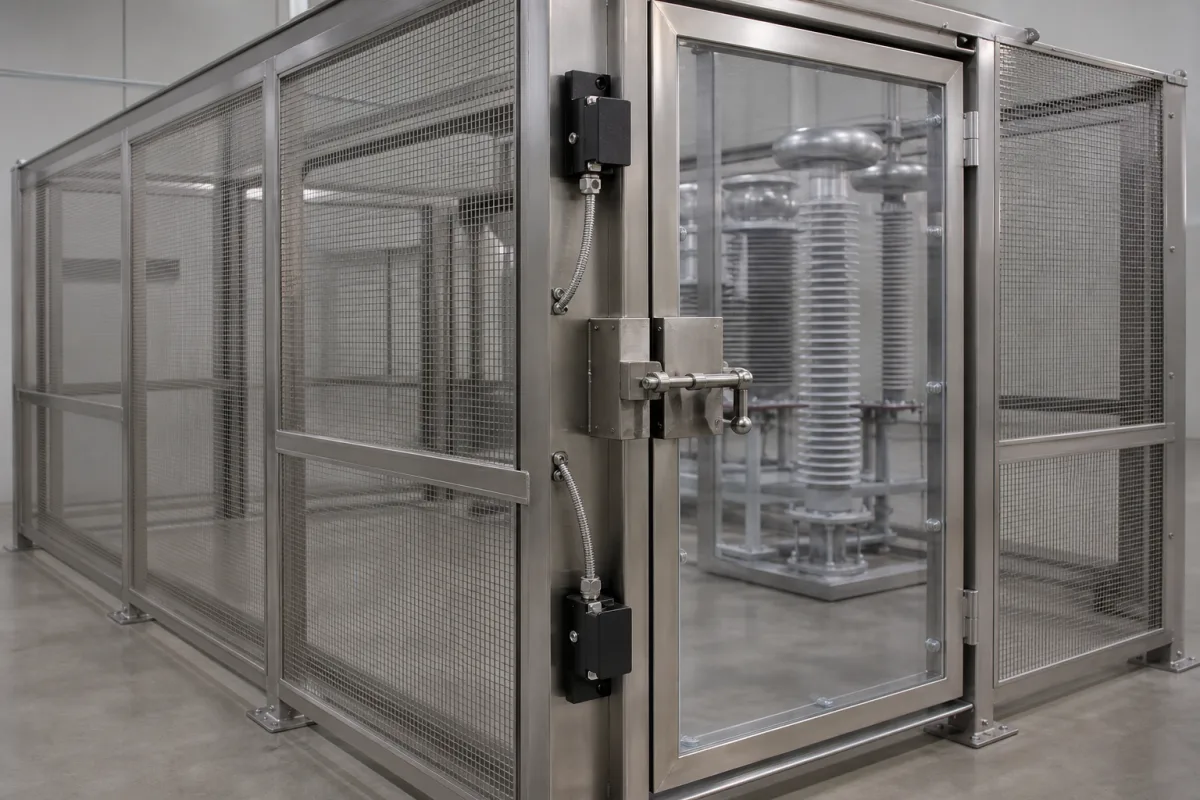
Safety system comprising a physical barrier and electrical/mechanical interlocks to prevent access to high-voltage areas during operation.
Product Specifications

Technical details and manufacturing context for Protective Enclosure and Interlocks

Definition
A critical safety component of a High-Voltage Test Unit, consisting of a robust enclosure that physically isolates the high-voltage test area and integrated interlock mechanisms. These interlocks are designed to automatically cut power or prevent the unit from energizing when access doors or panels are opened, ensuring operator safety by eliminating the risk of accidental contact with live high-voltage components.
Working Principle
The enclosure provides primary physical protection. The interlock system typically uses limit switches, sensors, or mechanical locks connected to the unit's control circuit. When an access point is breached, the interlock triggers, interrupting the control circuit that enables high-voltage output, thereby rendering the internal components safe before human access is possible.
Common Materials
Powder-coated steel, Polycarbonate viewing windows, Stainless steel hinges and latches
Technical Parameters
  • Rated withstand voltage for the enclosure and clearance distances for internal components. (kV) Per Request
Components / BOM
  • Main Enclosure Frame
    Provides structural integrity and mounts to the test unit base.
    Material: Powder-coated steel
  • Access Door with Interlock Switch
    Primary entry point; houses the interlock sensor that disables HV when opened.
    Material: Steel with polycarbonate window
  • Interlock Control Module
    Processes signals from door switches and interfaces with the HV power supply control system.
    Material: PCB with electronic components
Engineering Reasoning
0-40 kV DC, 0-1000 V AC, -40°C to +85°C ambient temperature
Interlock contact resistance > 100 mΩ, enclosure IP rating degradation below IP65, dielectric withstand voltage < 2.5 kV/mm
Design Rationale: Dielectric breakdown at 3.0 MV/m electric field strength (air), mechanical fatigue from >10⁶ cyclic loads at hinge points, galvanic corrosion at dissimilar metal interfaces
Risk Mitigation (FMEA)
Trigger Electromagnetic interference exceeding 100 V/m field strength
Mode: False interlock signal generation causing safety bypass
Strategy: Shielded twisted-pair wiring with ferrite cores and 1.5 mm aluminum enclosure shielding
Trigger Mechanical wear at hinge pivot points exceeding 0.5 mm clearance
Mode: Enclosure door misalignment preventing proper interlock engagement
Strategy: Self-lubricating bronze bushings with 0.1 mm tolerance and position sensors with 0.01 mm resolution

Industry Taxonomies & Aliases

Commonly used trade names and technical identifiers for Protective Enclosure and Interlocks.

Applied To / Applications

This component is essential for the following industrial systems and equipment:

Industrial Ecosystem & Supply Chain DNA

Complementary Systems
Downstream Applications
Specialized Tooling

Application Fit & Sizing Matrix

Operational Limits
pressure: 0 to 1.5 bar (ambient pressure rating)
other spec: IP65 ingress protection, NEMA 4X rating, 1000V AC/1500V DC max voltage rating
temperature: -20°C to +85°C
Media Compatibility
✓ Industrial electrical cabinets ✓ HVAC equipment rooms ✓ Robotic cell enclosures
Unsuitable: Corrosive chemical processing environments with acid/alkali mists
Sizing Data Required
  • Enclosure dimensions (HxWxD)
  • Required access points and door configurations
  • Interlock circuit voltage and safety category (e.g., SIL, PL)

Reliability & Engineering Risk Analysis

Failure Mode & Root Cause
Interlock Bypass or Tampering
Cause: Unauthorized personnel disabling or overriding safety interlocks to expedite maintenance or production, often due to time pressure or lack of training, leading to unsafe equipment operation.
Enclosure Seal Degradation
Cause: Environmental exposure (e.g., moisture, dust, chemicals) or physical damage compromising gaskets, seals, or hinges, resulting in ingress of contaminants that can damage internal components or cause electrical faults.
Maintenance Indicators
  • Visible damage to the enclosure (e.g., dents, cracks, corrosion) or loose/missing fasteners that compromise integrity.
  • Audible alarm or warning light indicating an interlock fault, or a door/panel that opens without triggering a safety shutdown as designed.
Engineering Tips
  • Implement a strict lockout-tagout (LOTO) program and regular audits to prevent interlock bypasses, ensuring all personnel are trained on safety protocols and consequences.
  • Conduct routine inspections of enclosure seals and hinges, using appropriate cleaning agents and replacing worn components promptly to maintain environmental protection.

Compliance & Manufacturing Standards

Reference Standards
ISO 13849-1: Safety of machinery - Safety-related parts of control systems ANSI/UL 508A: Standard for Industrial Control Panels DIN EN 60529: Degrees of protection provided by enclosures (IP Code)
Manufacturing Precision
  • Enclosure panel flatness: ≤0.5mm per meter
  • Interlock actuator alignment: ±0.1mm
Quality Inspection
  • IP Rating verification test (dust/water ingress protection)
  • Functional safety test for interlock reliability (ISO 13849 PL evaluation)

Factories Producing Protective Enclosure and Interlocks

Verified manufacturers with capability to produce this product in China

✓ 94% Supplier Capability Match Found

T Technical Director from United Arab Emirates Jan 10, 2026
★★★★★
"Testing the Protective Enclosure and Interlocks now; the technical reliability results are within 1% of the laboratory datasheet."
Technical Specifications Verified
P Project Engineer from Australia Jan 07, 2026
★★★★☆
"Impressive build quality. Especially the technical reliability is very stable during long-term operation. (Delivery took slightly longer than expected, but technical support was excellent.)"
Technical Specifications Verified
S Sourcing Manager from Singapore Jan 04, 2026
★★★★★
"As a professional in the Electrical Equipment Manufacturing sector, I confirm this Protective Enclosure and Interlocks meets all ISO standards."
Technical Specifications Verified
Verification Protocol

“Feedback is collected from verified sourcing managers during RFQ (Request for Quote) and factory evaluation processes on CNFX. These reports represent historical performance data and technical audit summaries from our B2B manufacturing network.”

18 sourcing managers are analyzing this specification now. Last inquiry for Protective Enclosure and Interlocks from Poland (1h ago).

Supply Chain Compatible Machinery & Devices

Circuit Breaker Arc Chute

Electrical component that extinguishes arcs in circuit breakers

Explore Specs →
Medium Voltage Switchgear Assembly Line

Automated production system for assembling medium voltage electrical switchgear.

Explore Specs →
Motor Terminal Block

Electrical connection interface for motor windings

Explore Specs →
PLC Control System

A digital industrial computer control system that monitors inputs, makes decisions based on a custom program, and controls outputs to automate industrial processes.

Explore Specs →

Frequently Asked Questions

What safety standards do these protective enclosures with interlocks comply with?

Our protective enclosures with interlocks are designed to meet relevant electrical safety standards including IEC 60204-1, NFPA 79, and OSHA requirements for machine guarding and electrical safety in manufacturing environments.

How do the electrical/mechanical interlocks prevent access to high-voltage areas?

The interlock system uses a combination of electrical switches and mechanical locking mechanisms that prevent the access door from opening while equipment is energized. When the door is opened, the interlock automatically cuts power to the high-voltage components, ensuring operator safety.

Can these enclosures be customized for specific electrical equipment configurations?

Yes, we offer customization options including different sizes, additional viewing windows, multiple access points, and integration with your existing control systems. The modular BOM components allow for flexible configuration to match your specific equipment layout and safety requirements.

Can I contact factories directly on CNFX?

CNFX is an open directory, not a transaction platform. Each factory profile provides direct contact information and production details to help you initiate direct inquiries with Chinese suppliers.

Get Quote for Protective Enclosure and Interlocks

Request technical pricing, lead times, or customized specifications for Protective Enclosure and Interlocks directly from verified manufacturing units.

Your business information is encrypted and only shared with verified Protective Enclosure and Interlocks suppliers.

Thank you! Your message has been sent. We'll respond within 1–3 business days.

Need to Manufacture Protective Enclosure and Interlocks?

Connect with verified factories specializing in this product category

Add Your Factory Contact Us
Previous Product
Protection Relay/Transistor
Next Product
Rechargeable Battery