Industry-Verified Manufacturing Data (2026)

Tank

Based on aggregated insights from multiple verified factory profiles within the CNFX directory, the standard Tank used in the Electrical Equipment Manufacturing sector typically supports operational capacities ranging from standard industrial configurations to heavy-duty production requirements.

Technical Definition & Core Assembly

A canonical Tank is characterized by the integration of Tank Body and Flanges. In industrial production environments, manufacturers listed on CNFX commonly emphasize Carbon Steel construction to support stable, high-cycle operation across diverse manufacturing scenarios.

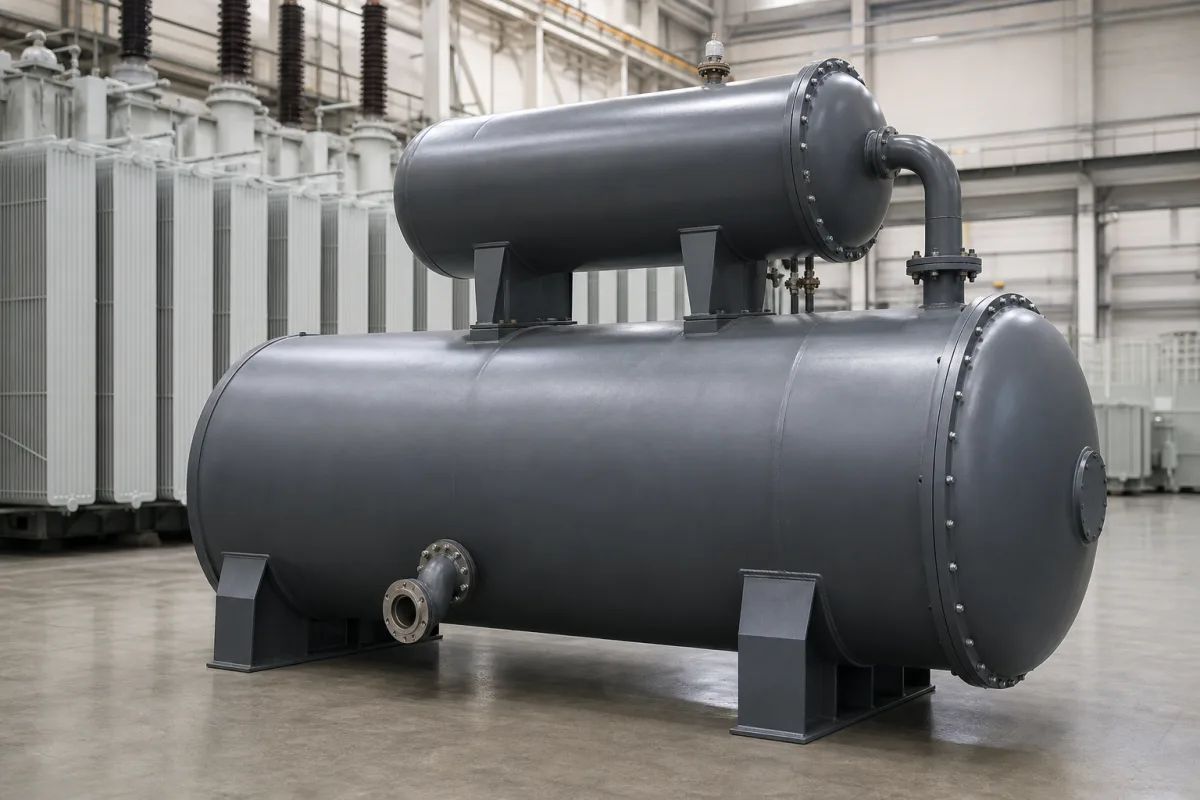
The sealed container that houses the transformer core, windings, and insulating oil in a power transformer.
Product Specifications

Technical details and manufacturing context for Tank

Definition
In a power transformer, the tank is the primary structural enclosure that contains all internal components including the magnetic core, high and low voltage windings, insulating oil, and cooling systems. It provides mechanical protection, contains the insulating medium, and serves as the foundation for mounting accessories like bushings, conservators, and radiators.
Working Principle
The tank functions as a pressure vessel that maintains the insulating oil in a sealed environment. It withstands internal pressure variations caused by temperature changes and fault conditions, prevents oil contamination from external elements, and facilitates heat dissipation through its surface and attached cooling equipment.
Common Materials
Carbon Steel, Stainless Steel
Technical Parameters
  • Tank wall thickness typically ranges from 6-25mm depending on transformer size and pressure requirements (mm) Per Request
Components / BOM
  • Tank Body
    Main structural shell providing containment
    Material: Carbon Steel
  • Flanges
    Connection points for accessories and covers
    Material: Carbon Steel
  • Lifting Lugs
    Attachment points for crane lifting during installation
    Material: Carbon Steel
  • Drain Valve
    Bottom outlet for oil drainage and sampling
    Material: Brass or Stainless Steel
Engineering Reasoning
0.1-1.5 bar gauge pressure
2.0 bar internal pressure differential causing permanent deformation of steel walls exceeding 0.2% strain
Design Rationale: Von Mises yield criterion failure due to hoop stress exceeding ASTM A36 steel yield strength of 250 MPa at 2.0 bar pressure differential
Risk Mitigation (FMEA)
Trigger Partial discharge exceeding 100 pC at 50 Hz causing oil decomposition
Mode: Gas bubble formation leading to dielectric breakdown at 15 kV/mm
Strategy: Installation of Buchholz relay with gas accumulation detection at 150 cm³ threshold
Trigger Corrosion rate exceeding 0.1 mm/year due to sulfur content >0.2% in insulating oil
Mode: Wall thickness reduction below minimum 6 mm causing structural failure at 1.8 bar
Strategy: Application of 300 μm epoxy-phenolic coating with dielectric strength >15 kV/mm

Industry Taxonomies & Aliases

Commonly used trade names and technical identifiers for Tank.

Applied To / Applications

This component is essential for the following industrial systems and equipment:

Industrial Ecosystem & Supply Chain DNA

Complementary Systems
Downstream Applications
Specialized Tooling

Application Fit & Sizing Matrix

Operational Limits
pressure: 0 to 0.5 bar gauge (normal), 1.0 bar gauge (max test pressure)
other spec: Dielectric strength >30 kV, moisture ingress <50 ppm, seismic zone 4 compliant
temperature: -40°C to 105°C (operating), -50°C to 115°C (storage)
Media Compatibility
✓ Mineral insulating oil ✓ Silicone-based transformer fluid ✓ Ester-based dielectric fluid
Unsuitable: Chlorinated solvents or strong oxidizing agents
Sizing Data Required
  • Transformer MVA rating and voltage class
  • Required oil volume with expansion margin
  • Installation footprint and seismic requirements

Reliability & Engineering Risk Analysis

Failure Mode & Root Cause
Corrosion
Cause: Chemical attack from stored fluids, atmospheric exposure, or galvanic action between dissimilar metals, leading to material degradation and potential leaks.
Structural fatigue cracking
Cause: Cyclic loading from thermal expansion/contraction, fluid sloshing, or pressure variations, initiating cracks at stress concentrations like welds or nozzles.
Maintenance Indicators
  • Visible weeping, staining, or bulging on tank walls indicating material failure or overpressure
  • Abnormal audible hissing or dripping sounds suggesting leaks or pressure loss
Engineering Tips
  • Implement regular non-destructive testing (e.g., ultrasonic thickness gauging) to monitor corrosion rates and schedule proactive repairs
  • Install corrosion protection systems (cathodic protection for buried tanks, protective coatings) and ensure proper ventilation to control condensation

Compliance & Manufacturing Standards

Reference Standards
ISO 9001:2015 - Quality management systems ASME BPVC Section VIII - Rules for construction of pressure vessels EN 14015:2004 - Specification for the design and manufacture of site built, vertical, cylindrical, flat-bottomed, above ground, welded, steel tanks for the storage of liquids
Manufacturing Precision
  • Wall thickness: +/-5% of specified thickness
  • Circularity: Maximum deviation of 1% from nominal diameter
Quality Inspection
  • Hydrostatic pressure test
  • Visual and dimensional inspection per ASME B31.3

Factories Producing Tank

Verified manufacturers with capability to produce this product in China

✓ 97% Supplier Capability Match Found

S Sourcing Manager from Canada Feb 09, 2026
★★★★★
"Standard OEM quality for Electrical Equipment Manufacturing applications. The Tank arrived with full certification."
Technical Specifications Verified
P Procurement Specialist from United States Feb 06, 2026
★★★★☆
"Great transparency on the Tank components. Essential for our Electrical Equipment Manufacturing supply chain. (Delivery took slightly longer than expected, but technical support was excellent.)"
Technical Specifications Verified
T Technical Director from United Arab Emirates Feb 03, 2026
★★★★★
"The Tank we sourced perfectly fits our Electrical Equipment Manufacturing production line requirements."
Technical Specifications Verified
Verification Protocol

“Feedback is collected from verified sourcing managers during RFQ (Request for Quote) and factory evaluation processes on CNFX. These reports represent historical performance data and technical audit summaries from our B2B manufacturing network.”

13 sourcing managers are analyzing this specification now. Last inquiry for Tank from Poland (1h ago).

Supply Chain Compatible Machinery & Devices

Circuit Breaker Arc Chute

Electrical component that extinguishes arcs in circuit breakers

Explore Specs →
Medium Voltage Switchgear Assembly Line

Automated production system for assembling medium voltage electrical switchgear.

Explore Specs →
Motor Terminal Block

Electrical connection interface for motor windings

Explore Specs →
PLC Control System

A digital industrial computer control system that monitors inputs, makes decisions based on a custom program, and controls outputs to automate industrial processes.

Explore Specs →

Frequently Asked Questions

What materials are used for transformer tanks in electrical equipment manufacturing?

Transformer tanks are typically constructed from carbon steel or stainless steel, chosen for their durability, corrosion resistance, and ability to safely house transformer components and insulating oil.

What are the key components included in a transformer tank BOM?

A standard transformer tank bill of materials includes the tank body, flanges for connections, lifting lugs for safe handling, and a drain valve for maintenance and oil changes.

Why is a sealed tank important for power transformers?

A sealed tank is crucial to protect the transformer core, windings, and insulating oil from environmental contaminants, moisture, and oxidation, ensuring reliable operation and extending the transformer's lifespan.

Can I contact factories directly on CNFX?

CNFX is an open directory, not a transaction platform. Each factory profile provides direct contact information and production details to help you initiate direct inquiries with Chinese suppliers.

Get Quote for Tank

Request technical pricing, lead times, or customized specifications for Tank directly from verified manufacturing units.

Your business information is encrypted and only shared with verified Tank suppliers.

Thank you! Your message has been sent. We'll respond within 1–3 business days.

Need to Manufacture Tank?

Connect with verified factories specializing in this product category

Add Your Factory Contact Us
Previous Product
Switching Element
Next Product
Tap Changer (if applicable)