Editorial Technical Reference

Power Transformer

This page explains how Power Transformer is classified within Electrical Equipment Manufacturing. Technical values and manufacturer relationships are research references; confirm the current specification and supplier evidence for each order.

Technical Definition & Core Assembly

A static electrical device that transfers electrical energy between circuits through electromagnetic induction, typically changing voltage levels while maintaining frequency.

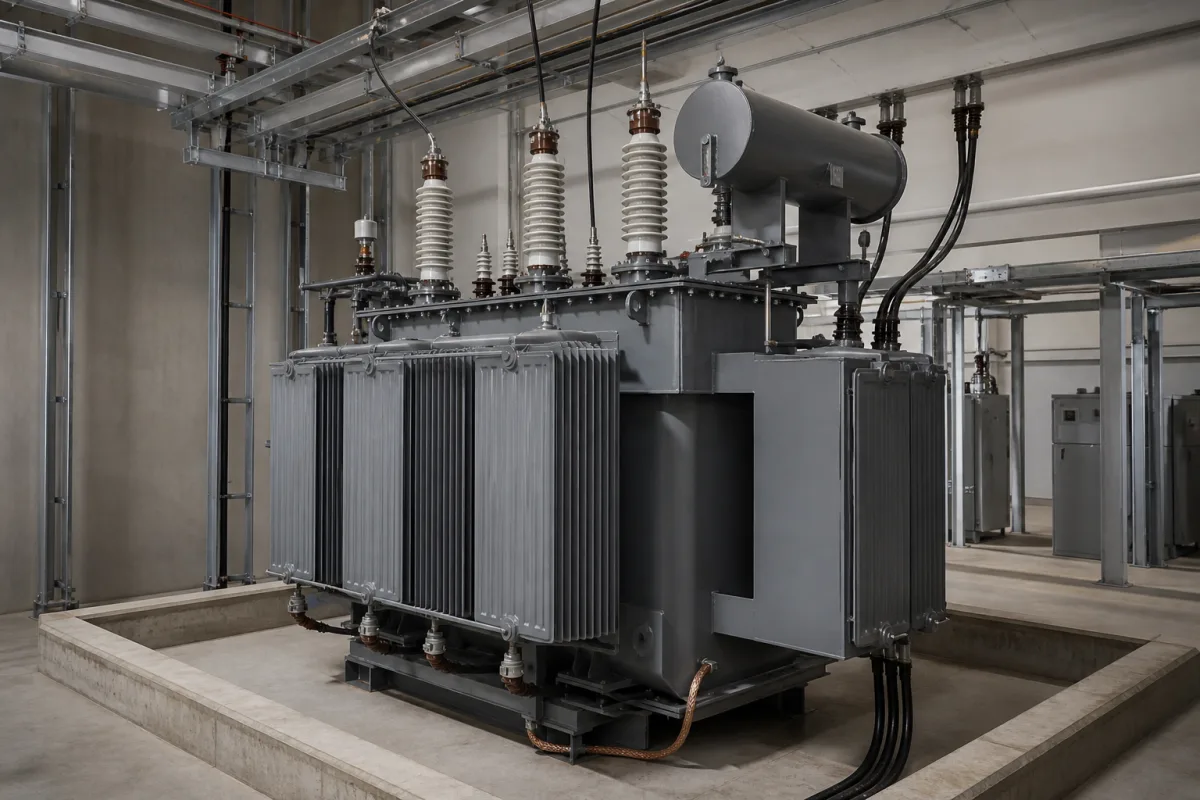
Representative product image. Confirm appearance and specifications with the manufacturer.

Product Specifications

Technical details and manufacturing context for Power Transformer

Definition
A power transformer is a static electrical device used in electrical power systems to transfer alternating current (AC) electrical energy between circuits via electromagnetic induction. Its primary function is to change voltage levels—stepping up voltage for efficient long-distance transmission and stepping down voltage for safe consumption by end-use equipment—while maintaining the system frequency. It also provides electrical isolation between the primary and secondary circuits, enhancing safety and system flexibility. As a core component of a power supply system, the transformer enables the efficient transmission, distribution, and utilization of electrical power across various voltage levels. The transformer consists of a magnetic core made of electrical steel (silicon steel), windings of copper or aluminum, insulating materials such as paper and oil, and a steel tank for structural support and protection. The transformer oil serves both as a coolant and as an insulating medium. Key parameters that define a transformer's performance and application include rated power (50–2500 kVA), primary voltage (6–35 kV), secondary voltage (0.4–11 kV), frequency (50–60 Hz), impedance voltage (4–10%), no-load loss (0.1–10 kW), load loss (1–50 kW), insulation class (A–H), temperature rise (60–75 K), cooling type (ONAN–OFAF), IP rating (IP54–IP65), and weight (500–15000 kg). These parameters are specified according to standards such as IEC 60076-1, IEC 60076-5, IEC 60076-2, IEC 60085, and IEC 60529. The values listed are typical reference ranges for distribution transformers; actual values must be confirmed with the manufacturer for a specific model and application. The transformer operates on the principle of electromagnetic induction, where an alternating current in the primary winding creates a varying magnetic flux in the core, inducing a voltage in the secondary winding. The voltage ratio is determined by the turns ratio (Vp/Vs = Np/Ns). Selection of a transformer involves considering the required voltage levels, power rating, efficiency, cooling method, and environmental conditions. Verification of compliance with relevant standards and performance specifications is essential before procurement and installation. Regular maintenance, including oil testing and inspection of insulation, is necessary to ensure reliable operation and to detect potential failures early.
Working Principle
The power transformer operates on the principle of electromagnetic induction. An alternating current (AC) flowing in the primary winding generates a time-varying magnetic flux in the laminated electrical steel core. This varying flux links the secondary winding, inducing an electromotive force (voltage) in it. The magnitude of the induced voltage is proportional to the number of turns in the secondary winding relative to the primary winding, as expressed by the turns ratio (Vp/Vs = Np/Ns). By selecting the appropriate number of turns, the transformer can step voltage up or down. The core is designed to minimize energy losses, and the windings are insulated and cooled to maintain safe operating temperatures. The transformer provides electrical isolation between circuits, ensuring safety and proper system operation.
Common Materials
Electrical steel (silicon steel), Copper or aluminum (windings), Insulating paper/oil, Transformer oil (for cooling and insulation), Steel (tank and structural parts)
Technical Parameters
ParameterTypical rangeNotes & selection driver
Rated Power50–2500 kVADetermines size and costIEC 60076-1
Primary Voltage6–35 kVCommon distribution levelsIEC 60076-1
Secondary Voltage0.4–11 kVTypical utilization levelsIEC 60076-1
Frequency50–60 HzMust match gridIEC 60076-1
Impedance Voltage4–10 %Affects fault current and regulationIEC 60076-5
No-Load Loss0.1–10 kWContinuous cost driverIEC 60076-1
Load Loss1–50 kWDepends on load and designIEC 60076-1
Insulation ClassA–HThermal limit of insulationIEC 60085
Temperature Rise60–75 KAbove ambient, limits lifeIEC 60076-2
Cooling TypeONAN–OFAFONAN natural, OFAF forcedIEC 60076-2
IP RatingIP54–IP65Dust and water protectionIEC 60529
Weight500–15000 kgAffects transport and installation

Ranges are indicative industry figures for RFQ preparation, not a supplier commitment. Confirm every value and standard with the legal manufacturer before ordering.

Components / BOM
  • Core Part
    Provides a low-reluctance path for the magnetic flux, constructed from laminated electrical steel to minimize eddy current losses.
    Material: Electrical steel (silicon steel)
  • Windings (Primary & Secondary) Part
    Conductors wound around the core; the primary receives input power, and the secondary delivers transformed output power.
    Material: Copper or aluminum
  • Insulation System Part
    Electrically isolates the windings from each other, from the core, and from the grounded tank. Includes paper, pressboard, and insulating oil.
    Material: Insulating paper, transformer oil
  • Tank
    Houses the core, windings, and insulating oil, providing mechanical protection and serving as a container for the cooling medium.
    Material: Steel
  • Bushings
    Insulated terminals that allow electrical connections to the windings from outside the tank while maintaining a sealed environment.
    Material: Porcelain or composite polymer, copper/aluminum conductors
  • Conservator Tank (Expansion Tank)
    A separate tank connected to the main tank that allows for the expansion and contraction of the insulating oil with temperature changes, preventing air ingress.
    Material: Steel
  • Cooling Radiators/Tubes Part
    Increase the surface area for heat dissipation from the insulating oil to the surrounding air.
    Material: Steel

Applied To / Applications

This component is essential for the following industrial systems and equipment:

Industrial Ecosystem & Supply Chain Structure

Complementary Systems
Downstream Applications
Specialized Tooling

Application Fit & Sizing Matrix

Operational Limits
pressure: Atmospheric to 15 psi (sealed units), higher for pressurized designs
other spec: Frequency: 50/60 Hz ±5%, Humidity: 0-95% non-condensing, Altitude: ≤1000m standard
temperature: -40°C to 120°C (ambient), 65°C to 95°C (winding hot spot rise)
Media Compatibility
✓ Mineral Oil (dielectric fluid) ✓ Silicone Fluid (dielectric fluid) ✓ Dry Air (sealed dry-type transformers)
Unsuitable: Saltwater immersion or continuous salt spray environments
Sizing Data Required
  • Required Power Rating (kVA/MVA)
  • Primary/Secondary Voltage Levels (kV)
  • Impedance Percentage (%)

Reliability & Engineering Risk Analysis

Failure Mode & Root Cause
Insulation Degradation
Cause: Thermal aging from prolonged overloading, moisture ingress, or contamination reducing dielectric strength.
Winding Deformation
Cause: Mechanical stress from through-fault currents, short-circuit forces, or improper transportation/handling.
Maintenance Indicators
  • Audible humming or buzzing that intensifies or changes pitch, indicating loose components or electrical issues.
  • Visible oil leaks, discoloration, or bulging of the tank, suggesting seal failures or internal pressure problems.
Engineering Tips
  • Implement regular dissolved gas analysis (DGA) and oil testing to detect early insulation breakdown and thermal faults.
  • Install and maintain proper cooling systems, ensure balanced loading, and use surge protection devices to minimize electrical and thermal stress.

Indicative industry ranges for design and RFQ preparation. Confirm the exact figures and applicable standard with the manufacturer before specifying.

Compliance & Manufacturing Standards

Applicable Standards
IEC 60076 (International Electrotechnical Commission) IEEE C57.12.00 (American National Standards Institute) EN 50588-1 (European Norm, CE marking relevant)

Quoted from the published standard.

Manufacturing Precision
  • Winding resistance: +/- 0.5% of specified value
  • No-load loss: +/- 10% of guaranteed value
Quality Inspection
  • Impulse withstand voltage test (lightning surge test)
  • Temperature rise test under rated load

Manufacturers of Power Transformer

12 companies list this product among what they make. Company figures are quoted from each company's own website; every card states where the relationship came from.

Andeli Group Co., Ltd.
Shanghai, CN
Founded 19853000 + staff235,000 m²
Listed on the company's own website · profile compiled by CNFX from public sources
Huayi Electric Co., Ltd.
Wenzhou, Zhejiang, CN
Listed on the company's own website · profile compiled by CNFX from public sources
Liyond
Zhejiang, CN
Founded 2001
Listed on the company's own website · profile compiled by CNFX from public sources
Lugao Power Co.,Ltd
Xiangyang, Hubei, CN
Founded 2016nearly 60 employees staff3000 square meter
ISO9001 SGS CCC CE
Listed on the company's own website · profile compiled by CNFX from public sources
XBRELE
Zhejiang, CN
ISO9001
Listed on the company's own website · profile compiled by CNFX from public sources
Xi'an Xigao Electricenergy Group Co., Ltd.
Xian, Shaanxi, CN
Founded 1993320000m2
Listed on the company's own website · profile compiled by CNFX from public sources
Changan Group
Zhejiang, CN
Listed on the company's own website · profile compiled by CNFX from public sources
CNC Electric
Zhejiang, CN
Listed on the company's own website · profile compiled by CNFX from public sources
Coilcore
Guangzhou, Guangdong, CN
Listed on the company's own website · profile compiled by CNFX from public sources
Evernew Transformer
Sichuan, CN
Listed on the company's own website · profile compiled by CNFX from public sources
Guang Er Zhong(Zhaoqing)Electronics Co., Ltd
Fujian, CN
Listed on the company's own website · profile compiled by CNFX from public sources
Henan Energy Electric Equipment Co.,Ltd
Henan, CN
Listed on the company's own website · profile compiled by CNFX from public sources
View All Factories

Manufacturer listings support early research and capability understanding. They are not certification, ranking, or transaction guarantees.

Technical documentation
Request current drawings, revision history, and a signed specification sheet.
Manufacturing capability
Verify equipment lists, process limits, capacity, and representative production evidence.
Inspection readiness
Confirm test methods, calibrated equipment, sampling plans, and traceable reports.
Supplier transparency
Check the legal entity, factory address, ownership, certifications, and direct contacts.

CNFX does not score or rank suppliers. Buyers must verify all claims and documents with the legal manufacturer before ordering.

Supply Chain Compatible Machinery & Devices

Medium Voltage Switchgear Assembly Line

Automated production system for assembling medium voltage electrical switchgear.

Explore Specs →
Motor Terminal Block

A motor terminal block is a standardized electrical component that provides secure, insulated connection points for motor winding leads.

Explore Specs →
PLC Control System

A digital industrial computer control system that monitors inputs, makes decisions based on a custom program, and controls outputs to automate industrial processes.

Explore Specs →
Control Panel

A centralized interface for monitoring and controlling industrial equipment and processes

Explore Specs →

Frequently Asked Questions

What is the primary function of a power transformer?

The primary function is to transfer electrical energy between circuits via electromagnetic induction, changing voltage levels while maintaining frequency. It steps up voltage for transmission and steps down for safe use.

What are typical voltage ranges for distribution transformers?

Typical primary voltages are 6–35 kV, and secondary voltages are 0.4–11 kV, as per IEC 60076-1. Actual values depend on the specific application and must be confirmed with the manufacturer.

How is the voltage transformation ratio determined?

The ratio is determined by the turns ratio of the primary and secondary windings (Vp/Vs = Np/Ns). By adjusting the number of turns, the transformer steps voltage up or down accordingly.

What standards apply to power transformers?

Key standards include IEC 60076-1 (general), IEC 60076-5 (impedance), IEC 60076-2 (temperature rise and cooling), IEC 60085 (insulation class), and IEC 60529 (IP rating). Compliance must be verified with the manufacturer.

Data Basis

Editorial classification, named public sources where available, and source-reviewed manufacturer records.

Preliminary Technical Classification
This page supports structured research, RFQ preparation, and supplier evaluation. It does not replace buyer-led supplier qualification, standards review, or technical approval.
Buyer enquiry

Request manufacturing insight for Power Transformer

Ask for use case, specification boundaries, supplier type, and RFQ preparation information for this product.

Where it goes
Straight to the CNFX editorial desk, and to the manufacturer if this product is linked to a claimed profile. Nothing is broadcast to a supplier list.
Your details stay here
We do not sell or rent enquiry data, and we do not add you to a mailing list. Used only to answer this request.
No commission, no middleman
CNFX is a directory. We take no cut of any order and never negotiate on a supplier's behalf.
What we don't claim
A listing is not an endorsement. Qualify every supplier and verify every figure yourself before ordering.

Your business information is used only to process this request.

Thank you! Your message has been sent. We'll respond within 1–3 business days.
Sorry, we couldn't send your message. Please try again, or email us at contact@cnfx.com.

Need to Manufacture Power Transformer?

Compare manufacturer profiles with relevant product and process capability.

Previous Product
Wire Tensioning System
Last Product
Get QuotesChat