Industry-Verified Manufacturing Data (2026)

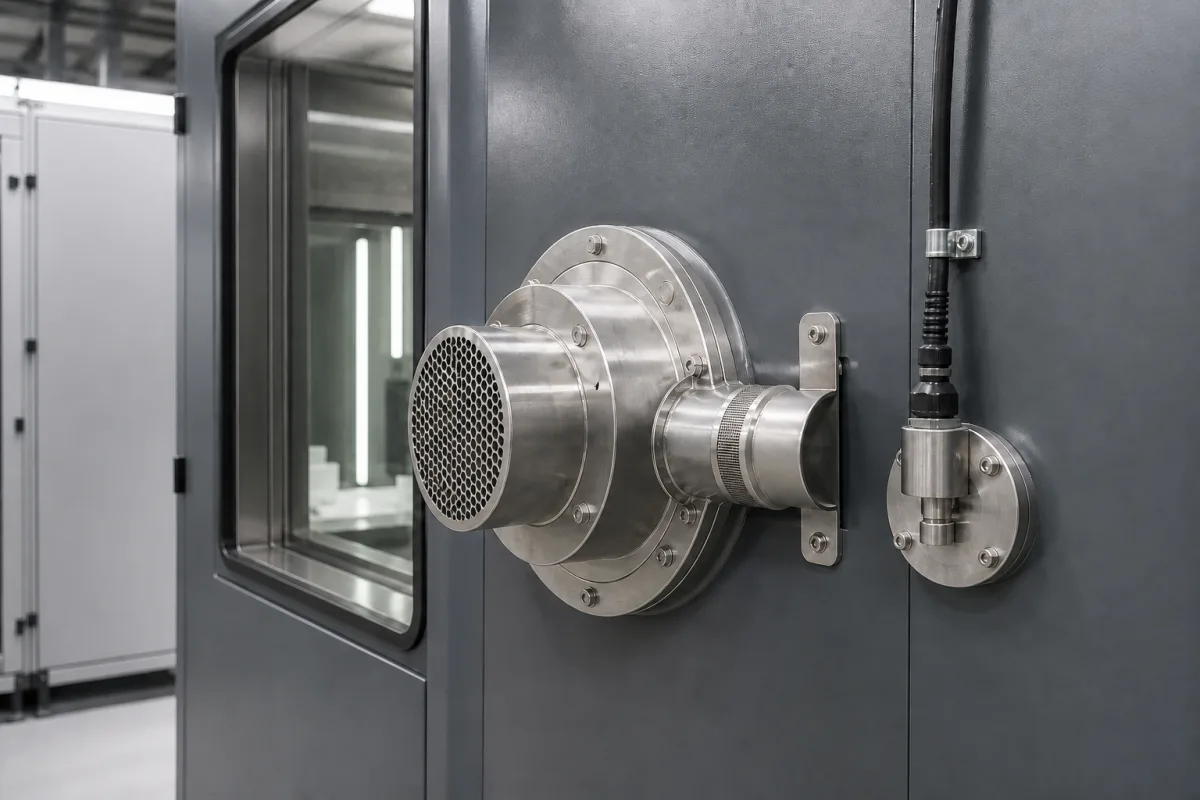
Ventilation & Gas Detection Port

Based on aggregated insights from multiple verified factory profiles within the CNFX directory, the standard Ventilation & Gas Detection Port used in the Electrical Equipment Manufacturing sector typically supports operational capacities ranging from standard industrial configurations to heavy-duty production requirements.

Technical Definition & Core Assembly

A canonical Ventilation & Gas Detection Port is characterized by the integration of Ventilation Flange and Gas Sensor Array. In industrial production environments, manufacturers listed on CNFX commonly emphasize Stainless steel construction to support stable, high-cycle operation across diverse manufacturing scenarios.

A specialized port integrated into electrical testing chambers that provides controlled ventilation while monitoring for hazardous gases.

Product Specifications

Technical details and manufacturing context for Ventilation & Gas Detection Port

Definition
A critical safety component of electrical testing chambers that serves dual functions: (1) providing controlled air exchange to maintain proper atmospheric conditions within the chamber, and (2) continuously monitoring for potentially hazardous gases that may be generated during electrical testing procedures, such as ozone, sulfur hexafluoride decomposition products, or other byproducts of electrical arcing and insulation breakdown.
Working Principle
The port combines ventilation ducting with integrated gas sensors. Air flows through the port via controlled ventilation systems, while gas detection sensors (typically electrochemical, infrared, or semiconductor-based) continuously sample the air stream. When gas concentrations exceed safe thresholds, the system triggers alarms and may automatically initiate emergency ventilation protocols.
Common Materials
Stainless steel, High-density polyethylene, Sensor elements (electrochemical/IR)
Technical Parameters
  • Port diameter and flange dimensions for chamber integration (mm) Standard Spec
Components / BOM
  • Ventilation Flange
    Provides sealed interface between chamber wall and ventilation system
    Material: Stainless steel
  • Gas Sensor Array
    Detects and measures specific hazardous gases
    Material: Sensor-specific materials (electrochemical cells, IR optics)
  • Protective Grille
    Prevents foreign object entry while allowing airflow
    Material: Stainless steel mesh
Engineering Reasoning
0.5-2.0 m³/min airflow, 0-1000 ppm gas concentration detection
Airflow drops below 0.3 m³/min or gas detection latency exceeds 30 seconds
Design Rationale: Particulate accumulation on sensor membranes reduces gas diffusion rates below Fick's Law thresholds (D<1×10⁻⁵ m²/s)
Risk Mitigation (FMEA)
Trigger Condensation formation at dew point (20°C, 60% RH)
Mode: Electrochemical sensor electrolyte dilution
Strategy: Integrated Peltier dehumidifier maintaining 40% RH
Trigger Electromagnetic interference from 50 kV/m fields
Mode: Hall effect sensor signal distortion
Strategy: Mu-metal shielding with 80 dB attenuation at 1 MHz

Industry Taxonomies & Aliases

Commonly used trade names and technical identifiers for Ventilation & Gas Detection Port.

Applied To / Applications

This component is essential for the following industrial systems and equipment:

Industrial Ecosystem & Supply Chain DNA

Complementary Systems
Downstream Applications
Specialized Tooling

Application Fit & Sizing Matrix

Operational Limits
pressure: 0 to 1.5 bar
flow rate: 5 to 50 m³/h
temperature: -20°C to +80°C
slurry concentration: Not applicable (gas phase only)
Media Compatibility
✓ Inert gases (N₂, Ar) ✓ Corrosive gases (Cl₂, SO₂) ✓ Combustible gases (CH₄, H₂)
Unsuitable: High-particulate environments (>100 mg/m³)
Sizing Data Required
  • Chamber volume (m³)
  • Required air changes per hour (ACH)
  • Target gas detection sensitivity (ppm)

Reliability & Engineering Risk Analysis

Failure Mode & Root Cause
Sensor drift or calibration loss
Cause: Exposure to harsh chemicals, moisture ingress, or prolonged operation without recalibration leading to inaccurate gas concentration readings
Port blockage or fouling
Cause: Accumulation of dust, debris, or particulate matter in the ventilation port, restricting airflow and impairing gas detection response
Maintenance Indicators
  • Audible alarm or flashing indicator signaling gas detection failure or sensor fault
  • Visible accumulation of debris or corrosion around the port, or inconsistent airflow measurements
Engineering Tips
  • Implement a scheduled calibration and bump-testing program using certified gas standards to ensure sensor accuracy and reliability
  • Install protective screens or filters on the port and establish routine cleaning protocols to prevent blockage and maintain optimal airflow

Compliance & Manufacturing Standards

Reference Standards
ISO 10156:2017 - Gases and gas mixtures ANSI/ISA 12.12.01-2018 - Electrical Equipment for Hazardous Locations DIN EN 60079-29-1:2017 - Gas detectors
Manufacturing Precision
  • Thread pitch tolerance: +/-0.05mm per thread
  • Port sealing surface flatness: 0.08mm maximum deviation
Quality Inspection
  • Helium leak test at 1.5 times working pressure
  • Gas detection response time verification test

Factories Producing Ventilation & Gas Detection Port

Verified manufacturers with capability to produce this product in China

✓ 93% Supplier Capability Match Found

P Project Engineer from Germany Jan 29, 2026
★★★★★
"The technical documentation for this Ventilation & Gas Detection Port is very thorough, especially regarding technical reliability."
Technical Specifications Verified
S Sourcing Manager from Brazil Jan 26, 2026
★★★★★
"Reliable performance in harsh Electrical Equipment Manufacturing environments. No issues with the Ventilation & Gas Detection Port so far."
Technical Specifications Verified
P Procurement Specialist from Canada Jan 23, 2026
★★★★★
"Testing the Ventilation & Gas Detection Port now; the technical reliability results are within 1% of the laboratory datasheet."
Technical Specifications Verified
Verification Protocol

“Feedback is collected from verified sourcing managers during RFQ (Request for Quote) and factory evaluation processes on CNFX. These reports represent historical performance data and technical audit summaries from our B2B manufacturing network.”

9 sourcing managers are analyzing this specification now. Last inquiry for Ventilation & Gas Detection Port from USA (1h ago).

Supply Chain Compatible Machinery & Devices

Circuit Breaker Trip Unit

Protective control module for electrical circuit breakers

Explore Specs →
Circuit Breaker Arc Chute

Electrical component that extinguishes arcs in circuit breakers

Explore Specs →
Medium Voltage Switchgear Assembly Line

Automated production system for assembling medium voltage electrical switchgear.

Explore Specs →
Motor Terminal Block

Electrical connection interface for motor windings

Explore Specs →

Frequently Asked Questions

What gases can this ventilation and detection port monitor?

The port monitors common hazardous gases found in electrical testing environments including hydrogen, methane, carbon monoxide, and volatile organic compounds using electrochemical or IR sensor elements.

How does this port maintain safety during electrical equipment testing?

It provides controlled ventilation to prevent gas buildup while continuously monitoring for hazardous concentrations, triggering alarms or automatic shutdowns when dangerous levels are detected to prevent explosions or equipment damage.

What maintenance is required for the gas detection components?

Sensor elements typically require calibration every 6-12 months and replacement every 2-3 years depending on usage. The stainless steel and HDPE construction requires minimal maintenance beyond routine cleaning.

Can I contact factories directly on CNFX?

CNFX is an open directory, not a transaction platform. Each factory profile provides direct contact information and production details to help you initiate direct inquiries with Chinese suppliers.

Get Quote for Ventilation & Gas Detection Port

Request technical pricing, lead times, or customized specifications for Ventilation & Gas Detection Port directly from verified manufacturing units.

Your business information is encrypted and only shared with verified Ventilation & Gas Detection Port suppliers.

Thank you! Your message has been sent. We'll respond within 1–3 business days.

Need to Manufacture Ventilation & Gas Detection Port?

Connect with verified factories specializing in this product category

Add Your Factory Contact Us
Previous Product
Valve Drive Circuit
Next Product
Ventilation Fan