Metal-oxide gas sensor arrays for indoor air: four-element, two-pixel and temperature-scanned chips read as one pattern for VOC, NOx and air-quality indices
Indoor-air sensing from two or more metal-oxide elements read together · four hotplates on one chip, a VOC pixel beside a NOx pixel, or one hotplate stepped through ten temperatures, and the indices, warm-up and current that come with each
A single metal-oxide gas sensor answers one question: did the resistance of its heated film change? It cannot say much about which gas caused it, because a heated metal-oxide film responds to a whole range of gases; ScioSense, for example, lists ethanol, toluene, hydrogen and oxidising gases for the elements of one chip. An array answers that by reading more than one response at once. The array can be physical, with two or more sensing films on separate hotplates, or virtual, with one film held at a series of temperatures so that each gas leaves a different pattern across the steps. The on-chip or host algorithm then turns the pattern into an output a ventilation controller can use: a TVOC or VOC index, a NOx index, an equivalent CO₂ estimate or an air-quality class.
Metal-oxide (MOX) gas sensor arrays for indoor air quality: multi-element chips with independent hotplates, multi-pixel chips with separate VOC and NOx elements, and single-element chips scanned through heater temperature steps, with their outputs (TVOC, eCO₂, VOC and NOx indices, air-quality indices), start-up and warm-up behaviour, current draw and packages. Single sensing elements and modules by principle (MOS, electrochemical, NDIR) are covered on the Gas sensor page. Complete gas detectors, NDIR CO₂ sensors, particulate sensors and laboratory electronic-nose instruments are outside this page.
CNFX editorial research · Sources checked October 13, 2026 · 3 sources
Four hotplates, a VOC pixel beside a NOx pixel, or one hotplate at ten temperatures: three ways to build the array
The three chips below all sit in packages about 3 mm square, but they create their 'array' differently, and that decides which gases they separate and what they report.
Sensirion specifies the SGP41's ranges as ethanol in clean air from 0 to 1,000,000 ppb and NO₂ from 0 to 10,000 ppb, and a limit of detection for ethanol of less than 50 ppb or 10 % of the set point, whichever is larger, in a background of 500 ppb ethanol. [2] Bosch reports an F1 score of 0.94 for H₂S scanning in the standard configuration, which detects volatile sulphur compounds as an indicator of, for example, bacterial growth. [3]
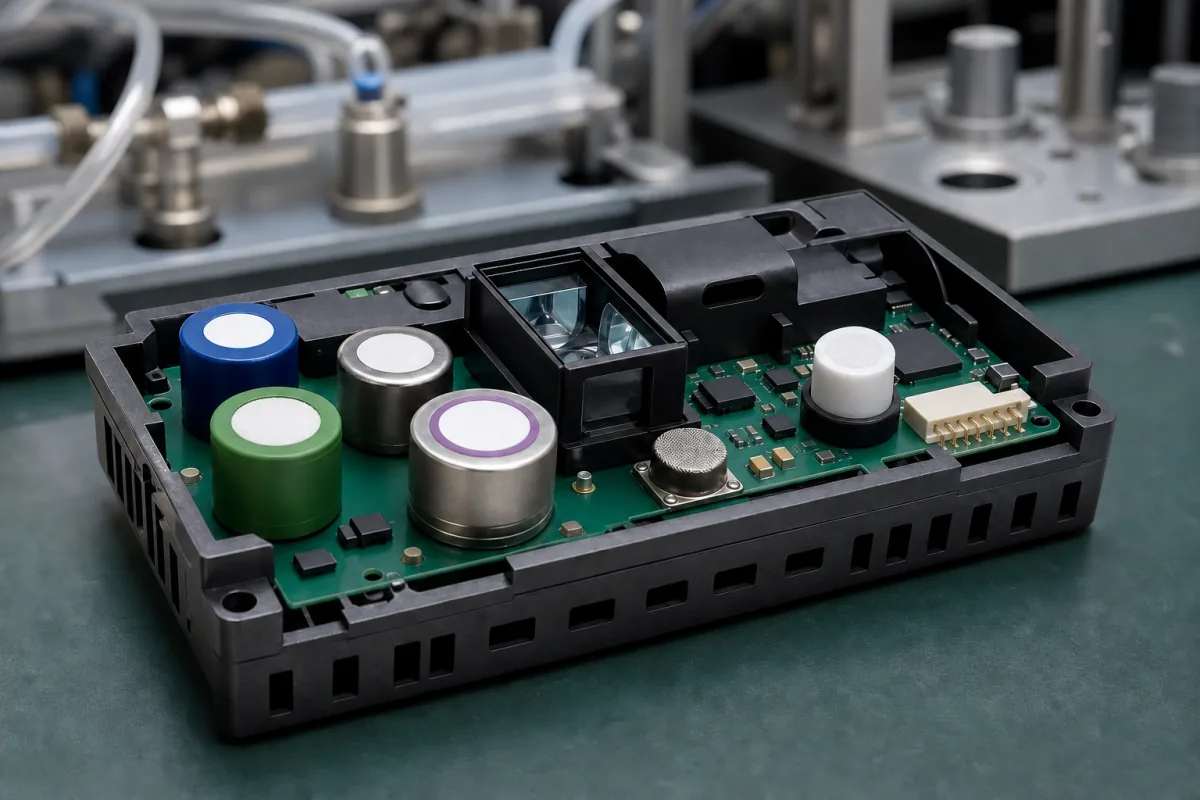
The picture above shows a different build of the same idea: a multi-gas board carrying a row of discrete sensors in cylindrical cans, an optical cell and a mesh-capped metal-oxide sensor side by side in a vented housing.
Chip
How the array is formed
Outputs
Package
ScioSense ENS160
Four independent heaters and gas-sensing elements; independent hotplate control for detecting VOCs including ethanol, toluene, hydrogen and oxidising gases [1]
TVOC 0–65,000 ppb; eCO₂ 400–65,000 ppm; AQI-UBA 1 to 5, all at resolution 1 [1]
One gas sensor hotplate run through up to 10 temperature steps and heating durations (G0–G9) in parallel mode, together with pressure, humidity and temperature sensing [3]
IAQ 0–500, bVOC- and CO₂-equivalents in ppm, gas-scan result in %; the gas scanner can be trained for an application with BME AI-Studio [3]
State the gases or events the product must separate (VOC, NOx, H₂S, CO₂ estimate), the output the controller needs (index, ppb, class), and whether the array may be trained on application data.
02
Start-up and power: 1 hour and 48 hours for ENS160, 60 seconds to 7 days for SGP41, 3.9 mA for a BME688 scan
Heated metal-oxide films settle after power-on, and each element of an array settles at its own rate. These figures decide when a product can show readings and how large its power budget must be.
Bosch gives the electric charge for a standard scan as 0.18 mAh for 5 scans, about one minute. [3] Sensirion recommends a 1 s sampling interval within a 0.5–10 s range and states that its limit-of-detection figures were tested over a simulated 10-year indoor lifetime of 200 h in 250 ppm of the siloxane D5. [2]
Editorial calculation: at 1.8 V the ENS160's 29 mA is about 52 mW (1.8 × 29), and the SGP41's 3.0 mA at 3.3 V about 10 mW (3.3 × 3.0), so the four-element chip draws roughly five times the power of the two-pixel one when running continuously. [1][2] On an assumed 1,000 mAh battery with no other load, the BME688's 3.9 mA standard scan would run about 256 hours, roughly 11 days (1,000 ÷ 3.9). [3]
Chip
Start-up and response
Current
ScioSense ENS160
Initial start-up after first power-on 1 hour; warm-up 3 minutes; immediate response (T63) 1 s; resistance change greatest in the first 48 hours, covered by a start-up algorithm [1]
29 mA average in STANDARD mode, 79 mA peak for under 5 ms, 0.01 mA in deep sleep; VDD 1.8 V [1]
Sensirion SGP41
Under 60 s until VOC or NOx events are detected reliably; VOC Index in spec after under 1.5 h, NOx Index after under 6 h, NOx raw signal after under 7 days; response under 10 s (VOC) and under 250 s (NOx); 10 s conditioning that must not be exceeded [2]
Explore company information and manufacturing capabilities, then discuss the scope of your project with a relevant supplier.
Share this page
Compiled and source-reviewed by the CNFX editorial team.
Each manufacturer above links to the page on that company's own website where the product is listed, with the date we checked it. How we source and review
· Page last updated 13 October 2026
Buyer questions
What is a gas sensor array?
Two or more gas-sensing responses read together: four independently heated MOX elements in ScioSense's ENS160, a VOC and a NOx pixel in Sensirion's SGP41, or one hotplate stepped through up to 10 temperatures in Bosch's BME688. [1][2][3]
What range does a MOX array report for TVOC?
The ENS160 reports TVOC from 0 to 65,000 ppb and eCO₂ from 400 to 65,000 ppm; the SGP41 reports VOC and NOx indices from 1 to 500. [1][2]
How long after power-on are readings valid?
ScioSense gives 3 minutes warm-up and 1 hour initial start-up for the ENS160; Sensirion gives under 60 s to detect events and under 1.5 h and 6 h for the VOC and NOx indices to meet specification. [1][2]
How much current do these arrays draw?
About 29 mA for the ENS160 in standard mode, 3.0 mA for the SGP41, and 3.9 mA for the BME688 in standard gas-scan mode. [1][2][3]
Sources and what still needs a direct check
Sources checked 2026-10-13. Three manufacturer datasheets: ScioSense ENS160, Sensirion SGP41 and Bosch Sensortec BME688.