Industry-Verified Manufacturing Data (2026)

Wire Guide Mechanism

Based on aggregated insights from multiple verified factory profiles within the CNFX directory, the standard Wire Guide Mechanism used in the Electrical Equipment Manufacturing sector typically supports operational capacities ranging from standard industrial configurations to heavy-duty production requirements.

Technical Definition & Core Assembly

A canonical Wire Guide Mechanism is characterized by the integration of Guide Nozzle/Tip and Guide Tube. In industrial production environments, manufacturers listed on CNFX commonly emphasize Stainless Steel construction to support stable, high-cycle operation across diverse manufacturing scenarios.

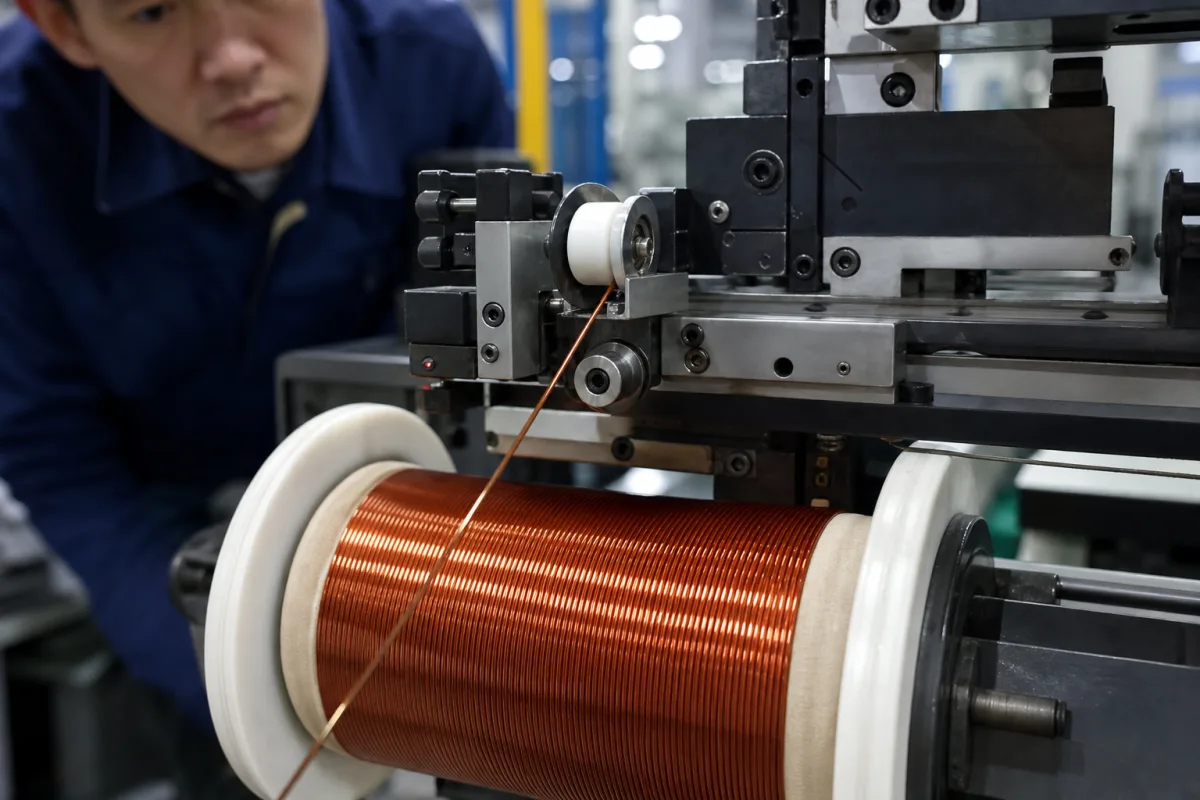
A precision mechanical component that guides and positions the wire during the winding process of a three-phase induction motor.
Product Specifications

Technical details and manufacturing context for Wire Guide Mechanism

Definition
The Wire Guide Mechanism is a critical sub-assembly within a Three-Phase Induction Motor Winding Machine. Its primary function is to accurately guide the enameled copper wire from the spool to the stator core, ensuring precise placement, consistent tension, and proper layering of the wire coils according to the motor's winding pattern. It directly influences the quality, consistency, and electrical performance of the finished motor windings.
Working Principle
The mechanism typically consists of a guide tube, rollers, or nozzles mounted on a movable carriage or arm. It follows a programmed path (often CNC-controlled) that corresponds to the stator slots. As the winding machine rotates the stator or moves the winding head, the guide precisely feeds the wire into the designated slots, controlling the wire's entry angle, tension, and layering to form the required coil configuration.
Common Materials
Stainless Steel, Hardened Tool Steel, Engineering Plastic (e.g., PEEK)
Technical Parameters
  • Wire diameter range the mechanism is designed to handle (e.g., 0.5mm - 2.0mm). (mm) Per Request
Components / BOM
  • Guide Nozzle/Tip
    The final contact point that directs the wire into the stator slot; often replaceable and sized for specific wire gauges.
    Material: Hardened Tool Steel or Ceramic
  • Guide Tube
    A rigid or flexible conduit that protects and channels the wire from the tensioner to the guide nozzle.
    Material: Stainless Steel or Nylon
  • Mounting Bracket/Carriage
    The structural frame that holds the guide assembly and attaches it to the winding machine's motion system (e.g., linear slide, robotic arm).
    Material: Aluminum Alloy or Steel
Engineering Reasoning
0.5-2.0 mm wire positioning tolerance, 0-150°C operating temperature, 0-1000 RPM rotational speed
Wire misalignment exceeding 2.5 mm tolerance, temperature exceeding 180°C, rotational speed exceeding 1200 RPM
Design Rationale: Thermal expansion coefficient mismatch (aluminum guide vs steel wire: α=23.1×10⁻⁶/K vs 11.0×10⁻⁶/K) causing binding, Hertzian contact stress exceeding yield strength (σ_y=250 MPa) at wire-guide interface
Risk Mitigation (FMEA)
Trigger Abrasive wear from copper wire surface roughness (Ra=1.6 μm) exceeding guide material hardness (HV=150)
Mode: Increased wire-guide clearance causing ±3 mm positional deviation
Strategy: Hardened ceramic coating (Al₂O₃, HV=1800) with 50 μm thickness on guide contact surfaces
Trigger Resonant vibration at 850 Hz matching guide natural frequency
Mode: Amplitude magnification factor of 8 causing guide fracture at stress concentration points
Strategy: Stiffness tuning via ribbed structure increasing moment of inertia by 40%, damping ratio ξ=0.15 via viscoelastic polymer inserts

Industry Taxonomies & Aliases

Commonly used trade names and technical identifiers for Wire Guide Mechanism.

Industrial Ecosystem & Supply Chain DNA

Complementary Systems
Downstream Applications
Specialized Tooling

Application Fit & Sizing Matrix

Operational Limits
pressure: Atmospheric to 1.5 bar
other spec: Wire tension: 0.5-15 N, Wire speed: 0.1-5 m/s
temperature: -20°C to 120°C
Media Compatibility
✓ Copper magnet wire ✓ Aluminum magnet wire ✓ Enamel-coated wire
Unsuitable: Abrasive or corrosive wire coatings
Sizing Data Required
  • Wire diameter range (mm)
  • Maximum winding speed (RPM)
  • Required positioning accuracy (mm)

Reliability & Engineering Risk Analysis

Failure Mode & Root Cause
Misalignment-induced wear
Cause: Improper installation or thermal expansion causing guide rollers/pulleys to deviate from optimal wire path, leading to accelerated abrasive wear on contact surfaces and potential wire damage.
Bearing degradation
Cause: Contamination ingress (dust, moisture) or inadequate lubrication in guide roller bearings, resulting in increased friction, overheating, and eventual seizure or excessive play.
Maintenance Indicators
  • Abnormal audible vibration or grinding noise during operation
  • Visible wire scoring, fraying, or inconsistent tracking through the guide path
Engineering Tips
  • Implement laser alignment checks during installation and periodic inspections to ensure guide rollers/pulleys maintain precise parallelism and perpendicularity to the wire path.
  • Establish a preventive lubrication schedule using manufacturer-specified greases and install protective seals or covers to minimize contamination ingress in bearing assemblies.

Compliance & Manufacturing Standards

Reference Standards
ISO 2768-1: General tolerances for linear and angular dimensions ANSI B4.1: Preferred Limits and Fits for Cylindrical Parts DIN 7184: Wire guides and wire guide systems for welding and cutting
Manufacturing Precision
  • Bore diameter: +/-0.01mm
  • Parallelism of guide surfaces: 0.05mm over 100mm length
Quality Inspection
  • Dimensional verification with coordinate measuring machine (CMM)
  • Surface roughness measurement per ISO 4287

Factories Producing Wire Guide Mechanism

Verified manufacturers with capability to produce this product in China

✓ 98% Supplier Capability Match Found

T Technical Director from Singapore Jan 22, 2026
★★★★★
"Found 28+ suppliers for Wire Guide Mechanism on CNFX, but this spec remains the most cost-effective."
Technical Specifications Verified
P Project Engineer from Germany Jan 19, 2026
★★★★☆
"The technical documentation for this Wire Guide Mechanism is very thorough, especially regarding technical reliability. (Delivery took slightly longer than expected, but technical support was excellent.)"
Technical Specifications Verified
S Sourcing Manager from Brazil Jan 16, 2026
★★★★★
"Reliable performance in harsh Electrical Equipment Manufacturing environments. No issues with the Wire Guide Mechanism so far."
Technical Specifications Verified
Verification Protocol

“Feedback is collected from verified sourcing managers during RFQ (Request for Quote) and factory evaluation processes on CNFX. These reports represent historical performance data and technical audit summaries from our B2B manufacturing network.”

17 sourcing managers are analyzing this specification now. Last inquiry for Wire Guide Mechanism from Mexico (13m ago).

Supply Chain Compatible Machinery & Devices

Circuit Breaker Arc Chute

Electrical component that extinguishes arcs in circuit breakers

Explore Specs →
Medium Voltage Switchgear Assembly Line

Automated production system for assembling medium voltage electrical switchgear.

Explore Specs →
Motor Terminal Block

Electrical connection interface for motor windings

Explore Specs →
PLC Control System

A digital industrial computer control system that monitors inputs, makes decisions based on a custom program, and controls outputs to automate industrial processes.

Explore Specs →

Frequently Asked Questions

What materials are best for wire guide mechanisms in high-volume motor production?

For high-volume production, hardened tool steel offers excellent wear resistance, while stainless steel provides corrosion resistance. Engineering plastics like PEEK are ideal for applications requiring electrical insulation and reduced friction.

How does the wire guide mechanism improve three-phase motor winding accuracy?

The mechanism precisely positions and guides the wire during winding, ensuring consistent layering and tension. This reduces defects, improves motor efficiency, and enhances overall performance in electrical equipment manufacturing.

What maintenance is required for wire guide components in continuous operation?

Regular inspection for wear on guide nozzles and tubes is recommended. Lubrication may be needed for moving parts like carriages, while plastic components should be checked for deformation. Proper alignment ensures longevity and consistent performance.

Can I contact factories directly on CNFX?

CNFX is an open directory, not a transaction platform. Each factory profile provides direct contact information and production details to help you initiate direct inquiries with Chinese suppliers.

Get Quote for Wire Guide Mechanism

Request technical pricing, lead times, or customized specifications for Wire Guide Mechanism directly from verified manufacturing units.

Your business information is encrypted and only shared with verified Wire Guide Mechanism suppliers.

Thank you! Your message has been sent. We'll respond within 1–3 business days.

Need to Manufacture Wire Guide Mechanism?

Connect with verified factories specializing in this product category

Add Your Factory Contact Us
Previous Product
Wire Feeder Mechanism
Next Product
Wire Guide System