Industry-Verified Manufacturing Data (2026)

Wire Feeder Mechanism

Based on aggregated insights from multiple verified factory profiles within the CNFX directory, the standard Wire Feeder Mechanism used in the Electrical Equipment Manufacturing sector typically supports operational capacities ranging from standard industrial configurations to heavy-duty production requirements.

Technical Definition & Core Assembly

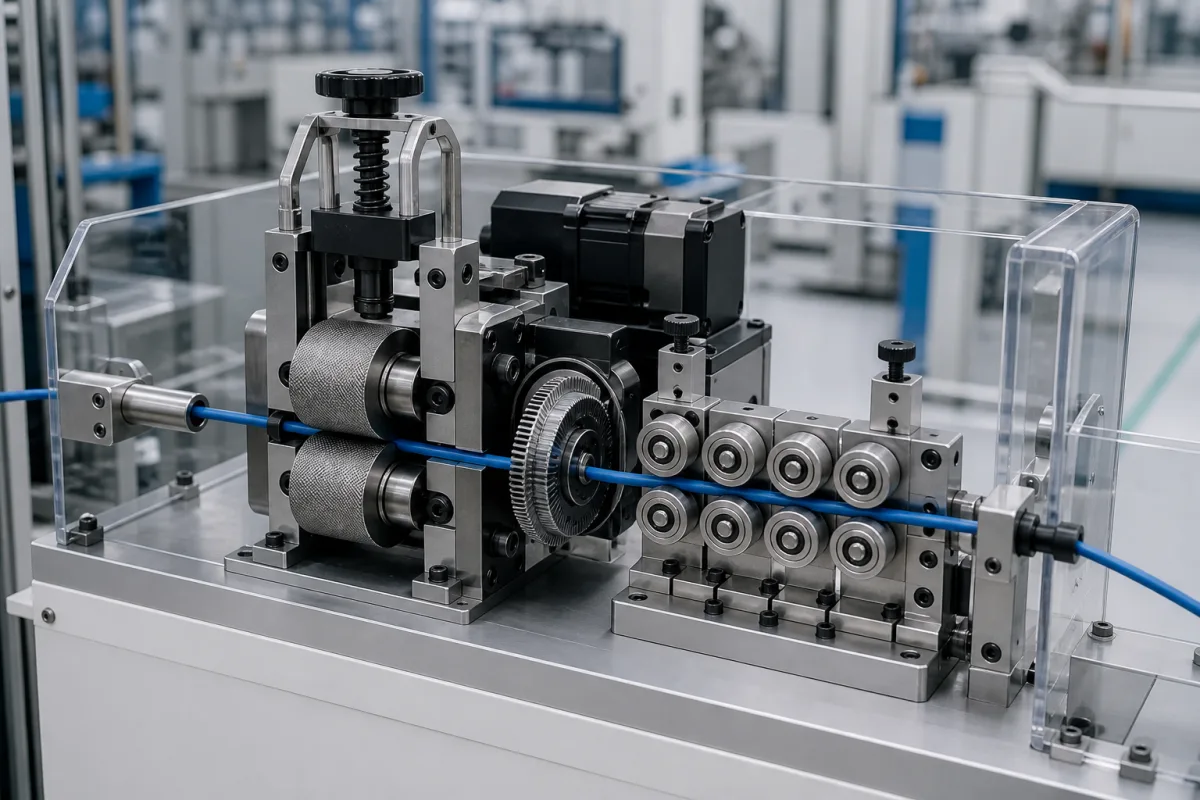
A canonical Wire Feeder Mechanism is characterized by the integration of Drive Motor and Feed Rollers / Pinch Wheels. In industrial production environments, manufacturers listed on CNFX commonly emphasize Steel (for rollers and frame) construction to support stable, high-cycle operation across diverse manufacturing scenarios.

A mechanical subsystem responsible for precisely advancing wire from a spool or reel into the processing zone of an automated wire stripping and termination machine.

Product Specifications

Technical details and manufacturing context for Wire Feeder Mechanism

Definition
The Wire Feeder Mechanism is a critical component within an Automated Wire Stripping and Termination Machine. Its primary role is to control the feed of wire from a source (such as a spool) into the machine's processing stages (stripping, cutting, crimping). It ensures consistent, accurate, and reliable wire advancement at a controlled speed and length, which is fundamental to the machine's overall precision, repeatability, and automation efficiency. It interfaces directly with the machine's control system and other components like cutters and strippers.
Working Principle
Typically, the mechanism uses a set of motor-driven rollers or pinch wheels. The wire is guided between these rollers. When activated by the machine's controller, the motor rotates the drive roller(s), which grip the wire via friction or a grooved profile and pull it forward from the supply spool. A servo or stepper motor is often used to allow for precise control over the feed length and speed. Some systems may incorporate sensors to detect wire presence, tension, or end-of-spool conditions.
Common Materials
Steel (for rollers and frame), Aluminum (for lightweight structural parts), Polyurethane or Rubber (for roller surfaces), Engineering Plastics (for guides and bushings)
Technical Parameters
  • Maximum wire diameter capacity (e.g., 0.1mm to 10mm) (mm) Per Request
Components / BOM
  • Drive Motor
    Provides the rotational power to advance the wire. Often a servo or stepper motor for precise control.
    Material: Various (motor housing: steel/aluminum; internal: copper windings, magnets)
  • Feed Rollers / Pinch Wheels
    The primary contact points that grip and pull the wire. Often one is driven, and the other is an idler or spring-loaded for adjustable pressure.
    Material: Steel core with polyurethane or rubber coating
  • Wire Guide / Straightener
    A channel or set of bushings that aligns the wire from the spool into the feed rollers and removes coil memory.
    Material: Hardened steel or ceramic
  • Tensioning System
    Maintains consistent, slight tension on the wire between the spool and feed rollers to prevent slack or over-pull.
    Material: Springs, dampers, various metals
Engineering Reasoning
0.5-5.0 N·m torque at 100-500 mm/s linear feed rate
Wire slippage occurs at >0.15 mm positional deviation from programmed path, or >10% torque variation from setpoint
Design Rationale: Coulomb friction coefficient degradation between drive rollers and wire surface due to particulate contamination accumulation exceeding 50 μm layer thickness
Risk Mitigation (FMEA)
Trigger Stepper motor microstepping resolution loss from 0.9° to 1.8° per step due to driver IC thermal drift
Mode: Feed length inaccuracy accumulating to ±2 mm error over 100 cycles
Strategy: Closed-loop optical encoder feedback with 0.01 mm resolution and PID compensation at 1 kHz sampling rate
Trigger Drive roller surface hardness reduction from 60 HRC to 45 HRC due to abrasive wear from copper wire oxides
Mode: Wire deformation exceeding 0.1 mm diameter compression causing termination crimp failure
Strategy: Tungsten carbide roller coating with 2000 HV hardness and automated surface inspection every 10⁶ cycles

Industry Taxonomies & Aliases

Commonly used trade names and technical identifiers for Wire Feeder Mechanism.

Industrial Ecosystem & Supply Chain DNA

Complementary Systems
Downstream Applications
Specialized Tooling

Application Fit & Sizing Matrix

Operational Limits
pressure: Ambient atmospheric pressure only
feed speed: 0.1 m/min to 30 m/min
temperature: 0°C to 50°C (operating), -20°C to 70°C (storage)
wire tension: 0.5 N to 20 N (adjustable)
wire diameter range: 0.05 mm to 6.0 mm
Media Compatibility
✓ Copper wire (solid/stranded) ✓ Aluminum wire ✓ Tinned copper wire
Unsuitable: Abrasive or corrosive wire coatings (e.g., fiberglass, heavily oxidized surfaces)
Sizing Data Required
  • Wire diameter and material type
  • Required feed speed and acceleration profile
  • Wire spool/reel dimensions and weight

Reliability & Engineering Risk Analysis

Failure Mode & Root Cause
Wire feed motor burnout
Cause: Excessive friction from misaligned drive rolls, worn liners, or debris buildup causing motor overload and overheating
Drive roll slippage and inconsistent wire feed
Cause: Worn or contaminated drive roll surfaces, improper roll tension adjustment, or liner obstruction creating irregular wire advancement
Maintenance Indicators
  • Erratic wire feed speed with audible motor strain or clicking sounds
  • Visible wire shavings accumulation around drive assembly or liner entry points
Engineering Tips
  • Implement regular drive roll inspection and replacement schedule based on wire tonnage, ensuring proper tension calibration with manufacturer specifications
  • Establish preventive liner replacement intervals and maintain clean, debris-free wire path with proper spool alignment to reduce friction forces

Compliance & Manufacturing Standards

Reference Standards
ISO 9001:2015 Quality Management Systems ANSI/AWS D17.1/D17.1M:2017 Specification for Fusion Welding for Aerospace Applications CE Marking (EU Machinery Directive 2006/42/EC)
Manufacturing Precision
  • Drive Roll Bore Diameter: +/-0.01mm
  • Wire Guide Alignment: 0.05mm concentricity
Quality Inspection
  • Dimensional Verification with CMM (Coordinate Measuring Machine)
  • Functional Performance Test under Load Conditions

Factories Producing Wire Feeder Mechanism

Verified manufacturers with capability to produce this product in China

✓ 95% Supplier Capability Match Found

S Sourcing Manager from Brazil Feb 09, 2026
★★★★★
"Standard OEM quality for Electrical Equipment Manufacturing applications. The Wire Feeder Mechanism arrived with full certification."
Technical Specifications Verified
P Procurement Specialist from Canada Feb 06, 2026
★★★★☆
"Great transparency on the Wire Feeder Mechanism components. Essential for our Electrical Equipment Manufacturing supply chain. (Delivery took slightly longer than expected, but technical support was excellent.)"
Technical Specifications Verified
T Technical Director from United States Feb 03, 2026
★★★★★
"The Wire Feeder Mechanism we sourced perfectly fits our Electrical Equipment Manufacturing production line requirements."
Technical Specifications Verified
Verification Protocol

“Feedback is collected from verified sourcing managers during RFQ (Request for Quote) and factory evaluation processes on CNFX. These reports represent historical performance data and technical audit summaries from our B2B manufacturing network.”

16 sourcing managers are analyzing this specification now. Last inquiry for Wire Feeder Mechanism from Poland (1h ago).

Supply Chain Compatible Machinery & Devices

Circuit Breaker Arc Chute

Electrical component that extinguishes arcs in circuit breakers

Explore Specs →
Medium Voltage Switchgear Assembly Line

Automated production system for assembling medium voltage electrical switchgear.

Explore Specs →
Motor Terminal Block

Electrical connection interface for motor windings

Explore Specs →
PLC Control System

A digital industrial computer control system that monitors inputs, makes decisions based on a custom program, and controls outputs to automate industrial processes.

Explore Specs →

Frequently Asked Questions

What materials are used in the wire feeder mechanism construction?

The mechanism uses steel for rollers and frame components, aluminum for lightweight structural parts, polyurethane or rubber for roller surfaces, and engineering plastics for guides and bushings to ensure durability and precise wire handling.

What components are included in the wire feeder BOM?

The bill of materials includes a drive motor for controlled advancement, feed rollers/pinch wheels for gripping wire, a tensioning system to maintain proper wire tension, and wire guides/straighteners to ensure smooth, aligned feeding into processing equipment.

How does this wire feeder mechanism improve automated wire processing?

It provides precise, consistent wire advancement from spools into stripping and termination machines, reducing wire waste, preventing jams, and ensuring accurate positioning for reliable automated electrical equipment manufacturing.

Can I contact factories directly on CNFX?

CNFX is an open directory, not a transaction platform. Each factory profile provides direct contact information and production details to help you initiate direct inquiries with Chinese suppliers.

Get Quote for Wire Feeder Mechanism

Request technical pricing, lead times, or customized specifications for Wire Feeder Mechanism directly from verified manufacturing units.

Your business information is encrypted and only shared with verified Wire Feeder Mechanism suppliers.

Thank you! Your message has been sent. We'll respond within 1–3 business days.

Need to Manufacture Wire Feeder Mechanism?

Connect with verified factories specializing in this product category

Add Your Factory Contact Us
Previous Product
Wire Feed Mechanism
Next Product
Wire Guide Mechanism