Industry-Verified Manufacturing Data (2026)

Door Panel

Based on aggregated insights from multiple verified factory profiles within the CNFX directory, the standard Door Panel used in the Fabricated Metal Product Manufacturing sector typically supports operational capacities ranging from standard industrial configurations to heavy-duty production requirements.

Technical Definition & Core Assembly

A canonical Door Panel is characterized by the integration of Outer Skin and Inner Skin. In industrial production environments, manufacturers listed on CNFX commonly emphasize Insulated Metal Composite Panel (e.g., steel skin with polyurethane foam core) construction to support stable, high-cycle operation across diverse manufacturing scenarios.

The primary structural and insulating element of an insulated chamber door.

Product Specifications

Technical details and manufacturing context for Door Panel

Definition
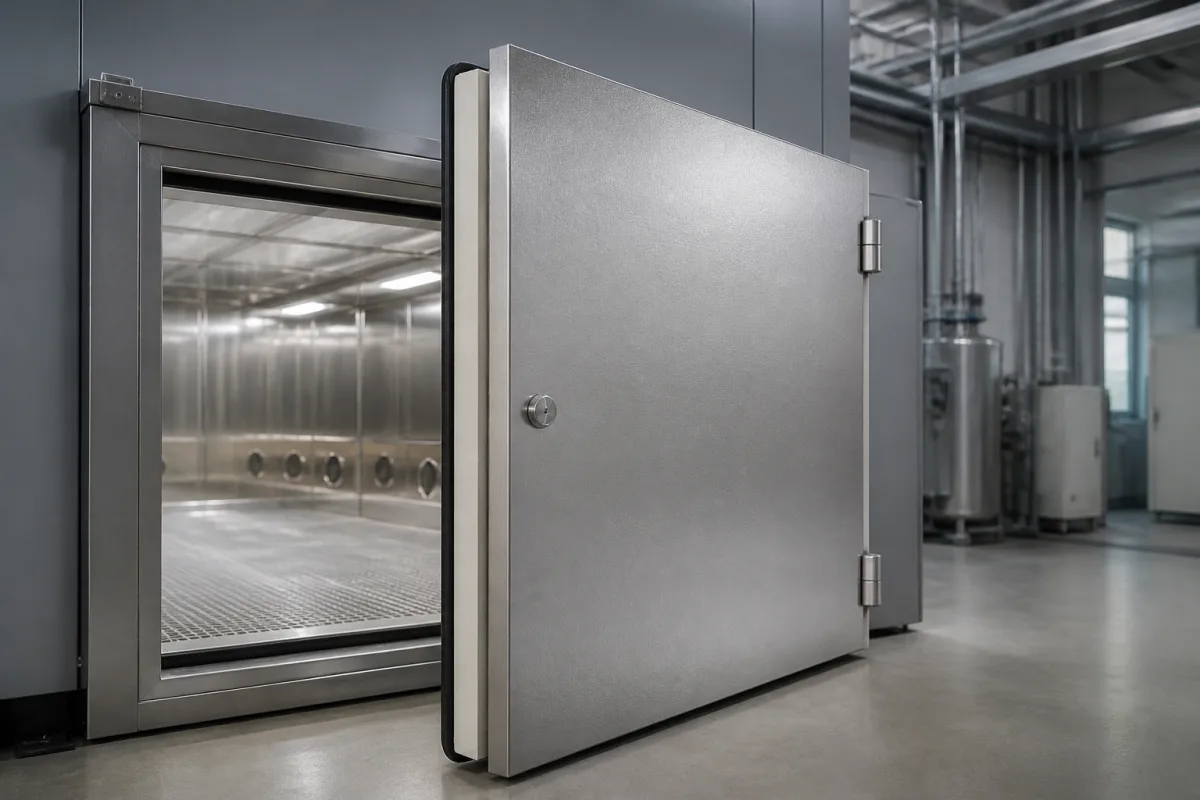
A door panel is the main body component of an insulated chamber door, forming the barrier that seals the chamber opening. It provides structural integrity, thermal insulation, and often incorporates sealing surfaces to prevent heat transfer, air leakage, or contamination between the chamber interior and the external environment.
Working Principle
The door panel functions as a static barrier. Its core provides thermal resistance (insulation), while its faces provide a rigid, often smooth, surface. When the door is closed, the panel's edges mate with the door frame seals, creating an airtight and thermally insulated closure for the chamber.
Common Materials
Insulated Metal Composite Panel (e.g., steel skin with polyurethane foam core), Stainless Steel, Galvanized Steel
Technical Parameters
  • Overall thickness of the door panel, critical for structural strength and insulation value (R-value/U-value). (mm) Per Request
Components / BOM
  • Outer Skin
    Provides the external protective and aesthetic surface; often corrosion-resistant.
    Material: Stainless Steel or Powder-Coated Steel
  • Inner Skin
    Provides the internal surface facing the chamber; often smooth and easy to clean.
    Material: Stainless Steel
  • Insulation Core
    Provides thermal resistance to minimize heat transfer through the door.
    Material: Polyisocyanurate (PIR) Foam or similar rigid foam
  • Edge Banding/Frame
    Encases the panel edges, provides structural rigidity, and forms the sealing surface.
    Material: Galvanized Steel or Aluminum
Engineering Reasoning
0-150°C temperature differential, 0-2.5 kPa pressure differential
Structural failure occurs at 3.0 kPa pressure differential or 200°C temperature differential
Design Rationale: Thermal stress-induced material fatigue exceeding yield strength of 250 MPa in polyurethane foam core at 200°C ΔT, combined with buckling failure of 1.2 mm steel skin at 3.0 kPa pressure
Risk Mitigation (FMEA)
Trigger Moisture ingress exceeding 5% by volume in polyurethane foam insulation
Mode: Thermal conductivity increase from 0.022 W/m·K to 0.045 W/m·K, causing 15°C temperature rise across panel
Strategy: Continuous perimeter seal with 3 mm EPDM gasket rated for 100,000 compression cycles at -40°C to 120°C
Trigger Cyclic mechanical loading exceeding 10⁶ cycles at 1.5 Hz frequency
Mode: Hinge mounting point fatigue crack propagation at 0.1 mm/cycle rate in 2.0 mm galvanized steel
Strategy: Reinforced mounting bracket with 4 mm steel plate and 8× M8 grade 8.8 bolts at 25 N·m torque

Industry Taxonomies & Aliases

Commonly used trade names and technical identifiers for Door Panel.

Applied To / Applications

This component is essential for the following industrial systems and equipment:

Industrial Ecosystem & Supply Chain DNA

Complementary Systems
Downstream Applications
Specialized Tooling

Application Fit & Sizing Matrix

Operational Limits
pressure: 0 to 0.5 bar differential
other spec: Max wind load: 150 km/h, Insulation R-value: ≥5.0 m²·K/W
temperature: -40°C to +120°C
Media Compatibility
✓ Food processing environments ✓ Pharmaceutical cleanrooms ✓ Industrial cold storage
Unsuitable: Continuous high-pressure washdown (>10 bar)
Sizing Data Required
  • Door opening dimensions (width × height)
  • Required thermal insulation performance (U-value)
  • Structural load requirements (including seismic zone if applicable)

Reliability & Engineering Risk Analysis

Failure Mode & Root Cause
Hinge wear and misalignment
Cause: Repeated cyclic loading from opening/closing cycles leading to material fatigue, lack of lubrication, or improper installation causing uneven stress distribution
Panel delamination or corrosion
Cause: Environmental exposure to moisture, chemicals, or temperature fluctuations compromising adhesive bonds or protective coatings, leading to material degradation
Maintenance Indicators
  • Audible squeaking, grinding, or popping sounds during operation indicating hinge wear or structural stress
  • Visible misalignment, sagging, or difficulty in latching/closing suggesting hinge failure or frame deformation
Engineering Tips
  • Implement regular lubrication schedules for hinges and moving parts using manufacturer-recommended lubricants to reduce friction and wear
  • Establish periodic inspection protocols for alignment, fasteners, and surface integrity, with prompt correction of minor issues before they escalate

Compliance & Manufacturing Standards

Reference Standards
ISO 9001:2015 - Quality management systems ANSI/BHMA A156.115 - Hardware for sliding doors DIN 18111 - Doors; concepts, requirements, testing
Manufacturing Precision
  • Panel thickness: +/-0.5mm
  • Door width/height: +/-2.0mm
Quality Inspection
  • Dimensional verification with calipers/gauges
  • Surface finish inspection for defects (visual/gloss meter)

Factories Producing Door Panel

Verified manufacturers with capability to produce this product in China

✓ 94% Supplier Capability Match Found

S Sourcing Manager from United Arab Emirates Jan 04, 2026
★★★★★
"Found 26+ suppliers for Door Panel on CNFX, but this spec remains the most cost-effective."
Technical Specifications Verified
P Procurement Specialist from Australia Jan 01, 2026
★★★★☆
"The technical documentation for this Door Panel is very thorough, especially regarding technical reliability. (Delivery took slightly longer than expected, but technical support was excellent.)"
Technical Specifications Verified
T Technical Director from Singapore Dec 29, 2025
★★★★★
"Reliable performance in harsh Fabricated Metal Product Manufacturing environments. No issues with the Door Panel so far."
Technical Specifications Verified
Verification Protocol

“Feedback is collected from verified sourcing managers during RFQ (Request for Quote) and factory evaluation processes on CNFX. These reports represent historical performance data and technical audit summaries from our B2B manufacturing network.”

19 sourcing managers are analyzing this specification now. Last inquiry for Door Panel from Vietnam (1h ago).

Supply Chain Compatible Machinery & Devices

Metal Plate Rolling Machine

Industrial machine for bending metal plates into cylindrical or conical shapes

Explore Specs →
Hydraulic Cylinder Piston Rod

Precision-machined rod that transmits force in hydraulic cylinders.

Explore Specs →
Metal Plate Bending Machine

Industrial machine for bending metal plates into angular shapes

Explore Specs →
Industrial Tube Bending Machine

CNC-controlled machine for precision bending of metal tubes and pipes

Explore Specs →

Frequently Asked Questions

What are the primary benefits of using an insulated metal composite panel for door construction?

Insulated metal composite panels provide excellent thermal insulation, structural strength, and durability. The steel skins offer impact resistance while the polyurethane foam core minimizes heat transfer, making them ideal for temperature-controlled chambers and industrial environments.

What materials are available for the door panel skins and how do they differ?

We offer stainless steel for corrosion resistance in harsh environments, galvanized steel for cost-effective protection against rust, and other coated steel options. Stainless steel provides superior longevity in wet or chemical-exposed applications, while galvanized steel offers reliable performance at a lower cost.

Can door panels be customized for specific chamber door applications?

Yes, our door panels are fully customizable in dimensions, material specifications, and edge banding configurations. We can accommodate various thicknesses, insulation densities, and specialized frame designs to meet specific thermal, structural, and dimensional requirements for your fabricated metal product applications.

Can I contact factories directly on CNFX?

CNFX is an open directory, not a transaction platform. Each factory profile provides direct contact information and production details to help you initiate direct inquiries with Chinese suppliers.

Get Quote for Door Panel

Request technical pricing, lead times, or customized specifications for Door Panel directly from verified manufacturing units.

Your business information is encrypted and only shared with verified Door Panel suppliers.

Thank you! Your message has been sent. We'll respond within 1–3 business days.

Need to Manufacture Door Panel?

Connect with verified factories specializing in this product category

Add Your Factory Contact Us
Previous Product
Door Assembly
Next Product
Ejector System