Industry-Verified Manufacturing Data (2026)

Insulated Chamber Door

Based on aggregated insights from multiple verified factory profiles within the CNFX directory, the standard Insulated Chamber Door used in the Machinery and Equipment Manufacturing sector typically supports operational capacities ranging from standard industrial configurations to heavy-duty production requirements.

Technical Definition & Core Assembly

A canonical Insulated Chamber Door is characterized by the integration of Door Panel and Sealing Gasket. In industrial production environments, manufacturers listed on CNFX commonly emphasize Stainless Steel (Frame) construction to support stable, high-cycle operation across diverse manufacturing scenarios.

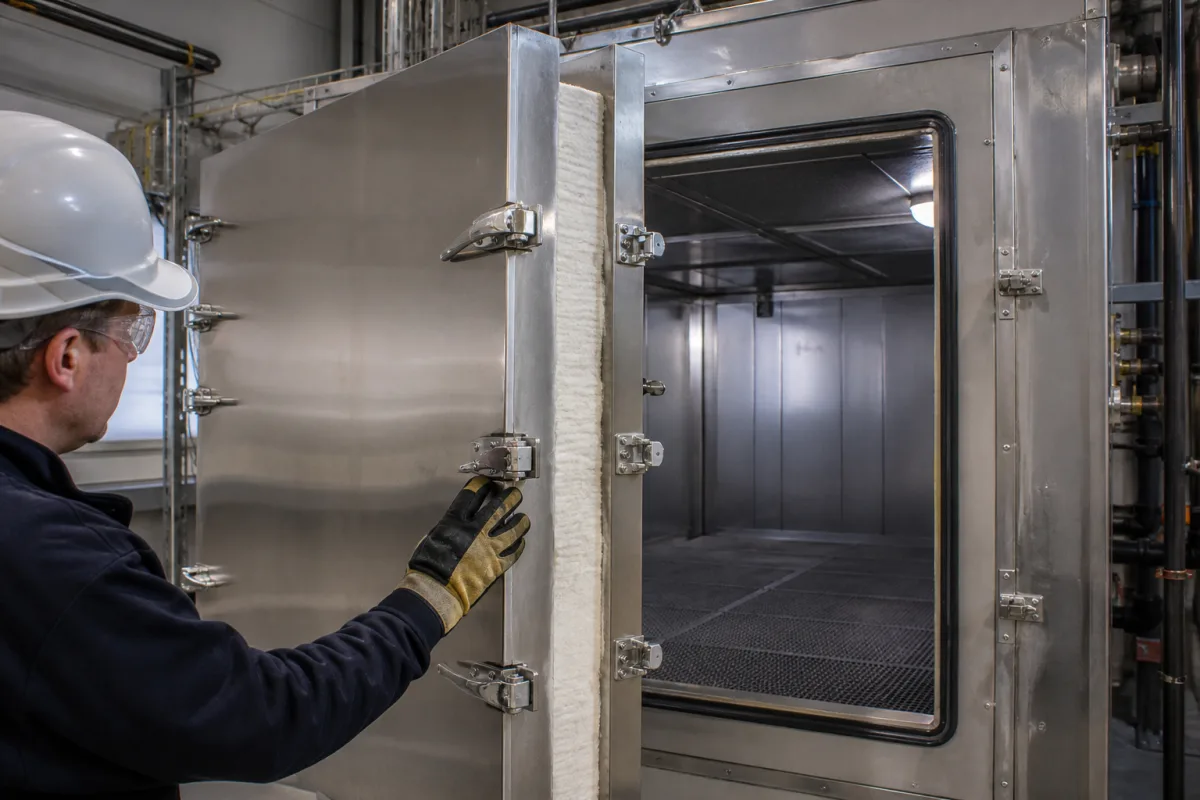
A specialized door designed to provide thermal insulation and environmental sealing for test chambers.
Product Specifications

Technical details and manufacturing context for Insulated Chamber Door

Definition
The Insulated Chamber Door is a critical component of a Test Chamber, engineered to maintain precise temperature, humidity, or atmospheric conditions within the chamber by minimizing thermal transfer and ensuring an airtight seal when closed. It serves as the primary access point while being integral to the chamber's performance and energy efficiency.
Working Principle
The door operates by creating a physical barrier with integrated insulation materials (e.g., polyurethane foam, mineral wool) to reduce heat conduction. A sealing mechanism, such as a gasket or inflatable seal, compresses against the door frame to prevent air leakage. It may include a locking system (manual latches, pneumatic clamps) and often features a viewport or window for observation without compromising insulation.
Common Materials
Stainless Steel (Frame), Polyurethane Foam (Core Insulation), Silicone Rubber (Seal/Gasket)
Technical Parameters
  • Overall dimensions (width x height x thickness) and insulation thickness. (mm) Customizable
Components / BOM
  • Door Panel
    Forms the primary structural barrier; typically consists of an outer metal skin and inner insulation core.
    Material: Stainless Steel / Aluminum (Skin), Polyurethane Foam (Core)
  • Sealing Gasket
    Creates an airtight seal between the door and chamber frame to prevent leakage of air, moisture, or gases.
    Material: Silicone Rubber / EPDM Rubber
  • Hinge Mechanism
    Allows the door to swing open and closed; designed to support the door's weight and maintain alignment.
    Material: Stainless Steel
  • Locking/Latching System
    Secures the door in the closed position, ensuring even compression of the seal across the perimeter.
    Material: Stainless Steel (Manual Latches) / Aluminum (Pneumatic Clamps)
  • Viewport/Window
    Provides visual access to the chamber interior without opening the door; often double-glazed with insulated frames.
    Material: Tempered Glass / Polycarbonate, Aluminum (Frame)
  • Handle
    Provides a grip for manual operation of the door.
    Material: Stainless Steel / Plastic
Engineering Reasoning
-70°C to +180°C temperature differential, 0-1000 Pa pressure differential
Seal compression set exceeding 15% permanent deformation, hinge torque exceeding 45 N·m, insulation R-value degradation below 3.5 m²·K/W
Design Rationale: Polymer seal material exceeding glass transition temperature (Tg) of -40°C to +120°C range, causing viscoelastic creep and permanent set; differential thermal expansion between stainless steel frame (17.3 μm/m·K) and polyurethane foam insulation (70-200 μm/m·K) creating shear stresses exceeding 25 MPa yield strength
Risk Mitigation (FMEA)
Trigger Cyclic thermal loading at 1 Hz frequency exceeding 50°C amplitude
Mode: Insulation foam delamination from metal substrate due to CTE mismatch fatigue
Strategy: Interlocking tongue-and-groove foam-to-metal interface with 0.5 mm interference fit and polyurethane adhesive with 12 MPa shear strength
Trigger Moisture ingress exceeding 10 g/m²·h vapor transmission rate
Mode: Corrosion-induced hinge seizure at stainless steel pivot points (316L SS)
Strategy: Double-lip silicone gasket with 0.3 mm compression and desiccant cartridge in door cavity maintaining <10% relative humidity

Industry Taxonomies & Aliases

Commonly used trade names and technical identifiers for Insulated Chamber Door.

Applied To / Applications

This component is essential for the following industrial systems and equipment:

Industrial Ecosystem & Supply Chain DNA

Complementary Systems
Downstream Applications
Specialized Tooling

Application Fit & Sizing Matrix

Operational Limits
pressure: Up to 2 bar differential pressure
other spec: Leakage rate < 0.1 m³/h at 1 bar differential
temperature: -70°C to +200°C
Media Compatibility
✓ Dry air/nitrogen environments ✓ Clean process gases ✓ Low-corrosion chemical vapors
Unsuitable: High-concentration abrasive slurries or corrosive liquids
Sizing Data Required
  • Chamber opening dimensions (width x height)
  • Required thermal insulation value (U-factor or R-value)
  • Sealing pressure differential requirement

Reliability & Engineering Risk Analysis

Failure Mode & Root Cause
Seal Degradation
Cause: Thermal cycling and compression set leading to loss of airtightness and insulation efficiency
Hinge Mechanism Wear
Cause: Misalignment, inadequate lubrication, and repeated mechanical stress causing binding or failure
Maintenance Indicators
  • Visible condensation or frost formation on door exterior indicating insulation breach
  • Audible hissing or whistling during closure signaling seal failure or pressure imbalance
Engineering Tips
  • Implement quarterly seal integrity testing with pressure decay or thermal imaging to detect early degradation
  • Establish precision alignment protocols and use high-temperature, food-grade lubricants on all moving components

Compliance & Manufacturing Standards

Reference Standards
ISO 9001:2015 - Quality Management Systems ASTM C518 - Standard Test Method for Steady-State Thermal Transmission Properties by Means of the Heat Flow Meter Apparatus CE Marking - EU Regulation for Construction Products (CPR 305/2011)
Manufacturing Precision
  • Door Seal Compression: +/- 0.5 mm
  • Overall Door Flatness: 0.2 mm per meter
Quality Inspection
  • Thermal Imaging Test for Insulation Uniformity
  • Air Leakage Test per ASTM E283

Factories Producing Insulated Chamber Door

Verified manufacturers with capability to produce this product in China

✓ 98% Supplier Capability Match Found

P Procurement Specialist from Singapore Jan 15, 2026
★★★★★
"Reliable performance in harsh Machinery and Equipment Manufacturing environments. No issues with the Insulated Chamber Door so far."
Technical Specifications Verified
T Technical Director from Germany Jan 12, 2026
★★★★★
"Testing the Insulated Chamber Door now; the technical reliability results are within 1% of the laboratory datasheet."
Technical Specifications Verified
P Project Engineer from Brazil Jan 09, 2026
★★★★★
"Impressive build quality. Especially the technical reliability is very stable during long-term operation."
Technical Specifications Verified
Verification Protocol

“Feedback is collected from verified sourcing managers during RFQ (Request for Quote) and factory evaluation processes on CNFX. These reports represent historical performance data and technical audit summaries from our B2B manufacturing network.”

8 sourcing managers are analyzing this specification now. Last inquiry for Insulated Chamber Door from Brazil (1h ago).

Supply Chain Compatible Machinery & Devices

Hydraulic Press

Industrial machine using hydraulic pressure to compress, form, or assemble materials

Explore Specs →
Heavy-Duty CNC Plasma Cutting Machine

Industrial machine for precision metal cutting using plasma arc technology

Explore Specs →
Automated Assembly Line System

Integrated production system for sequential component assembly operations

Explore Specs →
Automated Powder Coating System

Integrated industrial system for applying dry powder coatings to metal substrates.

Explore Specs →

Frequently Asked Questions

What temperature range can this insulated chamber door withstand?

Our insulated chamber doors are designed to maintain thermal integrity in test environments ranging from -40°C to +150°C, with the polyurethane foam core and silicone rubber seals providing consistent insulation across this spectrum.

How does the sealing system prevent environmental contamination?

The silicone rubber gasket creates a compression seal against the chamber frame, while the stainless steel construction and polyurethane foam core work together to prevent air leakage, moisture ingress, and thermal transfer in controlled environments.

Can the viewport be customized for specific testing requirements?

Yes, the viewport can be customized with various glass types (tempered, laminated, or double-paned) and sizes to accommodate different visibility needs, pressure ratings, or safety requirements for your specific testing applications.

Can I contact factories directly on CNFX?

CNFX is an open directory, not a transaction platform. Each factory profile provides direct contact information and production details to help you initiate direct inquiries with Chinese suppliers.

Get Quote for Insulated Chamber Door

Request technical pricing, lead times, or customized specifications for Insulated Chamber Door directly from verified manufacturing units.

Your business information is encrypted and only shared with verified Insulated Chamber Door suppliers.

Thank you! Your message has been sent. We'll respond within 1–3 business days.

Need to Manufacture Insulated Chamber Door?

Connect with verified factories specializing in this product category

Add Your Factory Contact Us
Previous Product
Insulated Chamber
Next Product
Insulated Chamber Housing