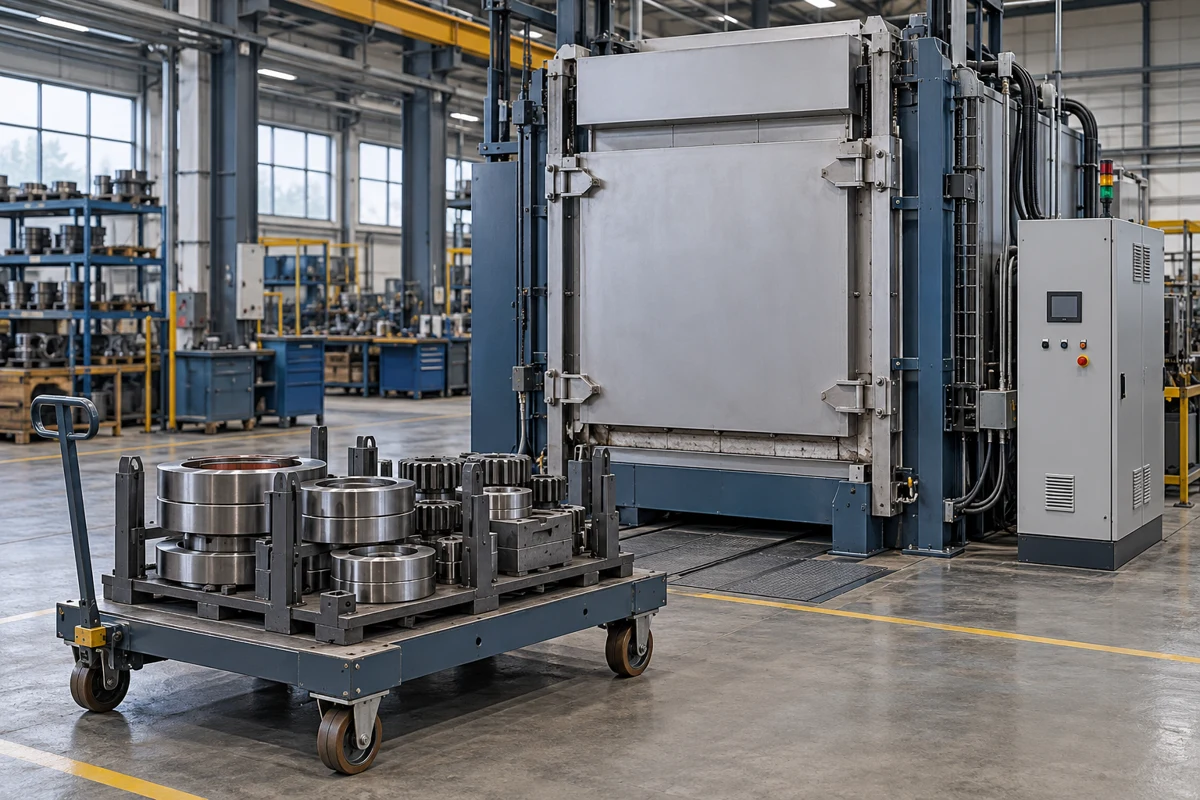
Specify the load and its thermal cycle first, then the furnace that can deliver them. Chamber dimensions, maximum temperature and installed power describe the equipment; a qualified work zone, loaded-cycle evidence and the customer’s pyrometry requirements establish whether it suits the job.
CNFX editorial research · Sources checked October 12, 2026 · 20 sources
This is a functional component reference, not a manufacturing BOM with quantities or interchangeable spare-part numbers. The GPC example is an electric chamber furnace; gas-fired, induction and quenching equipment add different assemblies. Confirm the as-built drawing and material grades for the selected model.
Assembly
Job in the furnace
Construction or scope actually supported
Heating chamber and lining
Contain the load and limit heat loss.
GPC: low-thermal-mass insulation and a hard-wearing refractory hearth. The datasheet does not identify a universal lining grade [7].
Resistance heating elements
Convert electrical power to heat around the chamber.
GPC: free-radiating coiled wire at both sides and the roof, with under-hearth heating. No wire-alloy grade is specified in the cited datasheet [7].
Controller and power regulation
Run the programmed temperature profile and regulate heat input.
GPC lists an EPC3016P1 programmer and over-temperature protection. Controller configuration and power hardware belong to the ordered assembly, not to a generic material specification [7].
Thermocouples and measurement channels
Measure control, recording or load temperature according to their assigned functions.
GPC 12/131B lists Type R. Survey sensors and instrumentation type require a separate schedule; Type K or S cannot be assumed for every furnace [7][1].
Atmosphere system · when fitted
Provide the specified gas environment through the appropriate enclosure and controls.
GPC offers metallic retorts for modified atmospheres up to 1100 °C. The older GPC 12/131 manual states that its optional gas inlet does not make the chamber gas-tight and excludes combustible/toxic gases. Confirm the exact retort and gas system [7][8].
Cooling or quench equipment · process dependent
Control the cooling stage required by the part’s process.
MSGC separately lists cooling chambers and vertical quenching furnaces. Such equipment is not established as standard on the GPC 12/131B; define the cooling method and transfer arrangement [11][7].
Hearth, trays and loading system
Support and position the load within the usable zone.
GPC has a refractory hearth and optional loading/unloading equipment. Hangshen’s trolley furnace is a different loading architecture. Neither establishes a universal tray steel grade [7][10].
Gas burner / radiant tube · alternative heating route
Transfer combustion heat to the chamber or through a radiant tube.
Fanghu supplies heat-resistant-steel radiant tubes. Its inspected page lists grade 1.4865 (HU), but headline and body temperature claims differ; obtain the selected tube’s duty limit and burner compatibility [12].
Induction coil · alternative heating route
An alternating field induces current and heat in the conductive workpiece.
Inductotherm describes a conductive coil, for example copper. Coil geometry, power and frequency are application-specific; this is not a standard component of the resistance-heated GPC example [9].
02
Read a named furnace’s data before comparing offers
The GPC 12/131B figures below come from Carbolite’s six-page datasheet dated 1 October 2026. They demonstrate how to read a quotation; they are not category-wide ranges or ratings for the Chinese suppliers below. Unpublished fields remain questions. [7]
The manufacturer’s own revision labels need resolving
The October 2026 GPC datasheet still names AMS2750F as a customization option, while Carbolite’s dedicated pyrometry page discusses AMS2750H. Neither proves that a standard GPC 12/131B is supplied qualified to H. Require the ordered configuration, revision and acceptance reports in writing [7][1].
Quotation field
Published example / boundary
What to establish for your load
Maximum and continuous temperature
1200 °C maximum; 1100 °C maximum continuous for GPC 12/131B.
State the process setpoints and duration; the two ratings are different [7].
Chamber dimensions
350 × 500 × 750 mm, internal H × W × D; 131 L nominal volume.
Get the qualified work zone and loading clearances, not just the internal box size [7][1].
Heating rate / heat-up time
150 minutes; manufacturer footnote: empty chamber to 100 °C below maximum.
Request the loaded ramp and soak cycle. Do not convert this empty-chamber time into a guaranteed production ramp [7].
Temperature uniformity
No GPC 12/131B class or uniformity guarantee stated in this table.
Specify the required limit, zone, temperature and test condition separately [7][1].
Power
24,000 W (24 kW) maximum.
This is a power rating. Obtain energy per agreed loaded cycle separately [7].
Atmosphere
Metallic retort is an option; modified-atmosphere use listed up to 1100 °C.
Specify gas, purity, enclosure, flow and exhaust arrangements for the actual option [7].
Chamber pressure / vacuum
No vacuum or positive-pressure rating established for this model.
Specify absolute pressure or gauge pressure explicitly when procuring a vacuum/pressure design; a gas inlet is not a vacuum rating [7][8].
Control accuracy
No complete measuring-system accuracy value stated here.
Obtain the configured sensor/controller performance and required SAT. Do not substitute work-zone uniformity [7][4].
Cooling rate
No guaranteed loaded cooling curve stated.
Give the process requirement and establish whether cooling or quenching is external equipment [7][11].
Load capacity
The listed 400 kg is furnace weight, not permissible charge mass.
Request maximum charge plus fixture mass and its distribution on the hearth [7].
Insulation
Low-thermal-mass insulation; refractory hearth.
Obtain the actual material and replacement specification for the ordered construction [7].
Heating-element construction
Free-radiating coiled wire; grade not stated.
Use model/serial-specific replacement parts, not a guessed NiCr, SiC or MoSi₂ material [7][8].
Controls / recording
EPC3016P1 programmer; alternative controls, recorders and loggers are options.
Agree channel count, recording functions and data access in the quotation [7].
Protection and conformity documents
Over-temperature protection is listed; the operating manual describes a door safety switch.
Request applicable declaration, supplied circuit drawings and commissioning tests. A maximum-temperature rating does not establish conformity [7][8].
03
The part’s thermal cycle is more than the controller reading
Resistance and gas furnaces transfer heat to the load by radiation and convection, followed by conduction through the part. Induction instead generates heat from induced current in the conductive workpiece. The selected heating route therefore changes the load arrangement and control problem [9].
Do not shield the control sensor with a large load
The GPC 12/131 operating manual warns that a large, poorly conducting object can shield the thermocouple from the elements and cause element overheating. It calls for a suitably controlled ramp or lower initial temperature. Agree the loading drawing and programmed cycle for the actual material; the manual does not provide a universal ramp for every part [8].
Agree the conditions of the acceptance run
Ask the supplier to document the charge and fixtures, sensor locations, heating/holding/cooling stages, and the work zone covered by its evidence. Carbolite’s pyrometry guidance distinguishes loaded and unloaded surveys, while its model heat-up specification is explicitly empty-chamber data. An empty result cannot by itself demonstrate your loaded production cycle [1][7].
04
Start from the rules your customer imposes
Name the material and process specification, then the pyrometry and assessment requirements invoked by the customer. These documents serve different purposes.
AMS2750H · pyrometry
SAE’s public scope covers sensors, instrumentation, thermal processing equipment, correction factors, SAT and TUS for metallic materials. Revision H is dated 15 July 2024. The public scope does not supply the full acceptance tables [5].
Nadcap · supplier process accreditation
PRI audits and accredits suppliers’ critical processes, including heat treating. Buying a furnace described as “Nadcap capable” does not itself give the purchaser Nadcap accreditation [6].
CQI-9 · automotive heat-treat assessment
AIAG describes the fourth edition as an audit “covering the most common heat treat processes employed by the automotive industry, intended to provide a common approach to a heat treat management system”. Its June 2020 announcement identifies revised pyrometry reporting, survey-sensor calculations and grace periods; use the edition named by the customer [2].
05
Choose the furnace class: how uniform the work zone must be
Carbolite publishes the following class summary on its AMS2750H equipment page. It is a manufacturer’s reference, not a reproduction of the purchased standard; two rows contain unresolved paired values [1].
Classes 2 and 3 are published with two values
Carbolite prints Class 2 as ±5 / ±6 °C and Class 3 as ±7 / ±8 °C without explaining the pairing. Do not choose the looser value: obtain the exact units, limit and revision in the acceptance procedure [1]. A historical AMS2750E article illustrates a 1900 °F setpoint with readings from 1887 to 1913 °F: the largest deviation is 13 °F, which its example places in Class 3. That arithmetic alone does not establish full equipment qualification under revision H [3].
Chamber volume is larger than the surveyed work zone
Carbolite recommends an 800 × 800 × 800 mm chamber for a 600 × 600 × 600 mm Class 1 work zone in its design guidance. This is its sizing example, not a universal dimensional requirement. Obtain the supplier’s usable work-zone drawing and loading arrangement for the quoted furnace [1].
Plan the surveys: TUS and SAT check different things
A TUS measures how temperature is distributed in the work zone; a SAT checks that the furnace's own measuring system agrees with a reference [4].
Instrumentation type describes functions, not just sensor count
Carbolite’s comparison distinguishes control, recording, over-temperature, high/low monitoring and load-temperature functions across instrumentation types. Ask for a channel schedule identifying each sensor and recorder. A list of thermocouples by itself does not identify the instrumentation type [1].
Use the measuring chain, not a probe certificate alone
JUMO explains that cables, switches, controllers and recorders can affect the measured result. Specify the complete test scope and identify which channels and correction factors the report covers. Obtain the provider’s accreditation scope where your governing requirements call for it; a vague claim of “national accreditation” is insufficient to establish compliance [4].
Do not copy an old survey interval into a new contract
The 2020 article cited here describes AMS2750E, including monthly versus quarterly examples and conditional extensions. These are historical examples, not the maintenance calendar for revision H. The test plan must use the contract’s revision, furnace class, instrumentation type and applicable conditions. AIAG likewise reports changes to sensor-number calculations and grace periods in CQI-9’s fourth edition [3][5][2].
07
Inspect the assemblies that protect the load and the operator
The following points are from the GPC 12/131 manual, revision 29 October 2021, linked on the current product page. Use the manual supplied for the actual serial number and controller; this older manual is not evidence that every current GPC 12/131B option is identical. [8]
Inspect the door plug/seal, hearth and extraction path for the damage or obstruction covered by the maintenance schedule. Establish the schedule for the actual duty rather than inventing a category-wide service interval [8].
The manual specifies a weekly operator check of the door safety switch at a safe temperature above ambient: heater lights should go out when the door opens. If they remain on, discontinue use and contact service. Its electrical isolation check is assigned to a qualified electrician [8].
Compare temperature indications with certified equipment and calibrate as the governing process requires. Sensor and controller drift are separate from a TUS demonstrating spatial uniformity [8][4].
For elements, thermocouples and refractory work, obtain the manufacturer’s replacement instructions and quote the model/serial number. The manual requires disconnection from power for repairs and addresses refractory-fibre handling [8].
08
Handover documents to require
Make the qualification part of the delivery, not a later service.
Customer process specification, pyrometry revision, furnace class where applicable, and instrumentation channel schedule [5][1].
Initial TUS report identifying the surveyed work zone, temperatures, loading condition and sensor positions; agree the acceptance procedure before purchase [1][3].
SAT and calibration reports with equipment identification, test scope and applicable correction factors [5][4].
Provider qualification and accreditation scope required by the governing contract; obtain the actual documents rather than a brochure claim [4].
Model-specific operating manual, load arrangement, utilities and maintenance instructions. The GPC manual is an example of the supplied equipment instructions, not a procedure for all furnaces [8].
09
Copy this RFQ and fill in the brackets
Paste it into your enquiry below or into an email to a maker, then replace every bracket.
Product: heat treatment furnace, configuration [chamber / trolley / pit / vacuum / continuous / induction]
Process and material: [alloy / condition / process specification and revision]
Load and fixtures: [H × W × D mm], [kg], arrangement [drawing], required throughput [basis]
Thermal cycle: [loaded ramp / soak start criterion / duration / cooling or quench method]
Temperature: process [range], maximum [°C], continuous rating [°C]
Atmosphere: [air / specified gas / vacuum], purity [requirement], pressure [value + absolute/gauge basis]
Qualification: customer pyrometry [document/revision], work zone [dimensions], uniformity [limit and units], instrumentation [functions/type]
Acceptance evidence: TUS [conditions], SAT [scope], calibration [scope/provider requirements], loaded trial [agreed conditions]
Utilities and installation: electrical [V / phases / Hz / available kW], gas [supply], extraction [arrangement], cooling [requirements]
Handover: model-specific manuals, drawings, protection tests, spares and training [scope]
Delivery: [location/date], installation and commissioning [scope]
12 companies list this product among what they make. Company figures are quoted from each
company's own website; every card states where the relationship came from.
Wuxi Junteng Fanghu Alloy Casting Co., Ltd.
Jiangsu, CN
Supplies furnace components: radiant tubes, trays, baskets and fixtures. The inspected radiant-tube listing gives 1100 °C in its specification and 1200 °C in its general text; resolve the selected alloy and duty rating. This source does not establish whole-furnace supply.
Product scope checked 2026-10-09
Founded 2006
ISO9001ISO14001
Listed on the company's own website · profile compiled by CNFX from public sources
Listed there as: “Custom Radiant Tubes for Heat Treatment Furnaces | FH®” View source page ↗alloy-casting.com · recorded 2026-08-22
Supplies temperature controls and SCR power regulators, including the MW10E. These are furnace control components; its inspected offering does not establish manufacture of complete heat-treatment furnaces.
Product scope checked 2026-10-09
Founded 2011
CE
Listed on the company's own website · profile compiled by CNFX from public sources
Listed there as: “Power controller for heat treatment furnace” View source page ↗maxwell-fa.com · recorded 2026-08-22
Lists trolley heat-treatment furnaces with RT-series model data, alongside annealing, tempering and atmosphere equipment. Obtain the work-zone drawing and loaded-cycle acceptance data for the quoted model; the page does not establish AMS2750 qualification.
Product scope checked 2026-10-09
Listed on the company's own website · profile compiled by CNFX from public sources
Listed there as: “Trolley Heat Treatment Furnace” View source page ↗hzfurnaces.com · recorded 2026-09-03
The inspected annealing range is for wire processing and includes electric and LPG-gas furnaces. Establish the wire/load arrangement and production-cycle basis rather than treating these as general aerospace chamber furnaces.
Product scope checked 2026-10-09
Listed on the company's own website · profile compiled by CNFX from public sources
Listed there as: “Annealing Furnace” View source page ↗china-equipments.com · recorded 2026-08-28
Lists mesh-belt heat-treatment equipment, including an electric controlled furnace with RB-series model data and atmosphere-control features. Verify the current configuration: the inspected model page is dated November 2019.
Product scope checked 2026-10-09
Listed on the company's own website · profile compiled by CNFX from public sources
Listed there as: “Electric Controlled Heat Treatment Furnace” View source page ↗rainbowtechnology.net · recorded 2026-09-18
Its heat-treatment category includes electric bogie-hearth and vacuum-atmosphere furnaces as well as other furnace types. The company’s induction-focused name does not identify the heating route of every listed product.
Product scope checked 2026-10-09
Listed on the company's own website · profile compiled by CNFX from public sources
Listed there as: “Heat Treatment Furnace” View source page ↗dw-inductionheater.com · recorded 2026-09-03
The inspected aluminium-industry range includes billet homogenizing, aging and vertical quenching furnaces, plus induction billet heating. Select a particular process and model; the category page mixes multiple technologies and their specifications.
Product scope checked 2026-10-09
Listed on the company's own website · profile compiled by CNFX from public sources
Listed there as: “Heat Treatment Furnaces” View source page ↗msgroupchina.com · recorded 2026-08-30
Explore company information and manufacturing capabilities, then discuss the scope of your project with a relevant supplier.
Share this page
Compiled and source-reviewed by the CNFX editorial team.
Each manufacturer above links to the page on that company's own website where the product is listed, with the date we checked it. How we source and review
· Page last updated 13 October 2026
Buyer questions
What is the difference between a TUS and a SAT?
A temperature uniformity survey measures how temperature is distributed in the work zone; a system accuracy test checks that the furnace's measuring system agrees with a reference. [4]
Do I need Class 1 uniformity?
Choose the uniformity required by the process and customer specification. Carbolite’s summary gives Class 1 as ±3 °C and illustrates a chamber larger than its qualified work zone. Its 800 mm / 600 mm cube example is design guidance, not a universal chamber-size rule. [1]
How often must the furnace be surveyed?
Use the revision and conditions specified in the contract, including furnace class and instrumentation type where applicable. The cited 2020 monthly/quarterly examples are for AMS2750E; they are not a verified revision-H schedule. [3][5]
Is CQI-9 only for automotive suppliers?
AIAG describes CQI-9 as a heat-treat management approach for automotive production and service parts. AMS2750 specifies pyrometry requirements, while Nadcap accredits supplier processes. Establish which requirements the customer invokes rather than treating these names as interchangeable furnace certificates. [2][5][6]
Can my furnace supplier calibrate the instruments?
Determine the required test and accreditation scope under your contract, then ask the proposed provider for evidence covering it. JUMO explains why cables, switches and instruments in the measuring chain matter; the manufacturer’s general webpage is not enough to decide whether a provider meets every clause of CQI-9. [4]
Sources and what still needs a direct check
Sources checked 2026-10-12. Standards bodies and regulations define the requirements; manufacturer pages show published ranges for those models only. CNFX does not certify products or suppliers.
The paid AMS2750H and CQI-9 texts were not read in full. Exact acceptance limits, sensor arrangements, survey intervals and provider requirements must be taken from the contract’s governing documents.
Carbolite’s Class 2/3 summary contains paired Celsius values without an explanation. The GPC datasheet names AMS2750F customization while its pyrometry page discusses H; the ordered revision needs written confirmation.
GPC data are a named manufacturer example. Load capacity, loaded heating/cooling performance, vacuum rating and a supplied furnace class were not established by that datasheet.
Component materials and quantities must come from the selected assembly. The functional list includes alternative technologies; it is not a parts kit or a manufacturing BOM.
Buyer enquiry
Request manufacturing insight
for Heat Treatment Furnace
Ask for use case, specification boundaries, supplier type, and RFQ preparation
information for this product.
Where it goes
Straight to the CNFX editorial desk, and to the manufacturer if this product is
linked to a claimed profile. Nothing is broadcast to a supplier list.
Your details stay here
We do not sell or rent enquiry data, and we do not add you to a mailing list.
Used only to answer this request.
No commission, no middleman
CNFX is a directory. We take no cut of any order and never negotiate on a
supplier's behalf.
What to include
Share your product specifications, quantity, destination and target delivery date.
Need to Manufacture Heat Treatment Furnace?
Compare manufacturer profiles with relevant product and process capability.