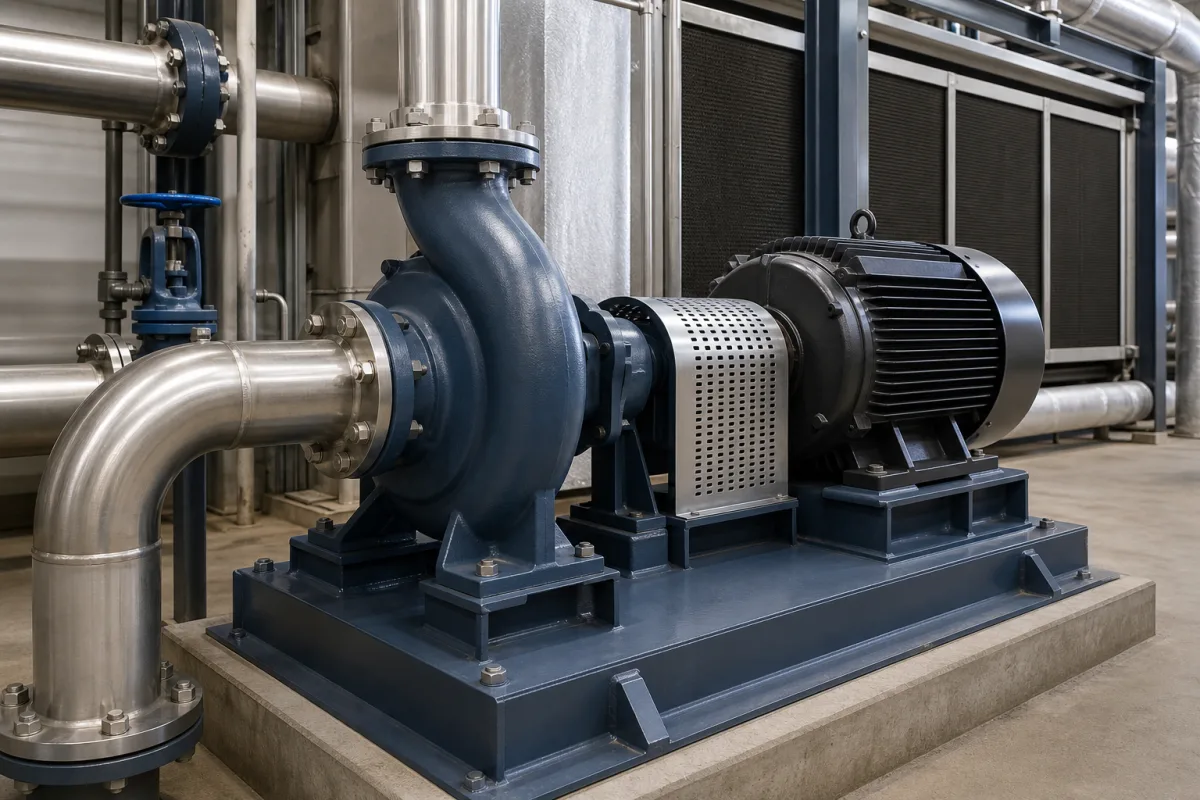
Cooling-water circulation pump for industrial cooling loops
Cooling-water circulation · Flow from heat load and temperature rise, closed or open loop head, duty and standby pumps, speed control
A cooling-water circulation pump moves water around a cooling loop — through process heat exchangers, moulds, condensers or jackets and back through a cooling tower or chiller — so that heat is carried away at a set temperature rise. Ask three things first: what flow the heat load and allowed temperature rise call for, how much of the head is static lift (an open tower loop) rather than friction (a closed loop), and how duty, standby and speed control will be arranged.
Electric centrifugal pumps used to circulate cooling water in industrial closed loops and open cooling-tower loops, including end-suction and in-line designs with their motors, couplings and baseplates. Centrifugal pump hydraulic selection — NPSH, operating regions and pump curves — is covered on the Industrial pumps page; engine coolant pumps, domestic circulators, slurry and sewage pumps and the cooling towers and chillers themselves are outside this page.
CNFX editorial research · Sources checked October 12, 2026 · 3 sources
Set flow from the heat load, then split the head into static and friction
The DOE, Hydraulic Institute and Europump guide to variable speed pumping separates head into static head — the height difference or the pressure in a vessel being fed, independent of flow — and friction head, which is proportional to the square of flow, and states that a closed-loop circulating system with no surface open to atmospheric pressure would exhibit only friction losses. Where friction predominates, reducing pump speed moves the operating point along a line of constant efficiency and the pump stays near its best efficiency point; where static head is present, a small speed reduction greatly reduces flow and efficiency, and applying the affinity laws to estimate savings can lead to major errors. [1]
Editorial calculation (assumption: water with a specific heat of about 4.19 kJ/kg·K and a density of about 1,000 kg/m³): carrying 500 kW of heat at a 5 K temperature rise needs 500 ÷ (4.19 × 5) ≈ 23.9 kg/s, or about 86 m³/h; allowing a 10 K rise halves the flow to about 43 m³/h. Fix the flow from your own heat load and allowed rise before choosing a pump size.
The same guide notes that pumping systems account for nearly 20% of the world's energy used by electric motors and 25% to 50% of total electrical energy use in certain industrial facilities, and warns that adding comfort margins to a calculated system curve results in an oversized pump, in its words that runs at excessive flow or must be throttled; it also notes that control valves are designed to be about 10% shut even at maximum flow, for control purposes. [1] Ask the supplier to plot your system curve — closed loop, or open to a cooling tower with its static lift — against the pump curve.
Give the supplier the heat load and allowed temperature rise, the loop type (closed, or open to a cooling tower), the static lift, the friction loss at design flow, the water quality and temperature, the number of duty and standby pumps, whether a variable speed drive is planned, the motor supply, and the space and baseplate arrangement.
02
Arrange duty and standby pumps and decide on speed control
DOE's tip sheet on parallel pumping warns against running lead and standby pumps together when one pump can meet the flow: in its example a split-case pump delivers 2,000 gpm at 138 ft (100 ft static) at 90% efficiency and 61.4 kW input; switching on an identical second pump raises flow by only 25%, to 2,500 gpm at 159 ft, while each pump falls to 80% efficiency and input power rises 62.2% to 99.6 kW. [2]
DOE expresses the result as energy intensity: 512 kWh per million gallons with one pump against 665 kWh with two, about 30% more energy for the same volume; it adds that parallel pumps give good flexibility in static head-dominated systems but are not nearly as effective in friction-dominated systems, and that multiple pumps should be compared with a single pump on adjustable speed control. [2] Editorial calculation: 665 ÷ 512 = 1.30, matching DOE's 30%; returning from two pumps to one saves (665 − 512) ÷ 665 ≈ 23% of pumping energy, the figure DOE gives. [2]
The variable speed guide lists bypass lines, throttling valves and speed adjustment as the ways to control flow and rates pump speed control above the other two for efficiency, while noting that speed adjustment is not appropriate for all pumping systems. [1]
03
Read an end-suction circulation pump's range and construction
Milestone (MST) describes its IS series as a single-stage, back pull-out end-suction pump for clean water, listing circulation and booster duty in plants among its uses: speeds of 2900 and 1450 r/min, inlet and outlet diameters of 50–200 mm, capacity of 6.3–400 m³/h, head of 5–125 m and liquid temperature not higher than 80 °C. [3]
The back pull-out design lets the pump body and cover separate behind the impeller, so the suction pipe, discharge pipe and motor stay in place during overhaul; a spacer coupling is opened to withdraw the rotor. Axial thrust is balanced by front and rear seal rings and a balance hole, and the shaft is sealed with packing fed by sealing water, with a sleeve and O-ring where the shaft passes the packing chamber. [3]
04
Pump data to state for a cooling-water duty
Flow and head come from your loop, not from the pump catalogue; temperature, material and seal follow from the water you circulate.
Field
Published values and meaning
Ask the supplier for
Flow rate (m³/h)
Set by heat load and temperature rise; IS series 6.3–400 m³/h. [3]
Two of the linked makers list end-suction water pumps for circulation duty; Shinhoo lists circulation pumps for industrial circulation and heating and cooling systems.
Milestone Engineering & Manufacturing Co.,Ltd.
Manufacturing site to be confirmed for the order
Lists IS-series end-suction centrifugal water pumps for clean water, including circulation and booster duty in plants, alongside slurry and sewage pumps.
Explore company information and manufacturing capabilities, then discuss the scope of your project with a relevant supplier.
Share this page
Compiled and source-reviewed by the CNFX editorial team.
Each manufacturer above links to the page on that company's own website where the product is listed, with the date we checked it. How we source and review
· Page last updated 13 October 2026
Buyer questions
Does running a second cooling pump double the flow?
No; in DOE's example a second identical pump raised flow by 25% while input power rose 62.2%. [2]
Where does speed control pay off in a cooling loop?
The DOE/HI/Europump guide says friction-dominated systems keep the pump near best efficiency as speed falls; with static head, a small speed cut greatly reduces flow and efficiency. [1]
What range does an end-suction circulation pump cover?
MST lists its IS series at 6.3–400 m³/h and 5–125 m for water up to 80 °C. [3]
Sources and what still needs a direct check
Sources checked 2026-10-12. The U.S. Department of Energy published the variable speed pumping guide with the Hydraulic Institute and Europump, and the parallel pumping tip sheet; Milestone (MST) describes its own IS-series end-suction pump.