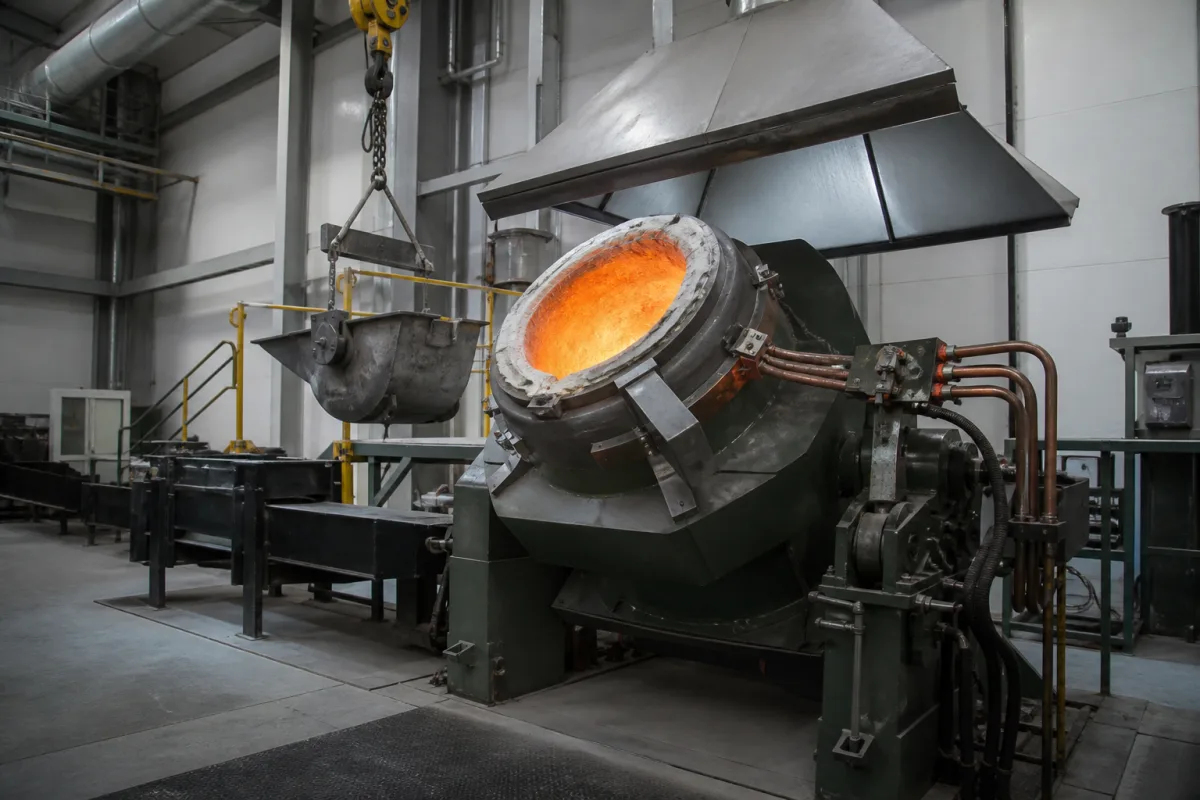
Foundry melting · Energy per tonne, capacity and power, cooling interlocks, ground detection and safe operation
An induction melting furnace melts metal in a refractory-lined crucible inside an induction coil fed from a power supply. Ask three things first: the metal, batch size and melt rate, the energy per tonne the supplier will guarantee, and the cooling and safety systems included.
Coreless induction melting furnaces and their power supplies for iron, steel, copper, aluminium and precious metals, from small crucible units to multi-tonne foundry furnaces. Induction heaters for forging, arc furnaces and vacuum melting systems are outside this page.
CNFX editorial research · Sources checked October 12, 2026 · 5 sources
A US Department of Energy best-practice study of metalcasting lists delivered energy for iron induction melting as 351.5 kWh per ton theoretical minimum, 796.3 kWh per ton industry average and 538.1 kWh per ton best-practice minimum. Citing an EPA background document, the same study notes that 95% of US induction melting furnaces were below 10 tons per hour melt capacity. [1]
Editorial calculation: the study uses US short tons (907 kg). Converting to metric tonnes, 538.1 ÷ 0.907 ≈ 593 kWh/t best practice and 796.3 ÷ 0.907 ≈ 878 kWh/t average. The gap is about 285 kWh per tonne, or about 2.85 GWh a year for a foundry melting 10,000 t. [1] Ask suppliers for guaranteed kWh/t at your metal, tapping temperature and duty.
Supplier ranges span small crucible furnaces to large foundry units; SEMC, for example, lists a 12 t, 8,000 kW medium-frequency induction furnace. [3]
Give the supplier the metal and grades, batch weight, melt rate, tapping temperature, charge materials, shifts and duty, energy guarantee basis, site power and harmonics limits, cooling water supply, tilt and pouring method, fume extraction and safety requirements.
02
Check cooling, interlocks and safe operation
Inductotherm's foundry safety fundamentals say any event that interferes with furnace cooling can quickly damage the coil and may cause a catastrophic explosion, so furnaces must have a backup cooling system and must not run without functioning water temperature and flow interlocks, which must not be bypassed; no induction melting equipment should run with any safety system jumpered or disabled. [2]
The same guidance says only dry spill pits can safely contain a run-out or emergency dump, furnaces must not run with ground probes disconnected or a faulty ground detection system, and the melt deck must be cleared on a ground-fault trip. All charge must be completely dry; wet charge, wet tools or additives, heavy charge dropped into the bath and sealed scrap are listed as primary causes of metal splash and furnace eruptions; people with pacemakers or metal implants must stay away from induction equipment, and Viton seals exposed to high temperature can form hydrofluoric acid. [2]
Ask the supplier which interlocks, backup cooling, ground and leak detection and lining-wear monitoring are included, and for operator training.
03
Relate furnace capacity, installed power and melt rate
OTTO JUNKER's induction melting brochure gives capacity and power pairs for coreless furnaces it has built: a Duomelt plant of 16 t capacity and 10 MW for melting up to 20 t of cast iron per hour; a standardised MFT JUPITER Line Duomelt plant of 8 t and 6 MW with IGBT converters; a medium-frequency coreless furnace of 12 t and 9 MW; and a medium-frequency furnace melting 1 t of aluminium in 80 minutes. The brochure lists furnaces for cast iron and steel, copper, aluminium, magnesium, silicon, silver, zinc and tin. Ajax TOCCO's coreless furnace page describes the parts such a furnace contains — a refractory-lined, insulated multi-turn copper coil, a steel shell or frame, silicon-steel yokes that return the magnetic flux, and top and bottom Faraday rings or flux plates that shield the steel structure — and lists shell, frame, box, lift-swing, lift-coil, rollover and high power density designs; its box furnace tilts a full 105° to empty the melt. [4][5]
Editorial calculation: installed power per tonne of capacity is about 625 kW/t for the 16 t, 10 MW plant, 750 kW/t for 8 t and 6 MW, and 750 kW/t for 12 t and 9 MW, against about 667 kW/t for SEMC's 12 t, 8,000 kW furnace; 10 MW over 20 t an hour is 500 kWh of installed power per tonne, below the DOE's 593 kWh/t best-practice figure above, so ask for the guaranteed kWh per tonne at your tapping temperature rather than inferring it from power. [4][3][1]
Crucible units to multi-tonne furnaces, and the equipment each listed supplier sells beside them
SEMC lists induction melting furnaces up to multi-tonne units; Hengyang, Hongteng and Runxiang list induction melting furnaces with rolling mill or casting equipment; Hani lists induction melting furnaces with arc and refining furnaces; Yantong lists melting furnaces with heat treatment furnaces; Foco and HLQ list induction melting furnaces with induction heaters; Superbmelt lists induction melting furnaces including small precious-metal units.
05
Coil, lining, power supply, cooling, ground detection and tilt
Inductotherm's safety guidance covers five of the six rows — coil, lining, cooling, ground detection and tilt hydraulics; only the power supply row comes from a supplier listing. [2][3]
Part
Role
Fix in the order
Induction coil
Heats the charge; damaged quickly if cooling fails. [2]
Coil design and cooling.
Crucible and lining
Holds the melt; Inductotherm: "The most intense wear occurs" at the slag-metal interface, where sidewalls join the floor and on less dense areas caused by poor installation. [2]
Capacity, power, melt rate, kWh per tonne, cooling and tilt for an induction furnace
The 593 kWh/t row is the DOE best-practice figure converted from short tons; set it beside the supplier's guaranteed value at your tapping temperature. Maximum temperature, crucible volume, cooling water pressure and noise have no published figure here. [1]
9 companies list this product among what they make. Company figures are quoted from each
company's own website; every card states where the relationship came from.
Shanghai Electric Heavy Machinery Co., Ltd.
Manufacturing site to be confirmed for the order
Lists induction melting furnaces, including a 12 t, 8,000 kW medium-frequency unit.
Explore company information and manufacturing capabilities, then discuss the scope of your project with a relevant supplier.
Share this page
Compiled and source-reviewed by the CNFX editorial team.
Each manufacturer above links to the page on that company's own website where the product is listed, with the date we checked it. How we source and review
· Page last updated 13 October 2026
Buyer questions
How much electricity does induction melting of iron use?
A US DOE study gives about 538 kWh per short ton best practice (about 593 kWh per tonne) and about 796 kWh per short ton industry average. [1]
What safety systems must an induction furnace have?
Backup cooling, water temperature and flow interlocks that are never bypassed, working ground detection and a dry spill pit. [2]
Why is wet scrap dangerous in an induction furnace?
Inductotherm lists wet or damp charge and sealed scrap among the primary causes of metal splash and furnace eruptions; metal reaching a wet spill pit can also cause an explosion. [2]
How much power does a large induction melting furnace use?
One maker lists a 16 t coreless furnace plant at 10 MW melting up to 20 t of cast iron per hour, and 8 t at 6 MW and 12 t at 9 MW for other units. [4]
Sources and what still needs a direct check
Sources checked 2026-10-12. The US Department of Energy study benchmarks metalcasting energy use. Inductotherm is an induction furnace maker; its safety guidance is its own. SEMC is a supplier listed on this page.