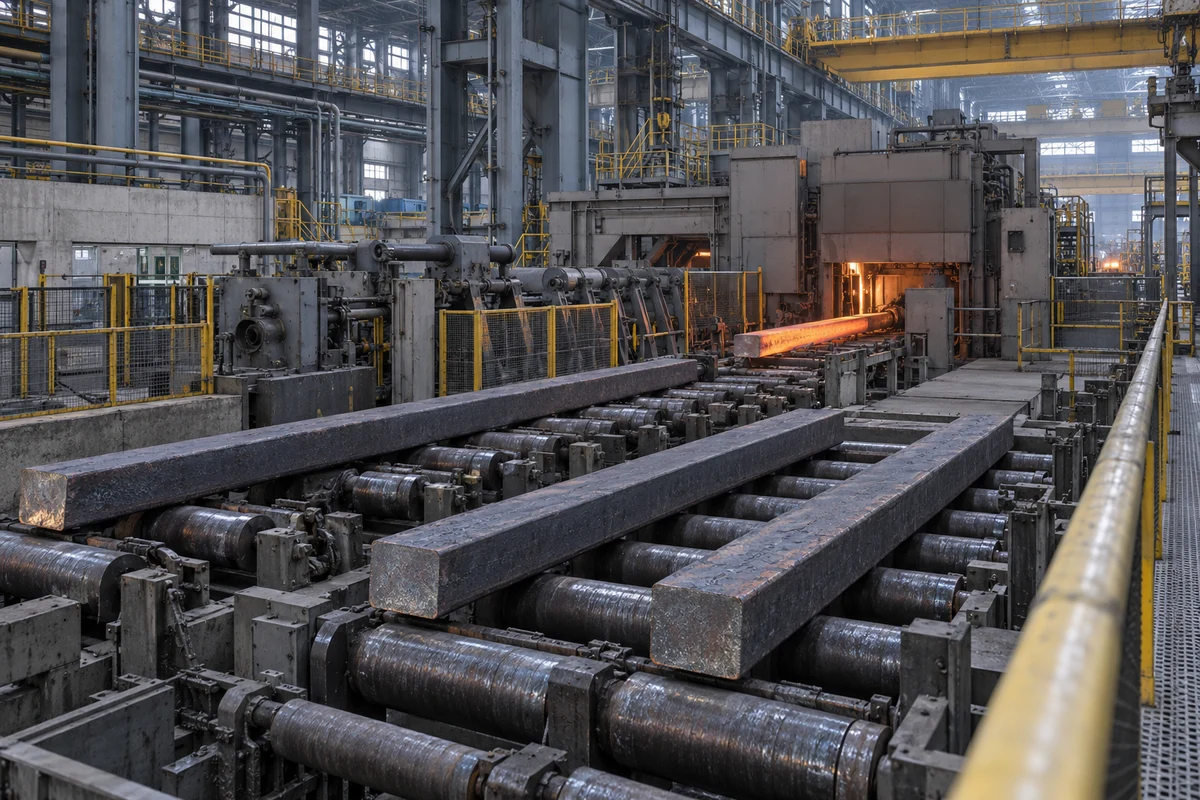
Start with the steel grades and the rolling mill’s required billet. Section, speed, strands and the melt-shop rhythm must work together; a headline annual tonnage cannot select the caster. Follow the strand, compare a published SBQ upgrade design, and define where the equipment quotation ends.
CNFX editorial research · Sources checked October 10, 2026 · 6 sources
SMS Concast’s current billet product page describes typical dimensions of 85–200 mm, while its technical table lists square/rectangular/CONREX formats of 105–200 mm and rounds of Ø130–Ø220 mm. These are differently scoped descriptions on that maker’s page, not an interchangeable industry limit [4].
Start from the mill's billet
Section and length are set by the rolling mill and its reheating furnace.
Work out tonnes per strand
For an illustrative 150 × 150 mm square at an assumed density of 7.8 t/m³: 0.15 × 0.15 × 7.8 = 0.1755 t/m. At an assumed 3 m/min, 0.1755 × 3 × 60 = 31.59 t/h per strand. This is geometric mass-flow arithmetic, not a tested caster output; it omits yield loss, downtime and restrictions imposed by the steel grade.
Match strands to the melt shop
Compare the sum of strand mass flows with tonnes of liquid steel available over the furnace cycle. Then define sequence hours, usable availability and saleable yield separately. Annual output cannot be established by multiplying a maximum speed by every hour in the year.
Choose the radius
SMS lists 6–10.25 m for its billet product family and 10.25–18 m for its bloom family [4][5]. The Huaigang upgrade announcement uses an existing 10.28 m caster [2]; a family table does not invalidate a documented project-specific geometry. Require the supplier’s layout and grade/section assessment.
“Up to 7 m/min” and “up to 60 t/h per strand” are SMS product-family maxima, not a guarantee that every section and grade achieves both at once. The listed annual capacity similarly needs an agreed operating basis. These figures do not establish DDMET or another Chinese supplier’s performance [4]. China Electric separately advertises small 60–90 mm billets on its R2.5m/R3m page, so the SMS family ranges are not a universal lower section limit [6].
02
Follow the strand from the tundish to billet delivery
The mould is the primary cooling stage; the strand then passes through support and secondary cooling before withdrawal/straightening, cutting and collection. DDMET lists these units, while SMS explains its mould heat-transfer and final-solidification technologies [3][2]. This is a functional equipment structure, not a manufacturing BOM with certified quantities or spare-part grades.
Equipment role
Function and configuration boundary
Ladle turret and tundish car
Position the liquid-steel supply and tundish. Both appear in DDMET’s mechanical scope; heat capacity, turret loads, car travel and included refractory work require the project specification [3].
Tundish
Receives and distributes steel toward the moulds. SMS’s stopper-control description concerns steel flow from tundish to mould; neither core source gives this project’s tundish working tonnage or a refractory schedule [2][3].
Mould / primary cooling
Establishes the strand section and removes heat in the primary zone. SMS names its CONVEX mould-tube heat-transfer technology. Tube material, coating and cooling design belong to the quoted caster; obtain them for that machine [2].
Mould oscillation and drive
Moves the mould with a specified motion. The Huaigang order names electric CONDRIVE with adjustable stroke/frequency, whereas DDMET lists a vibration device and drive without naming that technology. Do not substitute the old generic hydraulic/pneumatic description for either delivery [2][3].
Secondary cooling and strand support
Spray frames, pipes, nozzles and support rollers appear in DDMET’s list. Specify zone-by-zone cooling duties and supports; that list does not establish stainless nozzle grades, total water flow or a guaranteed solidification endpoint [3].
Withdrawal and straightening
DDMET names the machine, transmission and universal joint. SMS lists withdrawal/straightening units or DMSR modules as family options. Roller metallurgy, drive rating and the permissible grade/temperature window remain project-specific [3][4].
Dummy bar and storage
Provides the start/restranding equipment rather than becoming the finished billet. DDMET lists a rigid dummy bar, guide and storage; the Huaigang order specifies automatic insertion and liftable storage. That automation is not established for every DDMET caster [3][2].
Cutting unit
DDMET offers flame cutting or hydraulic shear as a customer choice. SMS lists 6–16 m cutting lengths for its billet family; neither statement guarantees cutting tolerance, blade alloy or a particular cut quality [3][4].
Run-out / delivery and collection
DDMET names billet delivery rollers, hydraulic pusher and collection platform. Its list does not by itself establish a complete cooling bed or the rolling-mill connection beyond collection [3].
Controls and auxiliaries
Oscillation, withdrawal, dummy-bar, roller-table, billet-discharge and hydraulic-station controls are separately named by DDMET. Name the agreed sensors, interlocks, interfaces, backup provisions and acceptance responsibilities; a control-system list is not a safety certification [3].
Require drawings, assembly identifiers and material/coating schedules before ordering replacement moulds, rollers, nozzles or cutting parts. The old seven component names are accounted for above; their unsourced materials have not been certified as standard equipment.
03
Keep the fourteen specification fields tied to a duty
Each field below belongs to a defined strand, circuit, component or operating basis. SMS family ranges are a comparison; the DDMET project list does not supply a numerical design for these fields.
Specification / unit
What belongs in the enquiry
Product cross-section · mm
Name square/rectangular dimensions or round diameter and grade. SMS’s descriptive 85–200 mm wording differs from its detailed 105–200 mm square/rectangular/CONREX table and Ø130–Ø220 mm rounds; request the actual mould/section schedule [4].
Annual capacity · t/year
Define saleable billet tonnes, grade/section mix, sequence time, availability and yield. SMS lists 300,000–2,500,000 t/year across its family, not an annual guarantee for any chosen configuration [4].
Ladle capacity · t
State heat mass and working ladle capacity, plus turret design loads and melt-shop cycle. DDMET lists a ladle turret without a tonnage rating; a furnace heat size is not automatically the turret’s approved load [3].
Number of strands · count
SMS lists 1–10 for its billet family. The Huaigang plan reduces six to five to make space for reduction modules; more strands alone does not define the better quality or capacity option [4][2].
Secondary cooling water flow · m³/h
Specify each zone and the operating/maximum flows, pressure, water quality and utility interface. DDMET names cooling-water control but gives no flow; keep mould cooling and secondary spray duties separate [3].
Casting speed · m/min
Specify grade- and section-dependent operating ranges. SMS’s maximum 7 m/min is a family figure; a higher geometric mass flow does not by itself establish acceptable solidification or saleable output [4].
Metallurgical length · m
Ask for the distance to final solidification under the defined grade, speed and cooling conditions, alongside the physical support/straightening layout. SMS’s COOL model calculates the billet liquid-core position; do not equate this process result with machine height or casting radius [2].
Tundish capacity · t
Request working steel mass, allowable level range and ladle-change requirements. Neither source gives a working capacity or a guaranteed changeover reserve; no reserve time follows from an invented nominal volume.
Oscillation frequency · cycles/min
Specify the frequency together with stroke and motion/control schedule for each duty. SMS’s order describes online-adjustable stroke and frequency without publishing settings; no generic frequency has been added [2].
Mould length · mm
Require the actual mould drawing, section, material/coating and cooling connections. DDMET’s list names the mould without a length; there is no evidence here for one universal standard tube length [3].
Casting radius · m
SMS billet-family data are 6–10.25 m, while the named existing Huaigang caster is 10.28 m. Confirm the project geometry and layout instead of treating a rounded catalogue range as a prohibition [4][2].
Cutting tolerance · mm
Specify length tolerance and measurement/acceptance conditions separately from nominal cut length and choice of flame cutter or shear. SMS’s 6–16 m length range is not a tolerance [4][3].
Operating temperature · °C
Separate steel process temperatures and cooling-water duties from ambient conditions around sensors, drives and control cabinets. The sources do not supply this caster’s ambient limit or steel-temperature schedule; no universal temperature value is asserted.
Electrical power · kW
Require the installed-load list, demand basis, supplies and included pumps/auxiliaries. DDMET names drives and controls but no total input; do not derive it from strand count or another maker’s machine [3].
Before defining maintenance, obtain the supplier’s mould/roller/nozzle inspection limits, water-circuit checks, drive service instructions, isolation procedures and spare-part identifiers. This page does not supply inspection intervals, a cooling-failure response or instructions for servicing hot equipment.
04
Match the technology to the steel grades
The 25 January 2021 SMS release reports Huaigang’s modernization order, with operation scheduled for the end of 2021. It explains the proposed change toward special bar quality steel; it is not a commissioning certificate or a later production report [2].
Seven dynamic mechanical soft reduction modules per strand [2]
Grades planned for addition
—
Bearing, gear, free-cutting and alloy structural steels [2]
Soft reduction
The ordered DMSR combines reduction modules with the COOL real-time solidification model; SMS describes reducing strand thickness at the final solidification stage to reduce centreline segregation and porosity. Require the supplier’s grade-specific control and acceptance basis, rather than treating “soft reduction” as a universal quality guarantee [2].
Stopper control
Controls steel flow from tundish to mould for closed casting [2]
Electric oscillation drive with stroke and frequency adjustable online [2]
Dummy bar
Rigid dummy bar with automatic insertion and liftable storage [2]
SMS said converting six strands to five would create room for seven DMSR modules per strand, with the same annual capacity intended. Neither completed commissioning nor achieved annual capacity has been verified from this order announcement. A future SBQ project needs its own steel-grade, section, solidification-model and layout requirements [2].
05
Check the quoted scope line by line
DDMET’s own page labels a China full-set/OEM item dated September 2012 and lists mechanical, control and auxiliary equipment. It is evidence of that advertised supply scope, not an independent acceptance report or an achieved speed specification [3].
A water-control system is not a water-treatment plant
DDMET names secondary-cooling water control, spray hardware, hydraulics and steam discharge, but this item list does not name water treatment, mould stirring or mould level measurement/control. Absence from this particular list does not prove those options are unavailable. Make each bidder identify the equipment and utility interfaces included in the price [3].
Ask for references at your section and grade
Ask for a reference matching your section, steel grades and casting mode, with dated operating and acceptance evidence. A project listing or an order announcement does not establish speed, availability, defect rate or the supplier’s responsibility for the complete melt shop.
A shell without lining is an incomplete working tundish
China Electric’s R2.5m/R3m supply list explicitly names two tundish shells without lining. Its listed power excludes water pumps, and its “Power consumption (kWh)” column contains 60–70% rather than an energy quantity. Define refractory supply/drying responsibility and pump/electrical scope, and ask for a corrected energy basis. These are that supplier’s page details, not DDMET’s package [6].
DDMET’s own full-set/OEM listing dated September 2012 names billet-caster mechanical, control and auxiliary equipment. The list supplies no achieved section/speed, utility ratings or independently accepted project result. Define the engineering, equipment and installation boundary in the quotation.
Its CCM page explicitly describes steel billet equipment and a supplier “Typical Value / Range” table. The page mixes general casting technologies with illustrative configurations; obtain a named design, grade/section performance basis and delivery boundary rather than treating the typical table as an installed-line guarantee.
The current product page describes casting liquid steel into billets, blooms or slabs; its collection also lists dummy-bar and roller parts. No named machine rating or complete delivery boundary is given on the reviewed product page. Ask whether the offer is a complete caster or particular assemblies.
Its R2.5m/R3m product page describes small steel billets and lists tundish shells without lining, mould/oscillation, guide/withdrawal, dummy bar, spray water, controls, rollers and hydraulic shear. Power excludes water pumps; a column headed kWh contains percentages. Obtain a corrected model-specific duty and energy basis instead of treating that column as measured consumption.
The root URL failed TLS validation, but the working www site has a Professional Continuous Casting Machine page describing steel continuous casting. It gives no section, strand, speed or utility schedule. Confirm the actual billet/slab configuration and delivery scope; the generic furnace certificates on the page are not verified caster certificates.
Its continuous-casting category lists steel billet casters among generic product entries. The reviewed category provides no named section/speed configuration or acceptance record. Ask for the actual machine specification and matching reference, not the category’s broad efficiency or certification claims.
Its square-billet category currently lists billet and full-arc casters, including six-strand R8.5 and four-strand R9 titles. These identify advertised variants; they do not establish every machine’s grade/section capability, achieved output or included auxiliaries.
Its steel CCM page gives multiple radii and billet formats, but introductory radius labels differ from its model table and the “3T–50T” capacity label lacks a clear time basis. Its “any water” claim is not an engineering water-quality specification. Require a consistent model table, separate cooling duties and site/lifting layout.
Explore company information and manufacturing capabilities, then discuss the scope of your project with a relevant supplier.
Share this page
Compiled and source-reviewed by the CNFX editorial team.
Each manufacturer above links to the page on that company's own website where the product is listed, with the date we checked it. How we source and review
· Page last updated 13 October 2026
Buyer questions
What section sizes does a billet caster cast?
SMS’s current product description says typical dimensions of 85–200 mm, while its detailed table gives 105–200 mm square/rectangular/CONREX and Ø130–Ø220 mm rounds. These different scopes need a specific mould/section quotation; they are not a universal limit. [4]
How fast does a billet caster cast?
SMS lists up to 7 m/min and up to 60 t/h per strand for its billet product family. The page does not guarantee that every grade and section achieves both maxima, or that DDMET has those ratings. [4]
What does soft reduction do?
The 2021 Huaigang order describes dynamic mechanical soft reduction during final solidification to reduce centreline segregation and porosity. It explains the planned technology; it does not independently verify the commissioned line’s quality results. [2]
What should a full-set caster quotation include?
From ladle turret and tundish through mould, cooling, withdrawal straightener, dummy bar, cutting and roller tables, plus controls, hydraulics and platforms. [3]
Sources and what still needs a direct check
Sources checked 2026-10-10. Standards bodies and regulations define the requirements; manufacturer pages show published ranges for those models only. CNFX does not certify products or suppliers.