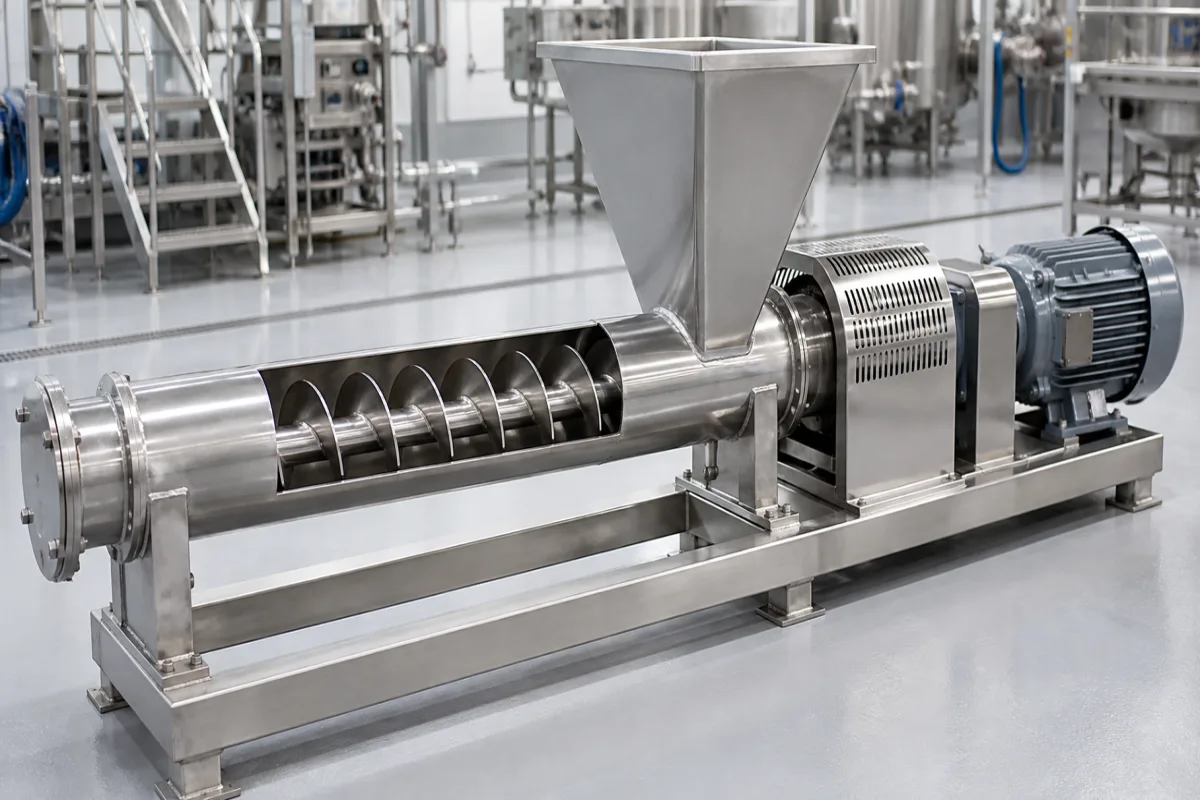
Variable-speed feeder auger for industrial meat grinders: running the hopper screw separately from the processing worm, and reversing it before the infeed packs
Industrial meat grinders · the hopper auger (feeder worm or conveyor screw) that pushes frozen blocks and fresh meat into the processing worm, driven on its own inverter so it can slow, stop or turn back when the zone between the two worms packs solid
A grinder that takes frozen meat blocks or large fresh pieces cannot rely on gravity to fill its processing worm. An auger at the bottom of the hopper does that job, and how it is driven decides whether the grinder runs evenly. On a shared drive the auger turns at a fixed ratio to the worm whatever the meat is doing; on its own variable-speed drive it can be slowed when the meat between the two screws compresses, stopped, or turned backwards for part of a revolution to break a bridge, while the processing worm and knife keep their speed.
The feeder auger (feeder worm, conveyor screw) at the base of an industrial grinder hopper that delivers meat, frozen blocks, pet food raw material or cheese to the processing worm: separate variable-speed drive versus a shared drive, speed reduction and short reversals against packing, sensing by pressure or drive power, recipe-based rotation patterns, and the conveyor-screw and feed-screw sizes in frozen-block grinders. Grinders and mixer-grinders with liquid nitrogen or CO₂ injection are covered on the Industrial meat grinder with cryogenic cooling page. Screw feeders that meter bulk powders and granules are covered on the Screw feeder page, bulk-solids screw conveyors on the Screw conveyor page, and powder feeding by weight on the Powder feeder with loss-in-weight control page.
CNFX editorial research · Sources checked October 13, 2026 · 3 sources
Slowing, stopping and briefly reversing the feeder worm while the processing worm keeps running
GEA Food Solutions' US 11,504,720 B2 describes a grinder whose hopper has a feeder worm at its base, above the processing worm that carries the meat to the cutting set. The method addresses one failure: the volume between the two worms packing with meat.
Handtmann's Inotec IW grinders put the same idea into a product sheet: a frequency-controlled conveyor screw with a reverse start function, a feed screw with reverse start on the IW 300 and IW 400, and on the IW 250 a choice between a high-speed fixed feed screw and a blade shaft separated from the feed screw, with the screw at 140 rpm and the blade shaft at 250 rpm. [1] Editorial calculation: in that IW 250 option the knife turns about 1.8 times as fast as the screw feeding it (250 / 140).
The older alternative is a shared drive. Hollymatic's US 4,736,896 places a pair of counter-rotating augers along the bottom of the hopper, above and parallel to the grinding head's feed screw; they push meat rearward into the grinding head and keep pressure on it, and augers and feed screw are driven from one motor and gear reduction unit at the rear of the machine. [3] The patent's aims are compactness and tool-free disassembly for cleaning, which it gets by pulling the hopper forward to release the auger drive connections and pivoting it clear. [3]
Control action in GEA's method
What the patent specifies
Periodic reversal
Feeder worm reversed during production on a preset pattern, not only on overload, for a set time or number of revolutions, for example 0.5–3 revolutions, then returned to its first direction [2]
Speed reduction
Feeder worm slowed relative to the processing worm so that it delivers less than the processing worm takes, gradually or down to zero, as soon as the mass compresses to an undesired density [2]
What is sensed
Pressure or density of the mass, or torque, current, voltage or power of the feeder or processing worm drive [2]
Processing worm
Keeps its direction and speed while the feeder worm reverses or stops [2]
Recipe
Pattern set by meat type (pork, beef, lamb, chicken), its temperature before grinding, the cutting set and the worm designs; the cutting set can carry an identification that loads the recipe [2]
Ask whether the hopper auger has its own inverter and motor, which signal (pressure, current or power) triggers slowing or reversing, how far it reverses, and whether the pattern can be stored per product and cutting set.
02
Conveyor screw, feed screw and hole plate on frozen-block grinders: Handtmann's IW figures
Handtmann's IW grinders take deep-frozen blocks down to −20 °C and fresh material without changing blades or hole plates, through a combination of conveyor screw and feed screw. [1]
The conveyor screw is 370 mm in diameter on all three models, the final hole plate goes down to 3 mm on the IW 250 and 8 mm on the larger two, and final grain sizes run from 3 to 30 mm. [1] Optional extras include a hopper filling-level sensor and a temperature probe in the hopper. [1]
Editorial calculation from Handtmann's table: frozen-block output per kW of total rated power falls from about 71 kg/h on the IW 250 to about 55 on the IW 300 and 52 on the IW 400; only the IW 250 is listed with more output on fresh than frozen material (6,100 against 5,200 kg/h, about 17 % more). The 370 mm conveyor screw is about 2.3 times the diameter of the IW 250's 160 mm feed screw.
State the block size and core temperature of frozen material, the fresh-meat share, the final plate size and the hourly output; ask for the conveyor screw diameter and speed range and the feed screw diameter and speed for that output.
03
Data for a grinder feeder auger enquiry
Paste it into your enquiry below or into an email to a maker, then replace every bracket.
Raw material: [species; frozen block size and temperature; fresh piece size; fat content]
Output: [kg/h; final hole plate mm]
Drive: [separate inverter or shared drive; speed range; reverse function]
Control: [trigger signal: pressure, current or power; reverse revolutions; recipes per product]
Hopper: [volume; filling level sensor; temperature probe; loading by belt or lifter]
Cleaning: [auger removal; tool-free disassembly]
Explore company information and manufacturing capabilities, then discuss the scope of your project with a relevant supplier.
Share this page
Compiled and source-reviewed by the CNFX editorial team.
Each manufacturer above links to the page on that company's own website where the product is listed, with the date we checked it. How we source and review
· Page last updated 13 October 2026
Buyer questions
Why reverse the feeder auger of a meat grinder during production?
GEA's US 11,504,720 B2 reverses the feeder worm on a preset pattern, for example 0.5–3 revolutions, to stop the volume between the feeder worm and processing worm packing; the processing worm keeps its speed meanwhile. [2]
What tells the controller to slow the feeder worm?
GEA's patent senses pressure or density of the mass, or the torque, current, voltage or power of the feeder or processing worm drive. [2]
How fast does a separately driven feed screw run?
Handtmann lists an IW 250 option with the feed screw at 140 rpm and the separated blade shaft at 250 rpm. [1]
Can hopper augers share the grinder's main drive?
Yes. Hollymatic's US 4,736,896 drives twin counter-rotating hopper augers and the grinding head's feed screw from one motor and gear reduction unit. [3]
Sources and what still needs a direct check
Sources checked 2026-10-13. Handtmann's product sheet gives the screw sizes, speeds and outputs of its IW grinders; GEA's and Hollymatic's patents describe separately controlled and jointly driven feeder augers.