Editorial Technical Reference

Control Panel

This page explains how Control Panel is classified within Food Manufacturing. Technical values and manufacturer relationships are research references; confirm the current specification and supplier evidence for each order.

Technical Definition & Core Assembly

A centralized interface for monitoring and controlling industrial equipment and processes
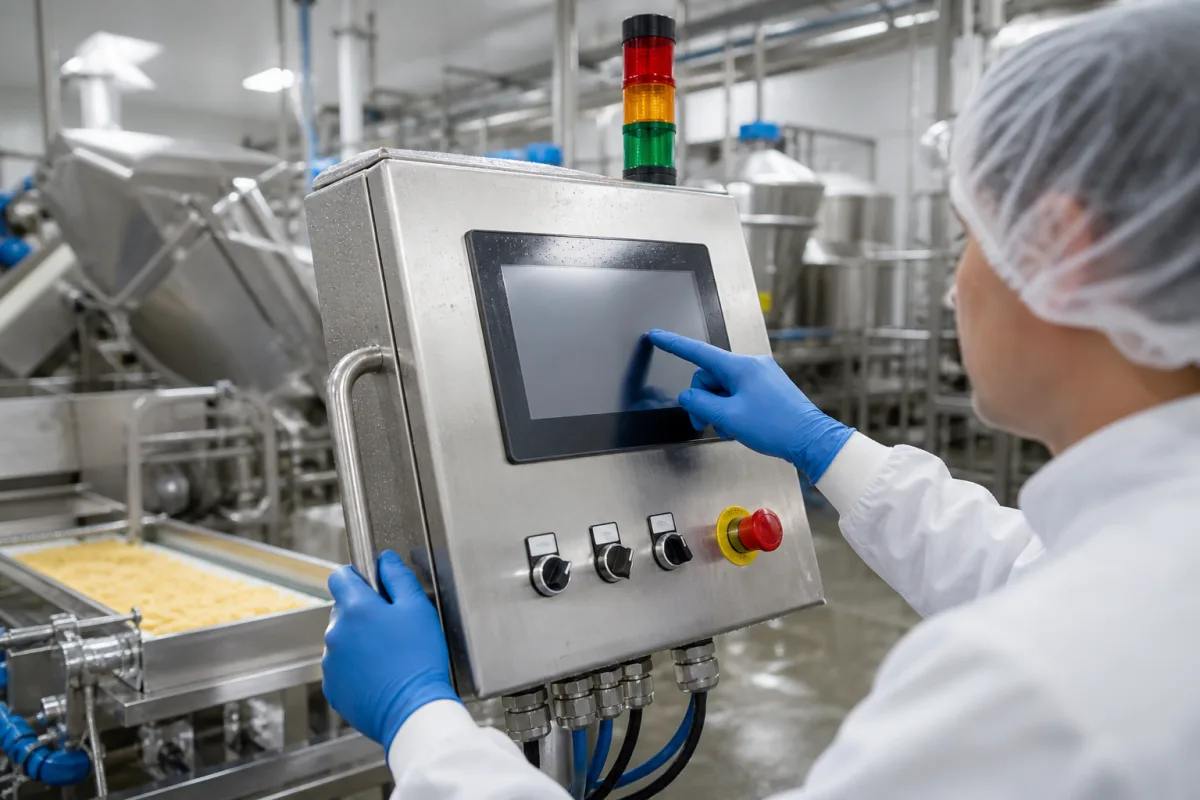
Representative product image. Confirm appearance and specifications with the manufacturer.

Product Specifications

Technical details and manufacturing context for Control Panel

Definition
The Control Panel is a component-level device used in food manufacturing environments as the primary human-machine interface within an industrial system. It provides operators with real-time monitoring capabilities and control functions to manage machinery, regulate processes, and ensure system safety and efficiency. The panel integrates displays, switches, indicators, and communication interfaces, all housed in a durable enclosure. Typical materials include stainless steel (grade 304) and polycarbonate, offering corrosion resistance and dust-tight, water-resistant protection (IP54–IP65). Electrical specifications include a rated voltage of 220–240 V AC (IEC 60038), rated current of 10–63 A (IEC 60947-1), frequency of 50–60 Hz (IEC 60038), and input voltage tolerance of ±10% (IEC 61000-4-30). Environmental limits cover operating temperature from -10 to 55 °C (IEC 60068-2-1) and non-condensing humidity of 5–95% RH (IEC 60068-2-78). The panel supports Modbus RTU communication (IEC 61158) with optional Profibus, and features a TFT touchscreen with 1280×800 pixel resolution. Dimensions are 400×500×200 mm (W×H×D) with weight ranging from 15 to 25 kg depending on configuration. All listed values are reference ranges that must be verified for the specific model and application. This directory entry does not imply certification or compliance; always confirm with the legal manufacturer or supplier.
Working Principle
The Control Panel physically functions by housing and organizing various control elements such as buttons, switches, indicators, and displays on a durable enclosure. Operators interact with these elements to send electrical signals to connected equipment, while the panel receives feedback signals from sensors and devices throughout the industrial system. The panel displays status information through visual indicators and digital readouts, enabling real-time monitoring and control. The enclosure provides mechanical protection and electrical insulation, with ingress protection ratings IP54–IP65 ensuring dust-tightness and water resistance. The panel operates within specified electrical and environmental limits, and its communication interfaces allow integration with higher-level control systems. Proper operation requires correct wiring, configuration, and adherence to the rated parameters. Failure to maintain these conditions can lead to malfunction or unsafe operation.
Common Materials
Stainless Steel, Polycarbonate
Technical Parameters
ParameterTypical rangeNotes & selection driver
Rated Voltage220–240 V ACStandard single-phase supplyIEC 60038
Rated Current10–63 ADepends on loadIEC 60947-1
Frequency50–60 HzAuto-sensingIEC 60038
Degree of ProtectionIP54–IP65Dust-tight and water-resistantIEC 60529
Operating Temperature-10–55 °CExtended range optionalIEC 60068-2-1
Humidity5–95 % RHNon-condensingIEC 60068-2-78
Enclosure Material304 Stainless SteelCorrosion-resistantASTM A240
Dimensions (W×H×D)400×500×200 mmCustom sizes available
Weight15–25 kgDepends on configuration
Display Resolution1280×800 pixelsTFT touchscreen
Communication ProtocolModbus RTUOptional ProfibusIEC 61158
Input Voltage Tolerance±10 %Per IEC standardsIEC 61000-4-30

Ranges are indicative industry figures for RFQ preparation, not a supplier commitment. Confirm every value and standard with the legal manufacturer before ordering.

Components / BOM
  • Display Screen Part
    Visual interface for monitoring system parameters and status
    Material: Tempered glass with LCD/LED display
  • Control Buttons/Switches Part
    Manual input devices for operator control and settings adjustment
  • Control Logic Board
    Processes inputs and outputs, contains microprocessor and control algorithms
  • Enclosure/Housing Part
    Protective casing for internal components, provides mounting structure
  • Programmable Logic Controller (PLC)
    The central processing unit that executes the panel logic and drives the outputs to field devices.
    Material: Electronic components (semiconductors, PCB)
  • Human-Machine Interface (HMI) Touchscreen
    Displays live process values and cycle status, and takes operator input.
    Material: Glass, polycarbonate, LCD panel
  • Power Supply Unit
    Converts incoming AC mains voltage to the lower DC voltages required by the panel's electronic components (PLC, HMI, relays).
    Material: Electronic components (transformers, rectifiers, capacitors)
  • I/O Terminal Blocks
    Connection points for wiring field devices (sensors, pumps, valves) to the PLC's input and output modules.
    Material: Plastic (housing), copper alloy (terminals)
  • Status Indicators
    LED lights showing operational states and alarms
    Material: Polycarbonate with LED components
  • Communication Ports Optional Part
    Interfaces for connecting to other system components
    Material: Plastic with metal connectors

Industry Taxonomies & Aliases

Commonly used trade names and technical identifiers for Control Panel.

Applied To / Applications

This component is essential for the following industrial systems and equipment:

Industrial Ecosystem & Supply Chain Structure

Complementary Systems
Downstream Applications
Specialized Tooling

Application Fit & Sizing Matrix

Operational Limits
pressure: N/A (enclosure rated for atmospheric conditions only)
other spec: IP65/NEMA 4X ingress protection, 10-90% non-condensing humidity, 0.5-2.0 m/s airflow for cooling
temperature: -20°C to +60°C (operating), -40°C to +85°C (storage)
Media Compatibility
✓ Clean air environments (HVAC-controlled rooms) ✓ General manufacturing areas (ISO Class 8) ✓ Dry process control rooms
Unsuitable: Washdown areas with high-pressure chemical sprays or submerged conditions
Sizing Data Required
  • Number of I/O points (digital/analog) required
  • Panel footprint constraints (WxDxH in mm)
  • Heat dissipation calculation (total power consumption in watts)

Reliability & Engineering Risk Analysis

Failure Mode & Root Cause
Electrical Overload
Cause: Excessive current draw from connected equipment, undersized components, or short circuits leading to overheating and component failure.
Corrosion and Contamination
Cause: Exposure to moisture, dust, chemicals, or conductive particles causing insulation breakdown, contact oxidation, or short circuits.
Maintenance Indicators
  • Unusual buzzing, arcing sounds, or burning odors from the panel
  • Visible overheating signs like discolored components, melted insulation, or hot surfaces
Engineering Tips
  • Implement regular infrared thermography scans to detect abnormal heat patterns in components before failure
  • Maintain proper environmental controls (sealing, ventilation, humidity control) and conduct periodic internal cleaning to prevent contamination buildup

Indicative industry ranges for design and RFQ preparation. Confirm the exact figures and applicable standard with the manufacturer before specifying.

Compliance & Manufacturing Standards

Applicable Standards
IEC 61439-1 — Low-voltage switchgear and controlgear assemblies, Part 1: General rules UL 508A — Standard for Industrial Control Panels ISO 13849-1 — Safety of machinery: Safety-related parts of control systems, Part 1: General principles for design

Quoted from the published standard.

Manufacturing Precision
  • Input Voltage Tolerance: +/-10%
Quality Inspection
  • Dielectric withstand and insulation resistance test
  • Functional test of control and interlock circuits

Manufacturers of Control Panel

Manufacturer profiles associated with Control Panel.

Sourcing Control Panel from China?
Tell us your specification and target quantity — we will match it against manufacturer records and come back with the factories that fit.
Request manufacturers We manufacture this

Manufacturer listings support early research and capability understanding. They are not certification, ranking, or transaction guarantees.

Technical documentation
Request current drawings, revision history, and a signed specification sheet.
Manufacturing capability
Verify equipment lists, process limits, capacity, and representative production evidence.
Inspection readiness
Confirm test methods, calibrated equipment, sampling plans, and traceable reports.
Supplier transparency
Check the legal entity, factory address, ownership, certifications, and direct contacts.

CNFX does not score or rank suppliers. Buyers must verify all claims and documents with the legal manufacturer before ordering.

Supply Chain Commonly Integrated Components

Gap Adjustment Mechanism

A precision mechanism that controls the distance between rollers in an industrial dough sheeter to regulate dough thickness.

Explore Specs →
Submerged Conveyor

A conveyor system designed to operate fully submerged in water or processing fluid within an industrial blancher.

Explore Specs →
Stainless Steel Washing Tank

The primary containment vessel in an industrial ultrasonic vegetable washer where produce is submerged and cleaned using ultrasonic cavitation.

Explore Specs →
Main Roller Assembly

The primary rolling mechanism in an industrial dough laminator that applies pressure to dough sheets.

Explore Specs →

Frequently Asked Questions

What is the typical rated voltage and current for this control panel?

The rated voltage is 220–240 V AC (IEC 60038) and rated current is 10–63 A (IEC 60947-1). These are reference ranges; the exact values depend on the specific model and load configuration. Always verify with the manufacturer.

What degree of protection does the enclosure provide?

The enclosure offers IP54–IP65 protection per IEC 60529, meaning it is dust-tight and water-resistant. This is suitable for food manufacturing environments, but confirm the exact rating for your model.

Which communication protocols are supported?

The panel supports Modbus RTU (IEC 61158) as standard, with optional Profibus. Verify protocol availability and configuration with the supplier for your application.

What are the operating temperature and humidity limits?

Operating temperature ranges from -10 to 55 °C (IEC 60068-2-1) and humidity from 5 to 95% RH non-condensing (IEC 60068-2-78). These are reference values; check the datasheet for your specific model.

Data Basis

Editorial classification, named public sources where available, and source-reviewed manufacturer records.

Preliminary Technical Classification
This page supports structured research, RFQ preparation, and supplier evaluation. It does not replace buyer-led supplier qualification, standards review, or technical approval.
Buyer enquiry

Request manufacturing insight for Control Panel

Ask for use case, specification boundaries, supplier type, and RFQ preparation information for this product.

Where it goes
Straight to the CNFX editorial desk, and to the manufacturer if this product is linked to a claimed profile. Nothing is broadcast to a supplier list.
Your details stay here
We do not sell or rent enquiry data, and we do not add you to a mailing list. Used only to answer this request.
No commission, no middleman
CNFX is a directory. We take no cut of any order and never negotiate on a supplier's behalf.
What we don't claim
A listing is not an endorsement. Qualify every supplier and verify every figure yourself before ordering.

Your business information is used only to process this request.

Thank you! Your message has been sent. We'll respond within 1–3 business days.
Sorry, we couldn't send your message. Please try again, or email us at contact@cnfx.com.

Need to Manufacture Control Panel?

Compare manufacturer profiles with relevant product and process capability.

Previous Product
Cleaning Solution Tanks
Next Product
Discharge Gate
Get QuotesChat