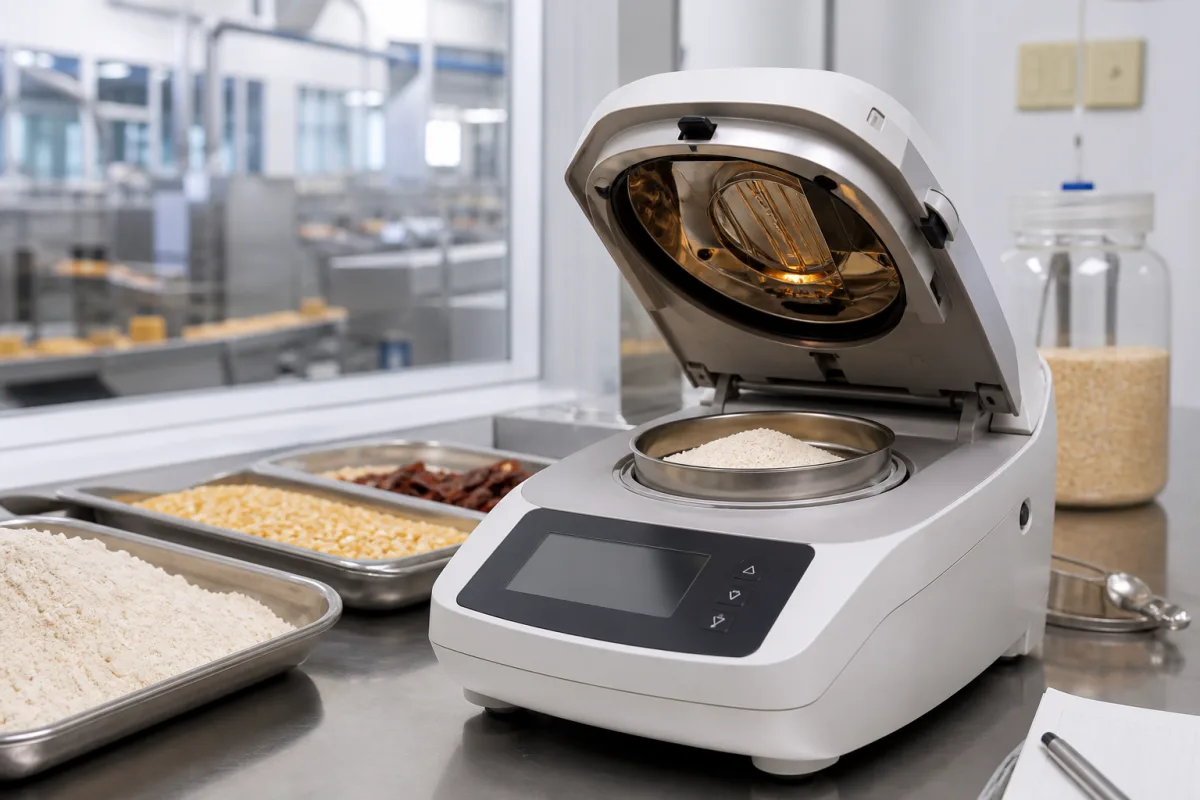
Halogen and infrared moisture analyzers for food and feed · Loss-on-drying principle, drying temperature matched to a reference oven method, switch-off criterion, sample preparation and size, validation against Karl Fischer or oven methods
A food moisture analyzer measures the moisture content of ingredients and products quickly beside the line or in the QC lab: benchtop units weigh a sample on a built-in balance, dry it with a halogen or infrared heater and calculate moisture from the weight lost. Ask three things first: which reference method the readings must match, what drying temperature and switch-off criterion reproduce it for each product, and how samples will be prepared, sized and spread.
Halogen and infrared loss-on-drying moisture analyzers (moisture balances) for food, feed and ingredient testing, benchtop or at-line. Drying ovens, Karl Fischer titrators, NIR analyzers and in-line microwave moisture sensors are outside this page except where compared.
CNFX editorial research · Sources checked October 11, 2026 · 4 sources
Set drying temperature and switch-off criterion against a reference
Mettler Toledo's Guide to Moisture Analysis explains that a halogen moisture analyzer works on the thermogravimetric principle: it records the sample's start weight, dries it with a halogen radiator while an integrated balance records the weight, and reports the total weight loss as moisture content. Because substances other than water may also evaporate, the result is moisture content rather than water alone. The switch-off criterion ends drying either after a set time or when the weight loss over a time interval falls below a set value, for example 1 mg per 10 s for quick trend measurement; faster criteria shorten the test but may leave drying incomplete. Its fine-flour example compares drying temperatures with a 103 °C oven reference and shows 90 °C too low and 150 °C too high. [2]
AAFCO's Moisture Best Practices Working Group (2018) found that drying at 104 or 105 °C for 3 hours gave the closest match to Karl Fischer moisture values, that the 135 °C / 2 h method overestimated water and should be discontinued for feeds, forages and grains, and that sugar-containing feeds caramelise and urea decomposes at the higher temperature. It names Karl Fischer as the method to validate all other moisture methods. [1]
Editorial note: set the analyzer's temperature and switch-off criterion per product by comparing with your reference method on the same samples, and record the settings in the product specification.
A national standards laboratory shows how such a check is reported. The Vanuatu Bureau of Standards dried 5 g of ground kava root in a halogen (IR) moisture analyzer at 105 °C, ending automatically when weight changed by less than 1 mg over 30 s, after verifying the balance with traceable weights and the heater with the maker's temperature calibration procedure. Against this, a 105 °C oven reached close agreement after 2 h: R² = 0.99, bias 0.12%, precision 0.2% and RMSE 0.20, with oven repeatability of 0.22% RSD and reproducibility of 0.29% RSD; samples dried at 125 °C and 131 °C lost significantly more weight than at 105 °C. [4] Editorial note: its switch-off of 1 mg per 30 s sets a loss-rate threshold one third of Mettler Toledo's 1 mg per 10 s quick-trend example, so drying runs longer, so state the criterion in mg per time when comparing instruments or methods. [4][2]
Give the supplier the products and their moisture range, the reference method each must match, required repeatability and readability, sample size, throughput, data output (printer, USB, LIMS), user management and audit-trail needs, power supply and bench space.
02
Prepare, size and spread samples, then validate
The Mettler Toledo guide advises mixing the sample well, using the same sample volume each time, and covering the pan thinly and evenly without piles, because an even layer heats uniformly and lets moisture diffuse out, giving more reproducible results; it notes that larger samples lengthen the measurement while very small ones reduce repeatability, and that too large a volume can heat unevenly, and that dark samples absorb more radiation and may need a lower temperature. [2]
AAFCO notes that "Most LOD methods are designed for low moisture (<15%) materials that can be easily comminuted to 1 mm"; high-moisture samples are first partially dried at below 60 °C (55 °C overnight in its recommended two-step method), ground, and then dried at 104 °C for 3 hours for residual moisture, with total dry matter = partial dry matter × laboratory dry matter / 100. [1]
Editorial calculation: a wet sample with 40% partial dry matter and 92% laboratory dry matter has 40 × 92 / 100 = 36.8% total dry matter, so 63.2% total moisture. [1]
03
Ask for repeatability data on foods like yours, not a salt standard
Shimadzu's MOC63u halogen moisture analyzer brochure publishes three-run results for food samples with the settings used, which shows how far repeatability varies by product. Milk (1 g on a fiberglass sheet, 140 °C, automatic end at 0.05%) gave 87.36% moisture with a CV of 0.04% in 7:30 min; corn starch (5 g, 180 °C, 0.02%) gave 12.17% with a CV of 0.73%; whole white rice (6 g, 200 °C) gave 14.48% with a CV of 0.42% but turned yellow from surface scorching; dried mangoes (5 g, 120 °C) took 28:27 min and gave a CV of 12.10%. The brochure's instrument repeatability figure, a standard deviation of 0.15% at 2 g, 0.05% at 5 g and 0.02% at 10 g, comes from a sodium tartrate dihydrate standard and is not guaranteed for all samples. [3]
The brochure warns that a high drying temperature set to shorten the test makes the halogen lamp's radiant heat significant and can scorch sample surfaces, so coloured and degradation-prone samples should be dried at as low a temperature as possible. Its automatic end stops when the change in the rate of decrease over 30 seconds falls below the set value, and for low-moisture samples a 0.05% setting can end the test before the moisture is removed. The temperature range is 50–200 °C, with a time restriction above 180 °C, and the optional temperature calibration kit calibrates at one temperature, 100 °C. [3]
Editorial note: the brochure gives repeatability figures, not agreement with an oven method. Ask bidders to run your own products in triplicate at your settings, state the sample mass, pan or fiberglass sheet, temperature and end criterion used, and report the CV alongside the reference-method comparison. [3]
Poorest repeatability in the food list; test your own product. [3]
04
Balance, halogen radiator, reflector and switch-off logic in one instrument
The integrated balance keeps weighing while the halogen radiator dries the sample, so the switch-off logic works from the live weight-loss curve rather than a separate weighing step. [2]
Moisture range, agreement with the reference method, sample load and data output
Accuracy in this table means agreement with your oven or Karl Fischer reference; the kava comparison by the Vanuatu Bureau of Standards is the one published bias figure on this page. [4]
2 companies list this product among what they make. Company figures are quoted from each
company's own website; every card states where the relationship came from.
Explore company information and manufacturing capabilities, then discuss the scope of your project with a relevant supplier.
Share this page
Compiled and source-reviewed by the CNFX editorial team.
Each manufacturer above links to the page on that company's own website where the product is listed, with the date we checked it. How we source and review
· Page last updated 13 October 2026
Buyer questions
How does a halogen moisture analyzer work?
It weighs a sample, dries it with a halogen radiator while recording weight, and reports the weight loss as moisture content (Mettler Toledo guide). [2]
What drying temperature should I use for feed or food samples?
Set it to match your reference; AAFCO found 104–105 °C for 3 hours closest to Karl Fischer, and Mettler Toledo shows tuning against a 103 °C oven for flour. [1][2]
Why do moisture results vary between runs?
Uneven or piled samples, inconsistent sample size and a too-early switch-off criterion reduce repeatability (Mettler Toledo). [2]
How repeatable is a halogen moisture analyzer on food samples?
Shimadzu's MOC63u brochure reports three-run CVs from 0.04% for milk to 12.10% for dried mangoes, while its instrument repeatability figure comes from a sodium tartrate dihydrate standard that it says is not guaranteed for all samples. [3]
Sources and what still needs a direct check
Sources checked 2026-10-11. The AAFCO working group report is industry-regulatory guidance; the Mettler Toledo guide is a maker's technical guide; Shimadzu's brochure reports its own instrument tests; the Vanuatu Bureau of Standards paper compares a halogen analyzer with oven drying.