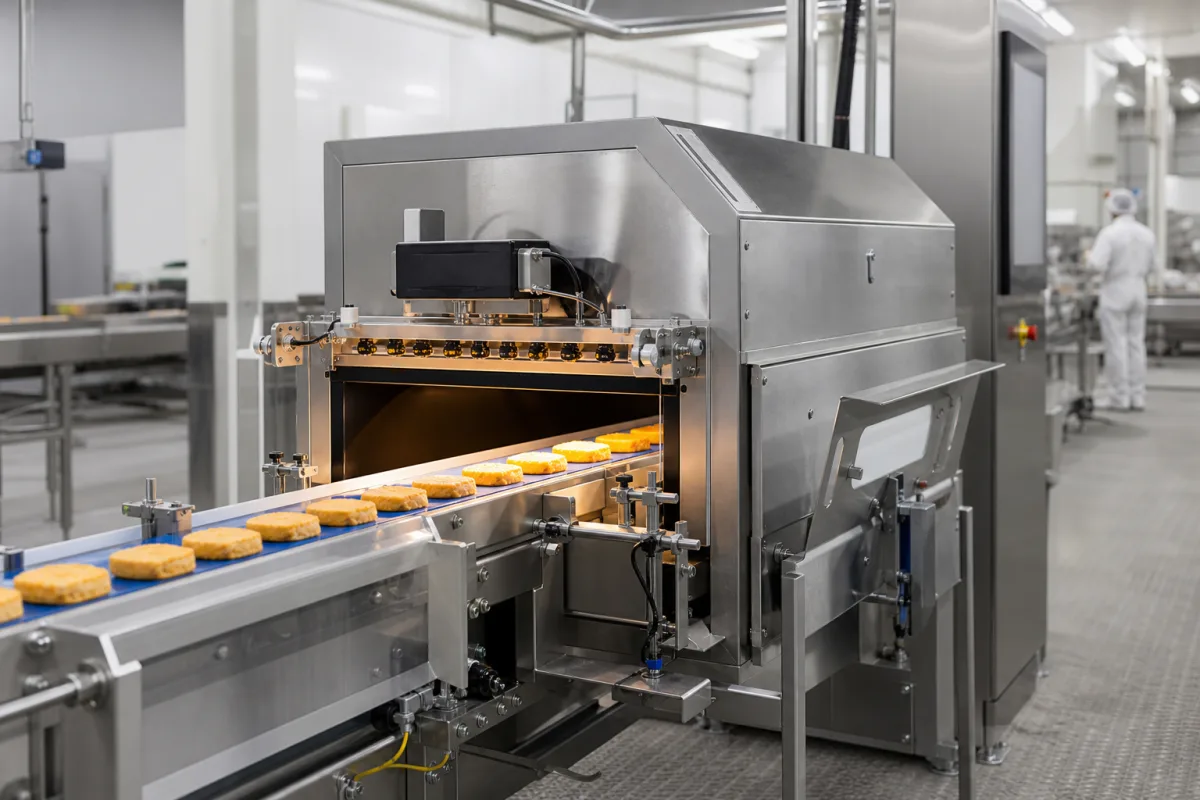
Inline colour measurement for food products on processing lines · tristimulus colorimeters and spectrophotometers, CIE L*a*b* and ΔE*ab colour difference, tolerance shapes, non-contact inline sensor specifications, metamerism limits, and how readings relate to visual colour standards such as the USDA fry colour scale
A food colour analyser measures the colour of products such as fried, baked or roasted foods and reports colour coordinates or differences from a target, either inline over a conveyor or on samples. Ask three things first: whether you need absolute colour coordinates or only differences from a reference, which instrument type (tristimulus colorimeter or spectral instrument) suits your products, and which grading standard or customer specification the readings must match.
Instruments and inline systems that measure the colour of food products for consistency and grading: tristimulus colorimeters, spectrophotometers and camera-based colour inspection. Display colour analysers for screens, optical sorters that reject individual items, and moisture analysers have their own pages or are outside this page.
CNFX editorial research · Sources checked October 12, 2026 · 9 sources
ASTM E1347 covers instrumental measurement of colour coordinates and colour differences with a tristimulus (filter) colorimeter, in reflected or transmitted light, using hemispherical (integrating sphere) or bidirectional (45:0 or 0:45) geometry. Because tristimulus colorimeters have limited absolute accuracy, it requires that, when colour coordinates are needed, the instrument be standardised against a product standard with similar spectral and geometric characteristics to the specimen. [1]
Tristimulus colorimeters give no reflectance or transmittance curves, so ASTM states they cannot reveal metamerism, and colour differences may only be measured between specimens with similar spectral and geometric characteristics. The method suits non-fluorescent, planar object-colour specimens. It does not cover spectrocolorimeters. ASTM adds that colorimeters with hemispherical geometry have a chromatic integrating-sphere error when standardised with a white standard. [1]
Where spectral data are measured, ASTM E308 provides the values and procedures to compute CIE tristimulus values X, Y, Z and chromaticity coordinates for the CIE 1931 and 1964 standard observers, with standard values for six CIE standard illuminants and three recommended fluorescent illuminants. [2]
Konica Minolta's colour booklet shows why spectral data matter for metamerism. In its example, two specimens read L* 50.93, a* 4.54, b* -5.12 under Standard Illuminant D65 (ΔE*ab = 0), but under Standard Illuminant A they read differently and ΔE*ab = 8.71. It states: "Tristimulus colorimeters can generally take measurements under only Standard Illuminant C and Standard Illuminant D65", which have similar spectral power distributions, so they cannot be used to measure metamerism; a spectrophotometer holds data for a wide range of illuminants and can. [5]
The same booklet describes two ways of handling gloss. SCE (specular component excluded) leaves out the specular reflection; SCI (specular component included) completes the sphere with a specular plug and measures specular plus diffuse reflection. HunterLab's SpectraTrend HT inline sensor, reviewed below, lists its specular component as excluded. [5][7]
Give the supplier the products and their surface (flat, irregular, breaded, glossy), whether measurement is inline or on samples, the line speed and product spacing, the colour scale and illuminant/observer required, the reference standards you use, the tolerance to be held, and the data and alarm outputs needed.
02
Express colour and set the tolerance in L*a*b*
Konica Minolta describes the L*a*b* colour space (CIELAB) as one of the uniform colour spaces defined by CIE in 1976. L* is lightness; +a* is the red direction and -a* green; +b* is yellow and -b* blue. The colour difference ΔE*ab is defined as the square root of (ΔL*)² + (Δa*)² + (Δb*)², a single number that gives the size of the difference but not its direction. In the booklet's apple example, ΔL* = +4.03, Δa* = -3.05 and Δb* = +1.04 give ΔE*ab = 5.16. [5]
Konica Minolta's tolerance guide lists four ways to set limits around the master colour: a box tolerance with ± limits on L*, a* and b*; ΔE*ab, which forms a sphere; CIE94, published by CIE in 1995 and based on automotive coating experiments on smooth surfaces; and CIE dE2000, which adds five compensations (hue rotation, neutral colours, lightness, chroma and hue) and forms an ellipsoid. It recommends assessing candidate samples visually in a light booth, measuring them, and setting the limits from the values furthest from the master that were still accepted. [6]
The booklet explains why ΔE*ab and the eye can disagree: the eye's discrimination thresholds are ellipses that lengthen in the saturation direction for highly saturated colours, while ΔE*ab treats every direction as a circle. The CIE 2000 formula was developed to close this gap. [5]
For browned foods, this means asking which tolerance shape the analyser applies and which formula (ΔE*, ΔE CMC or ΔE 2000) it reports. HunterLab lists ΔE*, ΔE, ΔE CMC and ΔE 2000 on its Aeros instrument and ΔE*, ΔE, ΔC*, ΔC and ΔE CMC on its SpectraTrend HT sensor. [9][7]
03
Compare inline and at-line sensor specifications
Two published datasheets show what non-contact sensors mounted over a line specify. Both measure 400–700 nm at 10 nm intervals and report CIE L*a*b*. The figures below are each maker's own published data, not results on food. [7][8]
X-Rite's sheet recommends validation every 30 days or 50,000 measurements, whichever comes first, and more frequent checks if the sensor is not kept clean. [8]
Editorial calculation: at its 1 s cycle time, 50,000 measurements take about 13.9 hours of continuous running, so on a line measuring without pause the measurement count arrives long before 30 days.
Note that the X-Rite sheet gives the enclosure as NEMA 4 / IP67 in its feature list and NEMA 4 / IP56 in its general specifications; confirm the rating in writing. The sheet is dated 2007. [8]
For irregular products sampled beside the line, HunterLab's Aeros measures a sample on a platter rotating at 12 RPM: 35 measurements per rotation, 177.25 cm² measured per 5-second rotation, sample height 65–140 mm. It quotes colorimetric repeatability of ΔE* < 0.025 maximum on a white tile and lists indices including Baking Contrast Units and SCAA. [9]
USDA grade standards for frozen french fried potatoes score colour at 30 of 100 points. Colour is judged as visually similar to the USDA Color Standards for Frozen French Fried Potatoes, which the standard says may also be used to classify the fry colour of other cooked products. [3]
The USDA inspection instructions describe the colour standards as colours numbered 0 to 4 that depict changes caused solely by frying. Sample units are designated Extra Light (No. 0) through Dark (No. 4), and sample units designated No. 4 Dark are not allowed in Grade A. The instructions note that some large users base raw potato contracts on these fry colours. [4]
Where a buyer or grade is defined against visual colour standards like these, ask the analyser supplier how its readings are correlated with the reference standards on your product. ASTM E1347 asks for the instrument to be standardised with a product standard of similar colour. [1]
05
Light source, spectrometer, geometry and white-tile standards inside an inline colour analyser
Part
Role
Fix in the order
Light source
LED source: full-spectrum balanced LED system (HunterLab); full system LED (X-Rite). [7][8]
2 companies list this product among what they make. Company figures are quoted from each
company's own website; every card states where the relationship came from.
CHNSpec Technology (Zhejiang)Co.,Ltd
Manufacturing site to be confirmed for the order
Its website lists the CS-600 series spectrophotometer for colour management in the food industry.
Explore company information and manufacturing capabilities, then discuss the scope of your project with a relevant supplier.
Share this page
Compiled and source-reviewed by the CNFX editorial team.
Each manufacturer above links to the page on that company's own website where the product is listed, with the date we checked it. How we source and review
· Page last updated 13 October 2026
Buyer questions
Can a tristimulus colorimeter detect metamerism?
No. ASTM E1347 states that tristimulus colorimeters give no spectral curves and cannot detect metamerism. [1]
How is fry colour graded by USDA?
Against the USDA Color Standards numbered 0 to 4. Colour scores 30 of 100 points, and No. 4 Dark sample units are not allowed in Grade A. [3][4]
What does ΔE*ab mean?
It is the CIE L*a*b* colour difference: the square root of (ΔL*)² + (Δa*)² + (Δb*)². Konica Minolta's example of two apples gives ΔE*ab = 5.16; the value shows the size of the difference, not its direction. [5]
How far from the product does an inline sensor sit?
HunterLab gives a working range of 65–115 mm for the SpectraTrend HT; X-Rite gives 4 in nominal for the VeriColor Spectro, tolerating ±0.20 in of depth change. [7][8]
Sources and what still needs a direct check
Sources checked 2026-10-12. The ASTM pages are public scope summaries of E1347 and E308. The USDA documents are the grade standard and inspection instructions for frozen french fried potatoes. Konica Minolta's booklet and tolerance note are maker education material. The HunterLab and X-Rite sheets are maker specifications for their own instruments, not results on food.