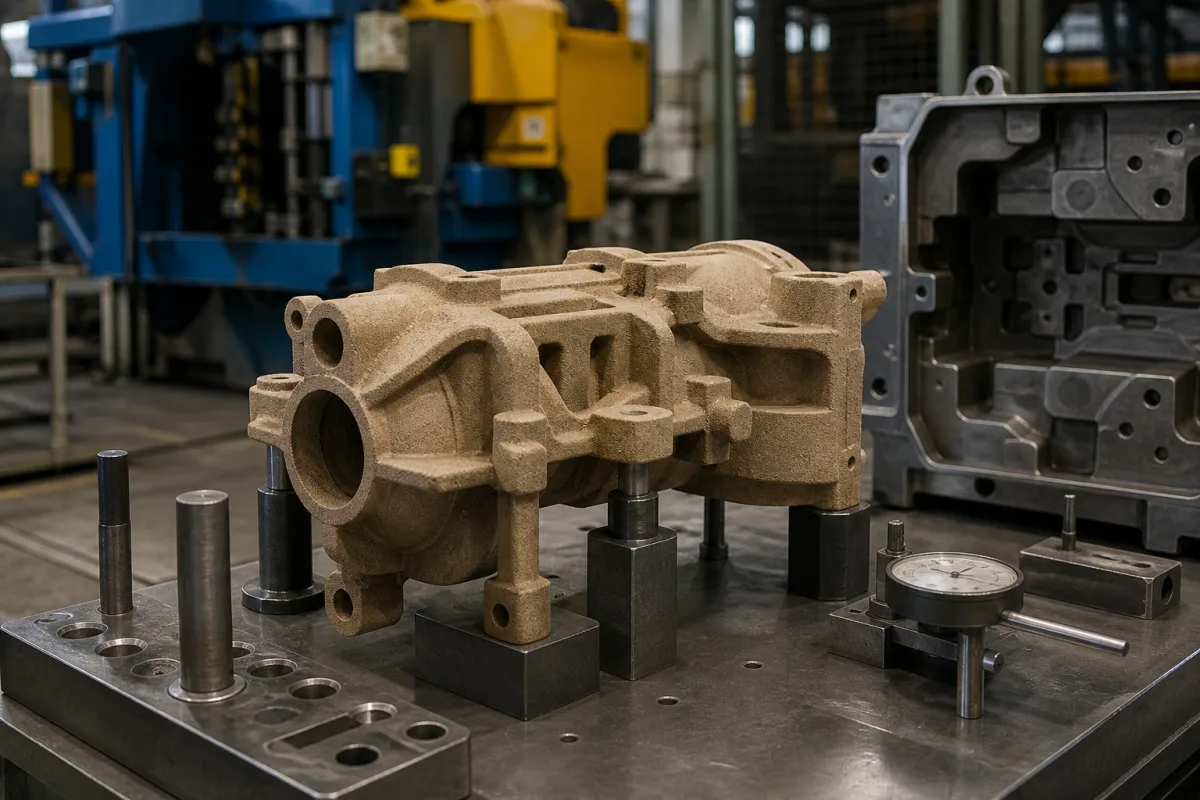
Foundry sand cores · Binder process (PU cold box, inorganic), core weight and geometry, dimensional accuracy, strength and thermal stability, coating, assembly into core packages, and shake-out
A casting core is a shaped body of bonded sand placed in a mould to form the internal passages and cavities of a casting — water jackets, oil ducts, ports — and broken out after the metal sets. Settle three things before asking for quotes: the binder process for your metal, volume and emission limits, the core geometry, weight and dimensional accuracy the casting needs, and the strength, coating, assembly and shake-out behaviour in your foundry.
Expendable sand cores and core packages for metal casting — cold box, inorganic and other bonded-sand cores — supplied by core shops or made in-house. Core-making machines, permanent metal cores and pins, ceramic cores for investment casting and the castings themselves are outside this page; sand moulding machines and ductile iron castings have their own pages.
CNFX editorial research · Sources checked October 12, 2026 · 4 sources
ASK Chemicals describes the PU cold box process as a phenol-formaldehyde resin (part 1) and an isocyanate (part 2) mixed with sand, compressed in a core box and hardened by gassing with a tertiary amine catalyst. ASK gives addition rates of 0.4–1.2% of the sand per part, depending on application and sand. The fast hardening suits automated series core production; cores can be cast shortly after production, can be assembled into packages and coated straight away, and have high thermal stability for water-jacket and oil-duct cores. ASK puts productivity at about twice that of the Croning (shell) process. [1]
Its INOTEC system is an inorganic, silicate-based core binder that ASK describes as emission-free, aimed especially at aluminium casting such as engine blocks and cylinder heads in permanent moulds, and also used for iron and other non-ferrous castings. [3]
Editorial calculation: at 0.4–1.2% per part for a two-part cold box binder, 100 kg of core sand takes 0.8–2.4 kg of combined binder; ask the core supplier which rate it uses, as binder level drives strength, gas evolution and shake-out. [1]
Give the supplier the casting drawing and metal, core drawings or 3D model, binder process required, core weight and quantity, dimensional tolerances and critical features, strength and handling needs, coating, assembly into core packages, packaging and delivery schedule, and any emission or sand-reclamation requirements.
02
Set core geometry, weight, accuracy and shake-out
ASK Chemicals' own core production makes cold box cores and core packages from 0.01 kg up to 350 kg, for prototypes and series, with core shooters covering a range of clamping dimensions, mixing plants, assembly lines and drying equipment. [2]
ASK lists cold box properties as high dimensional accuracy, smooth core surfaces, high initial strength for secure extraction with low core breakage, and good disintegration after casting: casting heat weakens the binder bridges so the sand can be removed mechanically, and the near pH-neutral sand can be regenerated and reused at high rates. The market asks of cold box resins include high reactivity, long bench life, low emissions and amine use, core box cleanliness and stability against water-based coatings. [1]
03
Plan amine emission control for a cold box core line
In the United States, the EPA's iron and steel foundry rule (40 CFR 63.7690, subpart EEEEE) sets a limit for each triethylamine (TEA) cold box mold or core making line at new and existing iron and steel foundries. The line must either keep TEA discharged through a conveyance to the atmosphere at or below 1 ppmv, or reduce TEA emissions by at least 99 percent, both shown by the performance test in § 63.7732(g). Where a wet acid scrubber controls the line, the 3-hour average scrubbing-liquid flow rate must not fall below the level set in the performance test, and the scrubber blowdown pH must not exceed 4.5, whether measured as a 3-hour average by a continuous monitoring system or once every 8 hours. The rule also requires a capture and collection system meeting accepted engineering standards for each TEA source. [4]
This applies to the amine-gassed PU cold box process described above, where the core is hardened by a tertiary amine catalyst; ASK describes its silicate-based INOTEC binder as emission-free. [1][3][4]
Editorial calculation: a 99% reduction means that if the core line exhausts 100 kg of TEA before control, no more than 1 kg may leave the stack.
40 CFR 63.7690 requirement (TEA cold box line)
Value
Emission limit, option (i)
TEA ≤ 1 ppmv at the stack
Emission standard, option (ii)
≥ 99% TEA reduction
Wet acid scrubber, liquid flow
3-hour average ≥ performance-test minimum
Wet acid scrubber, blowdown pH
≤ 4.5 (3-hour CPMS average or every 8 hours)
Capture system
Required for each TEA source
If cores are made by amine-gassed cold box in a US iron or steel foundry, ask the core supplier or equipment maker how the amine is captured and scrubbed, and for the scrubber flow and pH set points.
04
What to ask a core shop before trial castings
Ask each supplier for binder process and addition rate, core weight range, dimensional capability and measurement method, strength test results, coating and assembly options and sample cores for trial casting. [1][2]
05
Sand, binder, core box, coating and assembly: where core quality is set
Core properties to specify, from permeability to collapsibility
ASK's pages give a core weight range and qualitative cold box properties; permeability, moisture content and density have no published value here, so ask for the supplier's own test results.
Explore company information and manufacturing capabilities, then discuss the scope of your project with a relevant supplier.
Share this page
Compiled and source-reviewed by the CNFX editorial team.
Each manufacturer above links to the page on that company's own website where the product is listed, with the date we checked it. How we source and review
· Page last updated 13 October 2026
Buyer questions
How are cold box cores hardened?
A phenolic resin and an isocyanate mixed with sand are hardened in the core box by gassing with a tertiary amine catalyst. [1]
How much binder goes into a cold box core?
ASK Chemicals gives 0.4–1.2% of the sand per part for its two-part cold box binders. [1]
What sizes of sand cores can be made?
ASK Chemicals' core production covers cores and core packages from 0.01 kg to 350 kg. [2]
Are there emission-free core binders?
ASK's INOTEC inorganic silicate binder is described as emission-free, aimed especially at aluminium casting. [3]
Are amine emissions from cold box core making regulated?
In US iron and steel foundries, 40 CFR 63.7690 requires each TEA cold box core line to emit no more than 1 ppmv TEA or cut TEA by at least 99%, with acid scrubber blowdown pH kept at or below 4.5. [4]
Sources and what still needs a direct check
Sources checked 2026-10-12. ASK Chemicals' cold box technology, core production and INOTEC inorganic binder pages are used to show what a casting core specification covers; values for your order must come from the core supplier.