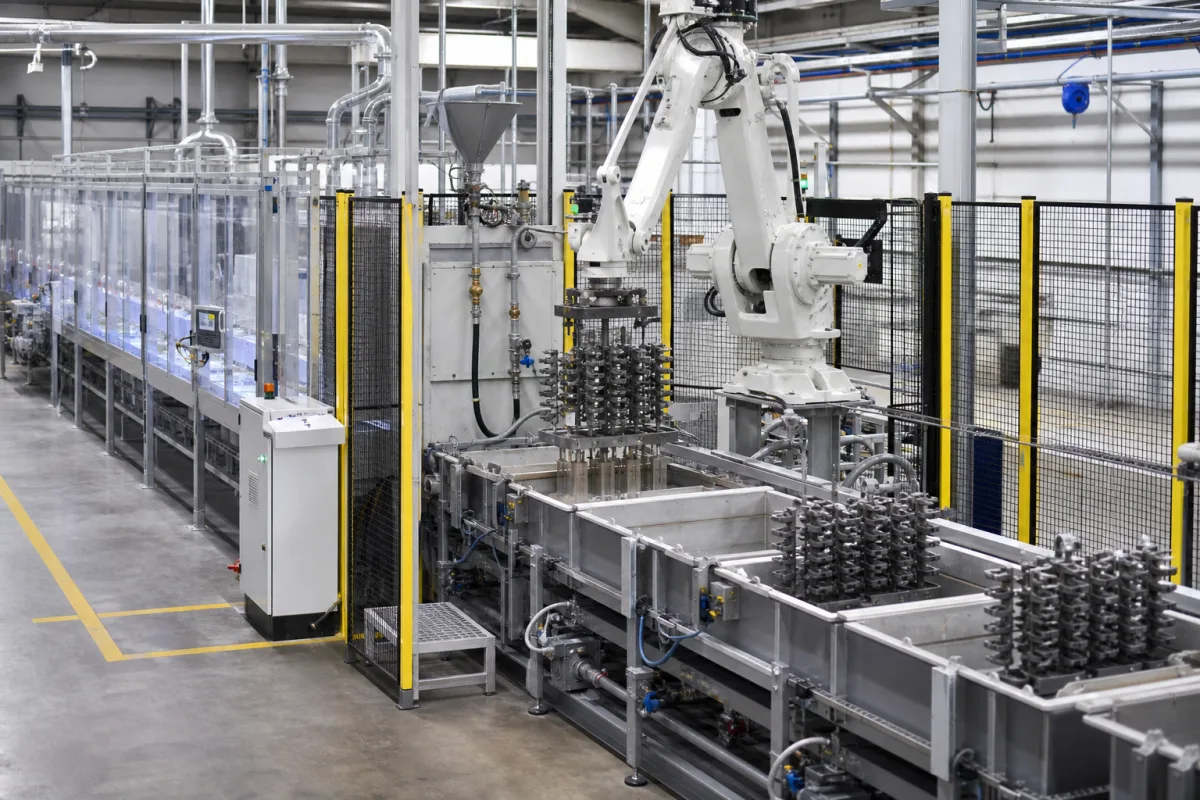
Automated investment-casting shell building · Robots dip wax clusters in slurry tanks, coat them in rainfall sanders or fluidized sand beds and route them through drying, under a supervisory system that tracks each mold
In precision (investment) casting, a wax pattern cluster is dipped repeatedly in ceramic slurry and coated with sand to build a shell, which is dried between coats before the wax is removed and metal is poured. An automated line hands the dipping, sanding and drying route to a robot and conveyors. Ask three things first: what cluster sizes and weights the robot must handle, how many coats and which slurry and stucco equipment, and how drying and mold tracking will be controlled.
Robotic shell-building lines for investment casting: robot dipping cells, slurry tanks, rainfall sanders, fluidized sand beds, drying conveyors and their control systems. Wax injection, dewaxing, melting furnaces (see induction melting furnace), die casting machines and continuous casting are outside this page.
CNFX editorial research · Sources checked October 11, 2026 · 4 sources
Vulcan Engineering lists the equipment of its automated shell coating systems as robotic mold handling, slurry tanks, a barrel sander, rainfall sanders, a control system and an overhead conveyor. It says its six-axis robots reach 13 to 22 feet and claims they can dip multiple wax clusters every three minutes. [1]
Its fluidized sand beds come in standard diameters of 30 in (750 mm), 36 in (900 mm), 48 in (1,200 mm), 60 in (1,500 mm) and 72 in (1,800 mm), or custom sizes. Each has a mild-steel air manifold with valves for tuning fluidization, a porous segmented bed sized to the customer's sand, a stainless tank to avoid rust contamination, a matched blower with filter, a clean-out door, a dust collar for the owner's dust collection, and an optional low-level probe that cuts the blower when sand runs low. [2]
An ABB case study describes a complete shelling system installed by Shell-O-Matic at Franklin Bronze in 2005: an ABB IRB 6600 robot, slurry tanks, fluidized beds and a rainfall sander with automatic sand feeding, with four compact conveyors drying the molds after each coat. [3]
Give the supplier the cluster sizes and loaded weights, number of coats, slurry and stucco types for prime and backup coats, rainfall sander or fluidized bed for each coat, target molds per day, drying time and climate per coat, room layout, dust collection, power and air supply, and how parts will be identified and tracked.
02
Plan the drying route and mold tracking
In the ABB case study, up to seven coatings, including colloidal slurry and a thin sand layer, are applied before shells are hung to dry for specified times. A supervisory computer reads a barcode as parts are loaded, chooses the robot's dipping program for that part, routes each mold through drying on its schedule and prints a report as the finished mold leaves. [3]
The case study reports that three workers made about 200 molds a day on the robot line, against about 100 a day from six workers dipping by hand; man-hours fell from 56 to 32 a day, and the roughly US$250,000 system was expected to pay back within 2.5 years. These figures date from 2005–2007 and describe one foundry. [3] Vulcan says its electronic shell management system provides inventory control and real-time shell tracking across robots, shell handling and conveyor drying. [1]
Editorial calculation: 200 molds from three workers is about 67 molds per worker per day, against about 17 per worker for 100 molds from six; cutting 56 to 32 man-hours a day is a 43% reduction. [3]
03
Questions for a shell-line builder before it quotes
Ask any supplier for robot reach and payload, cluster handling method, slurry tank sizes and mixing, sander and fluidized bed sizes, drying conveyor capacity and climate control, molds per day, tracking software, utilities, footprint and installation and training scope.
04
Set intercoat drying times from shell strength tests
Shell-materials maker REMET reports a laboratory trial on one backup slurry system: 60 modulus-of-rupture (MOR) bars, 12 each dried one, two, four, eight and 24 hours between dips, with five dips plus a sealcoat, at 50% relative humidity, a value chosen as representative of industry. [4]
Green and fired strength reached a virtual maximum at four hours between dips, with virtually no difference between four, eight and 24 hours. The one- and two-hour bars were much weaker because they were not dry: at 60 minutes 36.5% of the water remained, and at two hours about 11.5%. Longer final drying did not make up for short intercoat times; at one hour between dips, 24 hours of final drying instead of 12 added only 12 psi (9%) of green strength. REMET notes that its open MOR bars are easier to dry than production parts, and that longer drying reduces the potential for autoclave-related cracking. [4]
Editorial calculation: at four hours between dips, a seven-coat shell (the coat count in the ABB case study [3]) spends at least 24 hours in intercoat drying (6 intervals × 4 h) before its final dry. Ask what intercoat time and humidity the drying-conveyor capacity assumes.
05
Dipping robot, slurry tanks, sanders, drying conveyor and mold tracking
Stucco goes on either by a rainfall sander or by plunging the coated cluster into a fluidized sand bed; Vulcan builds its fluidized beds in 750–1,800 mm diameters. [1][2]
Part
Role
Fix in the order
Dipping robot
Dips and drains clusters, hangs them to dry. [1][3]
Dip cycle, molds per day and drying capacity of a shell line
Three rows carry published figures: Vulcan's claim of multiple clusters dipped every three minutes, about 200 molds a day in the ABB case study, and fluidized-bed diameters. The other rows have no value in the reviewed sources and must come from the builder. [1][3][2]
Field
What it means and published values
Ask the supplier for
Maximum Pouring Temperature (°C)
Pouring is outside the shell line; not stated in the reviewed sources.
Alloy data.
Cycle Time (seconds)
e.g. multiple clusters every three minutes (Vulcan claim). [1]
Explore company information and manufacturing capabilities, then discuss the scope of your project with a relevant supplier.
Share this page
Compiled and source-reviewed by the CNFX editorial team.
Each manufacturer above links to the page on that company's own website where the product is listed, with the date we checked it. How we source and review
· Page last updated 13 October 2026
Buyer questions
What equipment is in an automated shell line?
Vulcan lists robotic mold handling, slurry tanks, barrel and rainfall sanders, a control system and overhead conveyor. [1]
How many coats does an investment casting shell get?
In the ABB case study, up to seven coatings including colloidal slurry and a thin sand layer. [3]
What sizes do fluidized sand beds come in?
Vulcan lists standard diameters of 750, 900, 1,200, 1,500 and 1,800 mm, or custom. [2]
How long should an investment casting shell dry between dips?
In REMET's laboratory trial at 50% relative humidity, four hours between dips gave maximum or near-maximum strength, while one or two hours gave much weaker shells. [4]
Sources and what still needs a direct check
Sources checked 2026-10-11. Vulcan Engineering builds shell coating systems; ABB published a case study of a Shell-O-Matic robot shell line.