Editorial Technical Reference

Precision Casting Mold Cooling Channel Insert

This page explains how Precision Casting Mold Cooling Channel Insert is classified within Foundries. Technical values and manufacturer relationships are research references; confirm the current specification and supplier evidence for each order.

Technical Definition & Core Assembly

Specialized insert with internal cooling channels for temperature control in casting molds
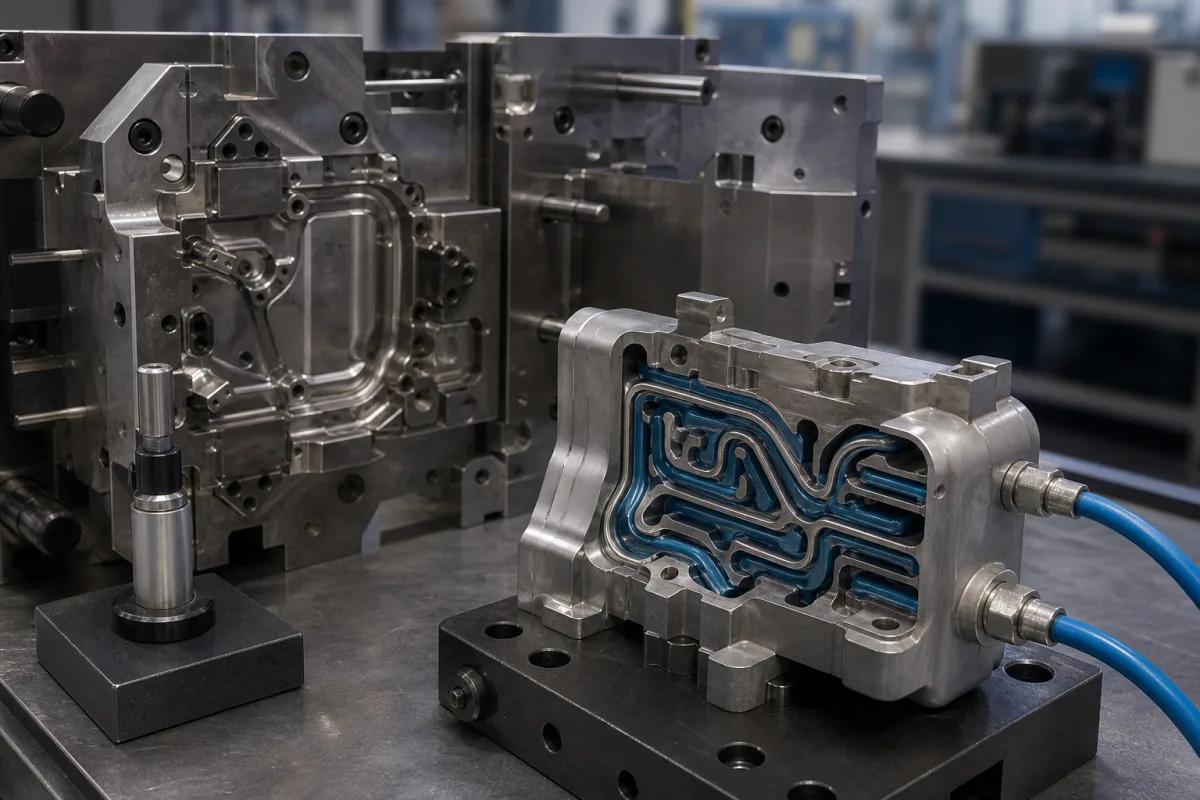
Representative product image. Confirm appearance and specifications with the manufacturer.

Product Specifications

Technical details and manufacturing context for Precision Casting Mold Cooling Channel Insert

Definition
The Precision Casting Mold Cooling Channel Insert is a component designed for integration into larger mold assemblies used in metal casting. Its primary function is to regulate mold temperature during the casting process by circulating coolant through internal channels. This helps achieve uniform cooling of the molten metal, which reduces thermal stress and minimizes defects such as shrinkage porosity. The insert is critical for maintaining dimensional accuracy and surface finish in cast parts, particularly in applications where precise temperature control is required.

This insert is typically made from H13 tool steel or copper alloy, materials selected for their thermal and mechanical properties. H13 tool steel offers high-temperature strength and wear resistance, while copper alloy provides superior thermal conductivity. The insert's dimensions and performance characteristics are specified by parameters such as maximum operating temperature (350–450 °C), cooling channel diameter (6–12 mm), surface hardness (45–55 HRC), thermal conductivity (25–40 W/m·K), pressure rating (1.0–1.6 MPa), dimensional tolerance (±0.05 mm per ISO 2768-mK), insert length (50–200 mm), insert diameter (20–80 mm), surface roughness (0.4–0.8 μm Ra per ISO 1302), cooling flow rate (5–20 L/min), and corrosion resistance (≥500 hours in salt spray per ASTM B117).

These values are reference ranges and must be verified for the specific model and application. The insert is installed within the mold, and coolant flows through its internal channels to extract heat, controlling the solidification rate of the cast metal. Proper selection of insert material, dimensions, and cooling parameters is essential for achieving desired casting quality. Maintenance and inspection should focus on channel integrity, surface condition, and dimensional accuracy. Failure to maintain proper cooling can lead to defects and reduced mold life. Always consult the legal manufacturer or supplier to confirm model-specific specifications and compliance with relevant standards.
Working Principle
Coolant flows through internal channels to extract heat from the mold, controlling solidification rates of cast metal. The insert is placed within the mold assembly, and a coolant (such as water or oil) is circulated through its internal passages. As the coolant absorbs heat from the surrounding mold material, it lowers the mold surface temperature, which influences the cooling rate of the molten metal. By adjusting the flow rate and temperature of the coolant, operators can control the solidification front, reducing thermal gradients and preventing defects like shrinkage porosity. The insert's material and channel design are optimized to provide efficient heat transfer while maintaining structural integrity under high temperatures and pressures.
Common Materials
H13 Tool Steel, Copper Alloy
Technical Parameters
ParameterTypical rangeNotes & selection driver
Maximum Operating TemperatureRequired350–450 °CHighest temperature the insert can withstand continuously
Cooling Channel DiameterRequired6–12 mmInternal diameter of cooling passages
Surface HardnessRequired45–55 HRCRockwell hardness of insert material
Thermal ConductivityRequired25–40 W/m·KMaterial's ability to conduct heat
Pressure RatingRequired1.0–1.6 MPaMaximum coolant pressure the channels can withstandISO 5208
Dimensional Tolerance±0.05 mmManufacturing precision of insert dimensionsISO 2768-mK
Material GradeH13Hot-work tool steel for high-temperature use.ASTM A681
Insert Length50–200 mmLength affects cooling uniformity.
Insert Diameter20–80 mmDiameter influences mold strength.
Surface Roughness0.4–0.8 μm RaSmoother surface reduces sticking.ISO 1302
Cooling Flow Rate5–20 L/minFlow rate affects heat transfer coefficient.
Corrosion Resistance≥500 h (salt spray)Minimum hours in salt spray test.ASTM B117

Ranges are indicative industry figures for RFQ preparation, not a supplier commitment. Confirm every value and standard with the legal manufacturer before ordering.

Components / BOM
  • Cooling Channel Network Part
    Distributes coolant throughout insert for heat extraction
    Material: Same as insert base material
  • Mounting Interface Part
    Provides secure attachment points to mold base
    Material: Same as insert base material
  • Thermal Barrier Coating Optional Part
    Optional coating to manage heat transfer characteristics
    Material: Ceramic or specialized coating
  • Insert Body
    The insert placed within the mold; carries the internal cooling channels that extract heat.

Industry Taxonomies & Aliases

Commonly used trade names and technical identifiers for Precision Casting Mold Cooling Channel Insert.

Industrial Ecosystem & Supply Chain Structure

Complementary Systems
Downstream Applications
Specialized Tooling

Application Fit & Sizing Matrix

Operational Limits
pressure: 0 to 150 bar
flow rate: 0.5 to 10 L/min per channel
temperature: -50°C to 400°C
slurry concentration: 0-30% solids by weight
Media Compatibility
✓ Water-glycol coolant ✓ Thermal oil ✓ Compressed air
Unsuitable: Highly corrosive acids (e.g., hydrochloric acid, sulfuric acid)
Sizing Data Required
  • Mold thermal load (kW)
  • Required cooling channel diameter (mm)
  • Available pressure drop (bar)

Reliability & Engineering Risk Analysis

Failure Mode & Root Cause
Thermal fatigue cracking
Cause: Repeated thermal cycling from molten metal contact and cooling water flow causes stress concentrations at channel corners, leading to crack initiation and propagation.
Corrosion and scaling
Cause: Coolant water impurities (dissolved minerals, chlorides) reacting with insert material at high temperatures, forming deposits that reduce heat transfer efficiency and promote pitting corrosion.
Maintenance Indicators
  • Visible coolant leakage at mold-insert interface during operation
  • Audible hissing or bubbling sounds from cooling channels indicating steam formation due to insufficient heat transfer
Engineering Tips
  • Implement regular water quality monitoring and treatment to maintain coolant pH (7.5-8.5) and hardness below 100 ppm to prevent scaling and corrosion
  • Use thermal imaging during production cycles to detect hot spots early and optimize cooling flow rates to minimize thermal stress gradients

Indicative industry ranges for design and RFQ preparation. Confirm the exact figures and applicable standard with the manufacturer before specifying.

Compliance & Manufacturing Standards

Applicable Standards
ISO 8062:2020 (Geometrical product specifications (GPS) - Dimensional and geometrical tolerances for moulded parts) ASTM A703/A703M-22 (Standard Specification for Steel Castings, General Requirements, for Pressure-Containing Parts) DIN 1681-1 (Steel castings for general purposes; unalloyed steels and low-alloy steels)

Quoted from the published standard.

Manufacturing Precision
  • Bore diameter: ±0.02 mm
  • Surface flatness: 0.1 mm per 100 mm length
Quality Inspection
  • Dye penetrant testing (PT) for surface defect detection
  • Coordinate measuring machine (CMM) dimensional verification

Manufacturers of Precision Casting Mold Cooling Channel Insert

Manufacturer profiles associated with Precision Casting Mold Cooling Channel Insert.

Sourcing Precision Casting Mold Cooling Channel Insert from China?
Tell us your specification and target quantity — we will match it against manufacturer records and come back with the factories that fit.
Request manufacturers We manufacture this

Manufacturer listings support early research and capability understanding. They are not certification, ranking, or transaction guarantees.

Technical documentation
Request current drawings, revision history, and a signed specification sheet.
Manufacturing capability
Verify equipment lists, process limits, capacity, and representative production evidence.
Inspection readiness
Confirm test methods, calibrated equipment, sampling plans, and traceable reports.
Supplier transparency
Check the legal entity, factory address, ownership, certifications, and direct contacts.

CNFX does not score or rank suppliers. Buyers must verify all claims and documents with the legal manufacturer before ordering.

Frequently Asked Questions

What materials are available for this insert?

The insert is available in H13 tool steel or copper alloy. H13 offers high-temperature strength, while copper alloy provides better thermal conductivity. The choice depends on the application's thermal and mechanical requirements.

What is the maximum operating temperature?

The maximum continuous operating temperature is 350–450 °C. This range should be verified for the specific model, as exceeding it may degrade the material properties.

How is the cooling channel diameter specified?

The internal cooling channel diameter ranges from 6 to 12 mm. The diameter affects coolant flow and heat transfer; the exact value must be confirmed with the manufacturer for your application.

What standards apply to this component?

Relevant standards include ISO 2768-mK for dimensional tolerance, ISO 1302 for surface roughness, and ASTM B117 for corrosion resistance. These are reference standards; compliance should be verified with the supplier.

Data Basis

Editorial classification, named public sources where available, and source-reviewed manufacturer records.

Preliminary Technical Classification
This page supports structured research, RFQ preparation, and supplier evaluation. It does not replace buyer-led supplier qualification, standards review, or technical approval.
Buyer enquiry

Request manufacturing insight for Precision Casting Mold Cooling Channel Insert

Ask for use case, specification boundaries, supplier type, and RFQ preparation information for this product.

Where it goes
Straight to the CNFX editorial desk, and to the manufacturer if this product is linked to a claimed profile. Nothing is broadcast to a supplier list.
Your details stay here
We do not sell or rent enquiry data, and we do not add you to a mailing list. Used only to answer this request.
No commission, no middleman
CNFX is a directory. We take no cut of any order and never negotiate on a supplier's behalf.
What we don't claim
A listing is not an endorsement. Qualify every supplier and verify every figure yourself before ordering.

Your business information is used only to process this request.

Thank you! Your message has been sent. We'll respond within 1–3 business days.
Sorry, we couldn't send your message. Please try again, or email us at contact@cnfx.com.

Need to Manufacture Precision Casting Mold Cooling Channel Insert?

Compare manufacturer profiles with relevant product and process capability.

Previous Product
Vacuum Induction Degassing Unit
Last Product
Get QuotesChat