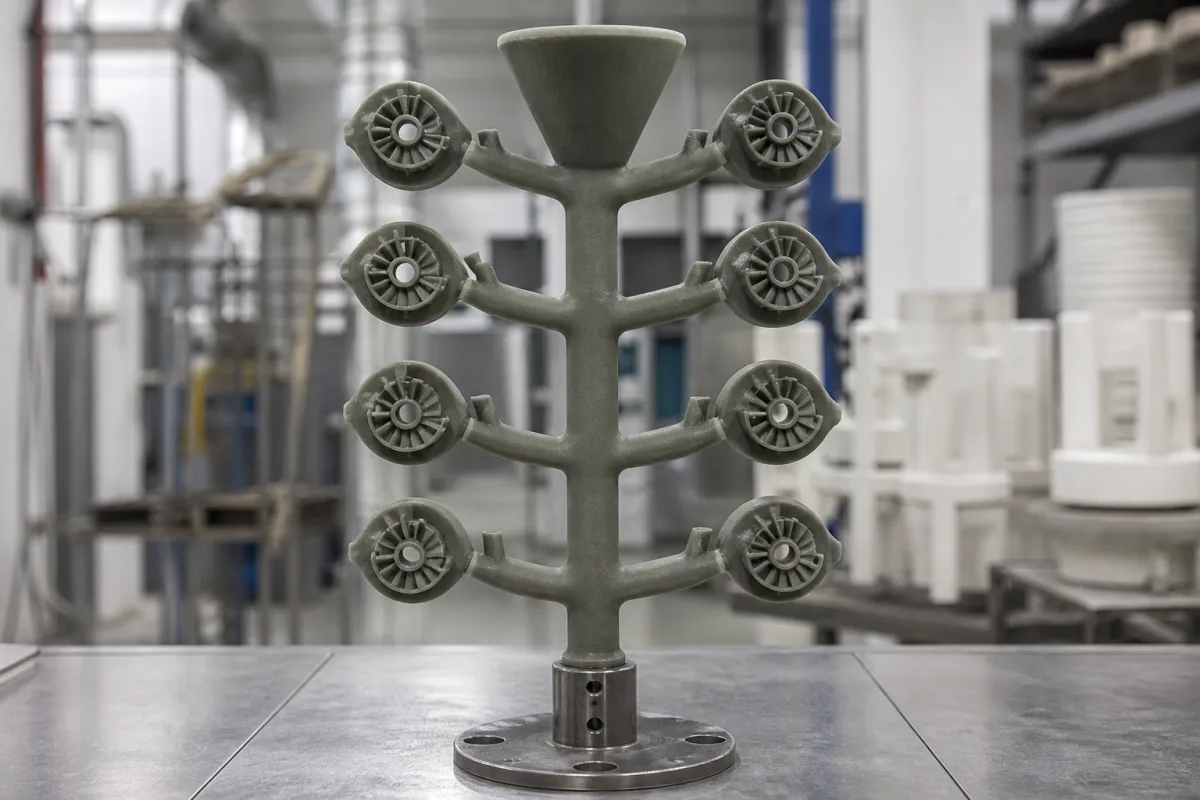
Investment casting runner system (gating tree of sprue, feeder bars, gates and pouring cup)
Investment casting gating tree · gate and feeder-bar sizing by modulus, wax tree assembly, pouring cups and ceramic runner parts
In investment casting the runner system is the gating tree: a pouring cup, a sprue or feeder bar and the gates that join each wax pattern to it, built in wax, invested in the ceramic shell with the patterns and later filled with metal; refractory pouring cups, runner tubes and filters are also sold as foundry parts for the metal entry. Ask three things first: how the gates and feeder bars are sized to feed each casting, how the patterns are joined to the wax runner, and which pouring and filtering components are supplied as parts.
Gating trees for investment (lost-wax) castings: wax sprues, feeder bars and gates, their sizing and assembly, and refractory pouring cups, runner tubes and filters used with them. Robotic shell-building lines are covered on the Automated precision casting production line page; die-casting runners, sand-casting gating and melting equipment are outside this page.
CNFX editorial research · Sources checked October 12, 2026 · 3 sources
Size the gates and feeder bars from the casting's modulus
Writing in Foundry Management & Technology, Finite Solutions describes adapting sand-casting rigging rules to investment castings with simulation: first simulate the casting without rigging, using the alloy, shell material, pouring temperature and shell pre-heat temperature, to find the last points to freeze on each feeding path, which are the preferred gate contact points; then size gates and feeder bars by the modulus technique, with solidification time converted into a thermal modulus that also reflects insulating wraps such as Kaowool or Fiberfrax. [1]
Its sizing guidelines are: the 2D modulus of the casting end of the gate equals the maximum modulus of the feeding zone, the 2D modulus of the feeder-bar end of the gate is 1.2 times that maximum, and the 2D modulus of the feeder bar is also 1.2 times the maximum; for a square cross-section the modulus is the edge length divided by 4. The rigged tree is then checked by CFD and solidification simulation, and reusable items such as a standard pouring cup can be kept as library components. [1]
Editorial calculation: for a feeding zone with a maximum modulus of 5 mm (an assumed value), a square gate is 4 × 5 = 20 mm across at the casting and 4 × 1.2 × 5 = 24 mm at the feeder bar, and a square feeder bar is 24 mm across. Run the same arithmetic on the thermal modulus your simulation gives for each pattern. [1]
Give the supplier or tooling shop the casting model and alloy, shell system, pouring and pre-heat temperatures, simulation results or maximum modulus per feeding zone, number of patterns per tree, gate and feeder-bar sections, pouring cup type, filters, and the wax or ceramic parts to be supplied.
02
Assemble the wax tree so the shell and metal stay sound
RMC, a Qingdao investment casting foundry, states that wax tree assembly influences the quality of the raw castings and the fluidity of the molten metal, especially for steel alloys. Its steps include inspecting every wax pattern, checking the wax runner (die head), fitting a cleaned cover plate on the gate cup and closing any gap with an electric soldering iron so slurry cannot flow into the shell, welding the patterns neatly and firmly to the runner with bonding wax or a soldering iron, marking the metal on the gate cup, and blowing wax chips off the module before it goes to washing. [2]
Its precautions are that the welds between patterns and runner be firm and seamless, that all patterns on one module be of the same material, and that wax droplets be scraped off the patterns. [2] Editorial note: the same article also gives steps for casting in a steel flask with plaster, which belong to flask investing rather than ceramic-shell trees; follow your own shell process for those stages.
For the metal entry, Cangzhou Sefu lists ceramic and related foundry products including pouring cups, riser sleeves, sprue and runner components, paper sprue runner casting tubes and ceramic foam and honeycomb filters. [3] Ask which of these parts suit an investment shell and its pre-heat temperature before ordering them for a tree.
03
Refractory pouring cups, runner parts and filters from Cangzhou Sefu
Cangzhou Sefu lists pouring cups, sprue and runner components and casting filters. Ask for the material, maximum service temperature and sizes of each part.
04
Pouring cup, sprue, feeder bars, gates and wax runner head
The wax parts form the path the metal will take, so each joint is sealed against slurry before dipping; the pouring cup and optional filter are refractory parts added to the tree.
Part
Role
Fix in the order
Pouring cup
Receives the metal; can be a standard library part. [1][3]
Size, material.
Sprue or feeder bar
Feeds the gates; 2D modulus 1.2 × zone maximum. [1]
Section and length.
Gates
Join each casting at its last point to freeze. [1]
Taper, contact point.
Wax runner (die head) and cover plate
Base the patterns are welded to; sealed gate cup. [2]
Explore company information and manufacturing capabilities, then discuss the scope of your project with a relevant supplier.
Share this page
Compiled and source-reviewed by the CNFX editorial team.
Each manufacturer above links to the page on that company's own website where the product is listed, with the date we checked it. How we source and review
· Page last updated 13 October 2026
Buyer questions
How are gates sized on an investment casting tree?
Finite Solutions' guideline sets the casting end of the gate at the feeding zone's maximum modulus and the feeder-bar end at 1.2 times it. [1]
Where should gates be attached?
At the last points to freeze on each feeding path, found by simulating the casting without rigging. [1]
What matters when welding wax patterns to the runner?
RMC requires firm, seamless welds, patterns of one material per module, and sealed gate cups so slurry cannot enter. [2]
What refractory parts are used with gating systems?
Cangzhou Sefu lists pouring cups, sprue and runner components, runner tubes and ceramic filters. [3]
Sources and what still needs a direct check
Sources checked 2026-10-12. Foundry Management & Technology published Finite Solutions' simulation-based rigging guidelines; RMC is a foundry describing its wax tree assembly; Cangzhou Sefu describes its own foundry consumables.