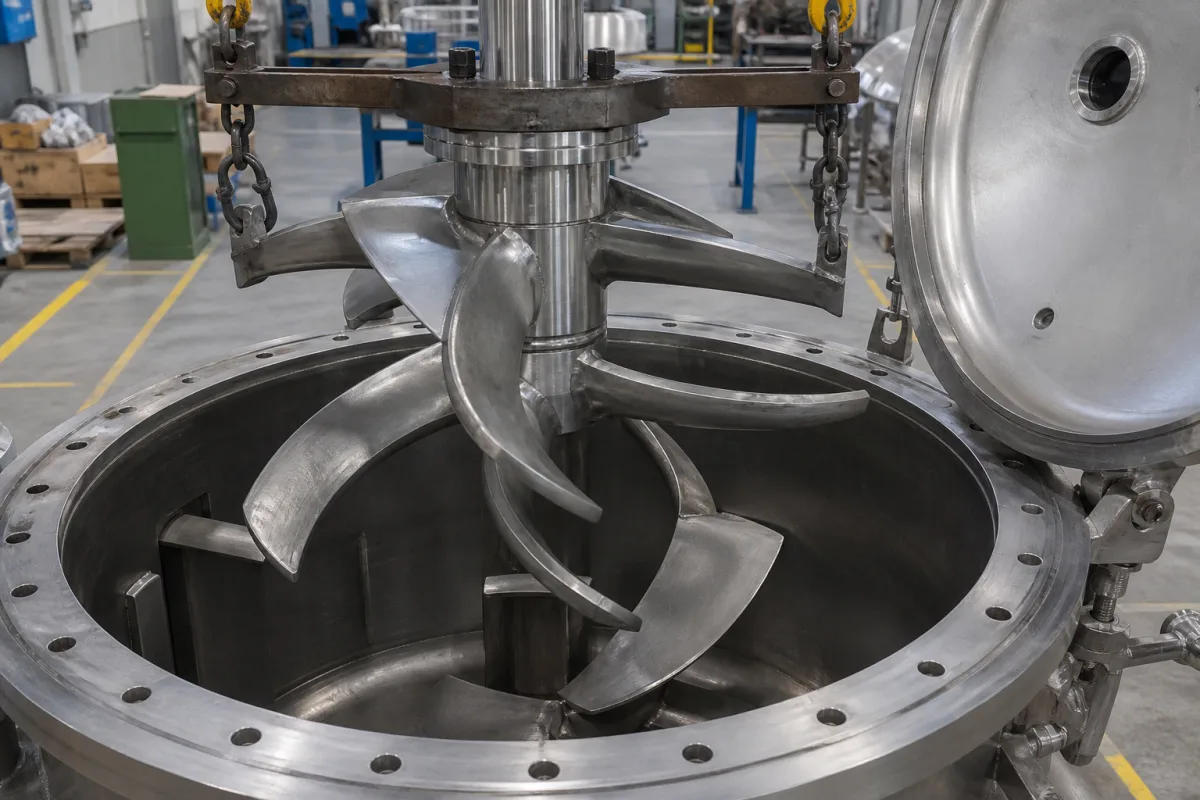
Curved paddle agitators (retreat-curve impellers) for glass-lined and pharmaceutical reactors
Swept-back paddles mounted close to a dished or conical bottom in vessels that have one beavertail baffle or none instead of four wall baffles · power number 0.3 to 0.9 in water depending on baffling, 2.4 in glycerine, and what fill level does to power and blend time
Glass-lined reactors, the workhorses of pharmaceutical and fine-chemical plants, have a coat of glass on the agitator and every wetted surface. NJIT researchers note that glass-lining fabrication issues lead these vessels to use a retreat-blade paddle mounted low over the bottom, and that because wall baffles cannot easily be mounted on a glass-lined wall, a single beavertail baffle hung from the top is used instead. The retreat-curve paddle has broad blades swept back from the direction of rotation. In such partly baffled vessels the measured power draw and blend time turn on the number of baffles and on how full the vessel is, as the studies below show.
Curved (retreat-curve, retreat-blade) paddle agitators for glass-lined, alloy and pharmaceutical stirred reactors, including their low bottom clearance and their behaviour with partial baffling such as beavertail baffles. Radial turbines, pitched-blade turbines, propellers and hydrofoils are covered on the Chemical reactor agitator blade (agitator impeller) page; the vessel as a whole on the Mixing vessel (agitated mixing tank) for liquids and Chemical reactor (jacketed stirred tank) pages; the paddle wheels inside tablet press feeders on the Pharmaceutical tablet press feed frame page.
CNFX editorial research · Sources checked October 12, 2026 · 3 sources
Power number of a three-blade retreat-curve paddle with four, one or beavertail baffles
Habib and co-workers at the University of Engineering and Technology, Peshawar, measured a 0.18 m three-blade retreat-curve paddle in a 0.29 m conical-based vessel holding 20 L, with water and glycerine, at clearances C/T of 0.16 and 0.32. [1]
The effect of clearance between C/T 0.16 and 0.32 was very small, and going from two beavertail baffles to one made almost no difference, while going from four wall baffles to one cut the power number. The paper cites earlier work with two beavertail baffles and D/T 0.58 in which Po fell from 0.79 to 0.70 between Re 10⁴ and 10⁵. [1]
Editorial calculation: shaft power is Po·ρ·N³·D⁵, so at the same speed a paddle drawing Po 0.4 (one baffle) uses about half the power of one at Po 0.75 (four baffles); the test paddle's D/T is 0.18 ÷ 0.29 = 0.62, much larger than the D/T of 1/3 the authors used for their pitched-blade comparison. Size the motor for the fullest baffling and the highest viscosity the batch will reach.
Dow Chemical engineers explain why such vessels run partly baffled: liquids that foul internals have led some plants to reduce baffling, leaving one or two glass-coated baffles that do not reach the bottom where the paddle sits, which can produce strongly swirling flow early in a semi-batch process. [3]
Give the paddle supplier the vessel diameter and bottom shape, the number and type of baffles (wall, beavertail, finger), the viscosity range over the batch and the bottom clearance, so the power number used for motor sizing matches the real vessel.
02
Partly filled batches: power number and blend time against liquid level
A 2013 NJIT thesis by Aniruddha Banerjee tested a retreat-blade paddle in a torispherical-bottomed 61 L scale model of a commercial De Dietrich glass-lined reactor, at liquid heights H/T from 0.3 to 1, six speeds between 75 and 200 rpm, and three baffling cases: one beavertail, four rectangular wall baffles, and none. [2]
The power number rose with more complete baffling and fell as the H/T ratio decreased. The 95 % blend time was inversely proportional to agitation speed in the partly and fully baffled vessels, with large deviations at low fill, but not always in the unbaffled one. [2]
Editorial note: for a semi-batch reaction that starts at H/T 0.3 and ends near 1, power per unit volume and blend time change during the batch; ask for the paddle's performance at the starting level, not only at full volume.
03
Why a large curved paddle blends quickly in a conical vessel
In the Peshawar tests, a standard pitched-blade turbine (Po 1.3, D/T 1/3) in a flat-based vessel gave a dimensionless 95 % mixing time Nθ95 of 44, matching Ruszkowski's correlation; the retreat-curve paddle in the conical vessel cut that dimensionless mixing time by 50 %, with no dependence on clearance at the two values tested. [1]
The authors' abstract puts the quick blending “mainly due to the use of a large RCI impeller”. [1] Editorial calculation: half of 44 is 22 revolutions; at 100 rpm that is about 13 s, against about 26 s for the pitched-blade turbine, before scale-up.
Editorial note: the test vessel was a 20 L conical model; ask the supplier for blend-time data or a scale-up basis for the actual vessel, and for the blade profile drawn against the vessel bottom with the gap at the outlet.
04
What to send for a curved paddle agitator
Paste it into your enquiry below or into an email to a maker, then replace every bracket.
Vessel: [diameter; bottom shape; volume; glass-lined or alloy]
Baffles: [number; wall, beavertail or finger; length]
Paddle: [diameter; number of blades; bottom clearance; coating]
Process: [viscosity range; fill levels from start to end; solids]
Drive: [speed range; motor power at fullest baffling and highest viscosity]
Documents: [power number basis; blade drawing against vessel bottom]
Explore company information and manufacturing capabilities, then discuss the scope of your project with a relevant supplier.
Share this page
Compiled and source-reviewed by the CNFX editorial team.
Each manufacturer above links to the page on that company's own website where the product is listed, with the date we checked it. How we source and review
· Page last updated 13 October 2026
Buyer questions
What is the power number of a retreat-curve paddle?
In a 0.29 m conical vessel Habib et al. measured 0.9 to 0.6 in water with four wall baffles, 0.5 to 0.3 with one, and 2.4 in pure glycerine at low Reynolds number. [1]
Why are retreat-curve paddles used in glass-lined reactors?
NJIT links the low-mounted retreat-blade paddle to glass-lining fabrication issues, and notes a single beavertail baffle replaces wall baffles; Dow describes plants left with one or two glass-coated baffles. [3][2]
Does fill level change paddle power?
Yes; NJIT found the power number falls as the liquid height-to-diameter ratio decreases from 1 to 0.3. [2]
Do beavertail baffles act like full baffling?
No; Habib et al. found one or two beavertail baffles gave power numbers within the single-wall-baffle range. [1]
Sources and what still needs a direct check
Sources checked 2026-10-12. Power numbers and mixing times come from Habib et al. (Sindh University Research Journal, 2013) and Banerjee's 2013 NJIT thesis; the reason for partial baffling from a Dow Chemical presentation abstract at the 2006 AIChE Annual Meeting.