Industry-Verified Manufacturing Data (2026)

Agitator/Feeder Mechanism

Based on aggregated insights from multiple verified factory profiles within the CNFX directory, the standard Agitator/Feeder Mechanism used in the Machinery and Equipment Manufacturing sector typically supports operational capacities ranging from standard industrial configurations to heavy-duty production requirements.

Technical Definition & Core Assembly

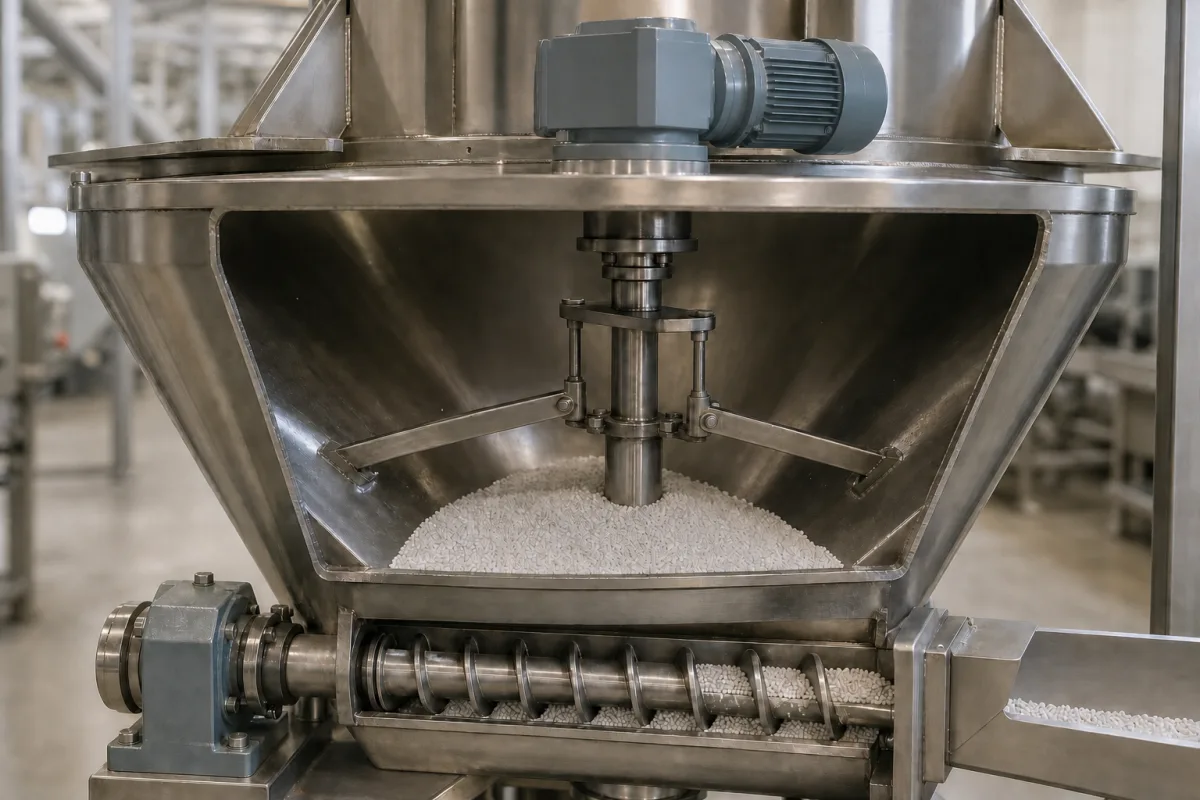
A canonical Agitator/Feeder Mechanism is characterized by the integration of Agitator Shaft and Agitation Paddles/Blades. In industrial production environments, manufacturers listed on CNFX commonly emphasize Stainless Steel construction to support stable, high-cycle operation across diverse manufacturing scenarios.

A mechanical component within a sorting hopper that agitates materials to prevent bridging and feeds them consistently to downstream processes.
Product Specifications

Technical details and manufacturing context for Agitator/Feeder Mechanism

Definition
The agitator/feeder mechanism is an integral part of a sorting hopper system designed to handle bulk materials. It combines agitation functions to break up clumps and prevent material bridging or arching with controlled feeding capabilities to ensure a steady, uniform flow of materials to subsequent sorting, processing, or packaging stages. This mechanism maintains material consistency and prevents blockages that could disrupt the sorting operation.
Working Principle
Typically consists of rotating paddles, screws, or vibrating elements that gently stir the material within the hopper while simultaneously conveying it toward the discharge point. The agitation action prevents material compaction and ensures free flow, while the feeding component controls the discharge rate through adjustable speed, gate openings, or vibration intensity.
Common Materials
Stainless Steel, Carbon Steel, Food-Grade Plastics
Technical Parameters
  • Diameter or width of the agitator/feeder element (mm) Standard Spec
Components / BOM
  • Agitator Shaft
    Central rotating component that supports agitation elements
    Material: Stainless Steel
  • Agitation Paddles/Blades
    Elements that physically stir and break up material
    Material: Stainless Steel or Food-Grade Plastic
  • Drive Motor
    Provides rotational power to the agitator/feeder mechanism
    Material: Various (housing typically steel or aluminum)
  • Feeding Element
    Screw, conveyor, or gate that controls material discharge
    Material: Stainless Steel
Engineering Reasoning
0.5-3.0 m/s agitator tip speed, 15-60 RPM rotational speed, 0.2-1.5 kN·m torque
Material bridging occurs at particle size > agitator blade clearance × 1.5, torque exceeds 2.0 kN·m causing shaft deformation > 0.5 mm, vibration amplitude > 0.8 mm RMS
Design Rationale: Bridging failure due to Janssen effect in granular materials with internal friction angle < 30°, mechanical failure from fatigue at stress concentration factor Kt > 3.0 in shaft fillets, bearing seizure at PV factor > 1.8 MPa·m/s
Risk Mitigation (FMEA)
Trigger Material adhesion coefficient μ > 0.7 causing torque spikes
Mode: Shear pin failure at 2.5 kN·m torque threshold
Strategy: Teflon-coated blades with μ < 0.3, torque limiter with 2.0 kN·m setpoint
Trigger Abrasive particle concentration > 15% by mass
Mode: Blade wear rate > 0.1 mm/hour causing clearance loss
Strategy: Hardened steel blades (HRC 55-60), wear-resistant tungsten carbide inserts

Industry Taxonomies & Aliases

Commonly used trade names and technical identifiers for Agitator/Feeder Mechanism.

Applied To / Applications

This component is essential for the following industrial systems and equipment:

Industrial Ecosystem & Supply Chain DNA

Complementary Systems
Downstream Applications
Specialized Tooling

Application Fit & Sizing Matrix

Operational Limits
pressure: Atmospheric to 2 bar
flow rate: 0.5 to 50 m³/h
temperature: -20°C to 120°C
slurry concentration: Up to 70% solids by weight
Media Compatibility
✓ Dry granular materials (e.g., grains, plastics pellets) ✓ Wet slurries (e.g., mineral concentrates, wastewater sludge) ✓ Free-flowing powders (e.g., cement, flour)
Unsuitable: Highly abrasive materials with Mohs hardness >7 (e.g., silicon carbide, alumina)
Sizing Data Required
  • Hopper volume and geometry (m³)
  • Material bulk density (kg/m³)
  • Required throughput rate (tons/hour)

Reliability & Engineering Risk Analysis

Failure Mode & Root Cause
Bearing fatigue and seizure
Cause: Inadequate lubrication, contamination ingress, or misalignment leading to excessive radial/axial loads on agitator shaft bearings.
Impeller blade wear and fracture
Cause: Abrasive particle erosion, corrosion from chemical exposure, or fatigue from cyclic loading and material stress concentrations.
Maintenance Indicators
  • Unusual grinding or knocking noises from the gearbox or drive assembly
  • Excessive vibration or wobbling of the agitator shaft during operation
Engineering Tips
  • Implement condition-based lubrication with high-temperature, water-resistant grease and install bearing isolators to prevent contamination.
  • Use wear-resistant coatings (e.g., tungsten carbide) on impeller blades and conduct regular alignment checks with laser tools to minimize dynamic stresses.

Compliance & Manufacturing Standards

Reference Standards
ISO 1940-1:2003 (Balance quality requirements for rigid rotors) ANSI/ASME B73.1-2012 (Specification for horizontal end suction centrifugal pumps for chemical process) DIN 28131-1:2012 (Agitators for vessels - Part 1: Main dimensions and nominal powers)
Manufacturing Precision
  • Shaft runout: +/-0.05mm
  • Impeller clearance: +/-0.1mm
Quality Inspection
  • Non-destructive testing (NDT) for weld integrity
  • Vibration analysis for dynamic balance verification

Factories Producing Agitator/Feeder Mechanism

Verified manufacturers with capability to produce this product in China

✓ 98% Supplier Capability Match Found

P Procurement Specialist from Singapore Jan 11, 2026
★★★★★
"Impressive build quality. Especially the technical reliability is very stable during long-term operation."
Technical Specifications Verified
T Technical Director from Germany Jan 08, 2026
★★★★★
"As a professional in the Machinery and Equipment Manufacturing sector, I confirm this Agitator/Feeder Mechanism meets all ISO standards."
Technical Specifications Verified
P Project Engineer from Brazil Jan 05, 2026
★★★★★
"Standard OEM quality for Machinery and Equipment Manufacturing applications. The Agitator/Feeder Mechanism arrived with full certification."
Technical Specifications Verified
Verification Protocol

“Feedback is collected from verified sourcing managers during RFQ (Request for Quote) and factory evaluation processes on CNFX. These reports represent historical performance data and technical audit summaries from our B2B manufacturing network.”

17 sourcing managers are analyzing this specification now. Last inquiry for Agitator/Feeder Mechanism from Thailand (1h ago).

Supply Chain Compatible Machinery & Devices

Heavy-Duty CNC Plasma Cutting Machine

Industrial machine for precision metal cutting using plasma arc technology

Explore Specs →
Automated Assembly Line System

Integrated production system for sequential component assembly operations

Explore Specs →
Automated Powder Coating System

Integrated industrial system for applying dry powder coatings to metal substrates.

Explore Specs →
Centrifugal Pump Impeller

Rotating component that transfers energy to fluid in centrifugal pumps.

Explore Specs →

Frequently Asked Questions

What materials are available for the agitator/feeder mechanism?

Our agitator/feeder mechanisms are available in stainless steel, carbon steel, and food-grade plastics to suit various industrial applications and material compatibility requirements.

How does the agitator/feeder prevent material bridging in hoppers?

The mechanism uses rotating paddles or blades to continuously agitate materials, breaking up clumps and preventing bridging that can disrupt material flow in sorting hoppers.

What are the main components of the agitator/feeder mechanism?

Key components include the agitator shaft, agitation paddles/blades, drive motor, and feeding element, all designed for reliable operation in demanding industrial environments.

Can I contact factories directly on CNFX?

CNFX is an open directory, not a transaction platform. Each factory profile provides direct contact information and production details to help you initiate direct inquiries with Chinese suppliers.

Get Quote for Agitator/Feeder Mechanism

Request technical pricing, lead times, or customized specifications for Agitator/Feeder Mechanism directly from verified manufacturing units.

Your business information is encrypted and only shared with verified Agitator/Feeder Mechanism suppliers.

Thank you! Your message has been sent. We'll respond within 1–3 business days.

Need to Manufacture Agitator/Feeder Mechanism?

Connect with verified factories specializing in this product category

Add Your Factory Contact Us
Previous Product
Agitator Paddles
Next Product
Agitator/Stirrer