Machine Bed & Column
View system integration details
This page explains how Bed Casting/Weldment is classified within Machinery and Equipment Manufacturing. Technical values and manufacturer relationships are research references; confirm the current specification and supplier evidence for each order.
The structural foundation of a machine bed, manufactured through casting or welding processes to provide rigidity and stability.
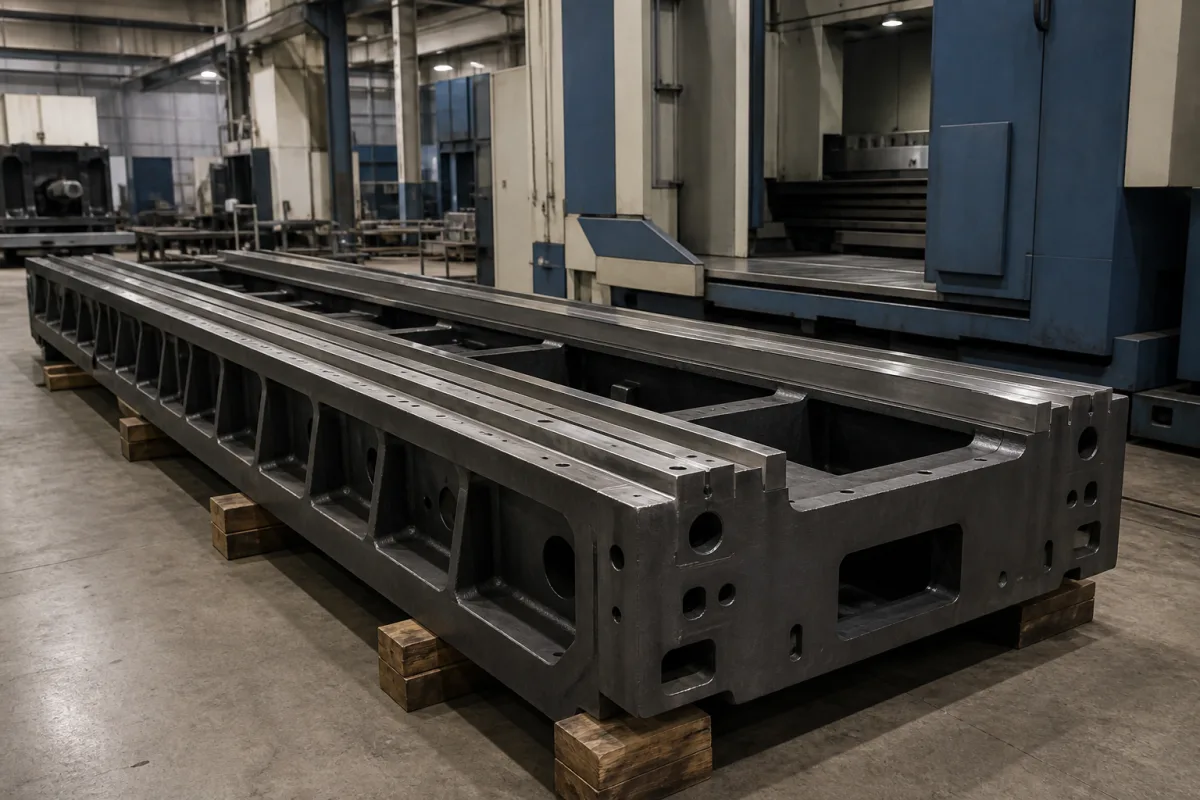
Technical details and manufacturing context for Bed Casting/Weldment
| Parameter | Typical range | Notes & selection driver |
|---|---|---|
| Material Grade | HT250–HT300 | Higher grade for higher rigidityGB/T 9439 |
| Tensile Strength | 250–300 MPa | Minimum for structural integrityGB/T 9439 |
| Hardness | 170–240 HB | Affects wear resistanceGB/T 9439 |
| Flatness Tolerance | 0.02–0.05 mm/m | Critical for guideway accuracyISO 1101 |
| Surface Roughness | Ra 1.6–3.2 μm | For mounting surfacesISO 1302 |
| Operating Temperature | -20–60 °C | Beyond range may cause distortion |
| Damping Capacity | 0.05–0.10 log dec | Higher reduces vibration |
| Weight | 500–5000 kg | Depends on machine size |
| Maximum Load Capacity | 10–50 kN | Static load on bed |
| Thermal Conductivity | 45–50 W/(m·K) | Affects heat dissipation |
| Modulus of Elasticity | 100–130 GPa | Stiffness of material |
| Corrosion Resistance | ISO 9227 h | Salt spray test durationISO 9227 |
Ranges are indicative industry figures for RFQ preparation, not a supplier commitment. Confirm every value and standard with the legal manufacturer before ordering.
| pressure: | Static structural loads only (no internal pressure rating) |
| other spec: | Maximum deflection tolerance: 0.1-0.5 mm/m (application dependent) |
| temperature: | -40°C to 200°C (depending on material and coating) |
Indicative industry ranges for design and RFQ preparation. Confirm the exact figures and applicable standard with the manufacturer before specifying.
Quoted from the published standard.
A practical evidence checklist for RFQ preparation and supplier evaluation.
Compare the published product scope and source details, then include your specifications and quantity in an enquiry.
Manufacturer profiles associated with Bed Casting/Weldment.
Explore company information and manufacturing capabilities, then discuss the scope of your project with a relevant supplier.
Ask for use case, specification boundaries, supplier type, and RFQ preparation information for this product.
Common materials include cast iron (e.g., HT250–HT300 per GB/T 9439) and steel. Cast iron offers good damping and wear resistance, while steel provides higher strength and toughness. The choice depends on the application's load, vibration, and cost requirements.
Flatness tolerance on guideways is typically 0.02–0.05 mm/m per ISO 1101, and surface roughness on mounting surfaces is Ra 1.6–3.2 μm per ISO 1302. These ensure alignment accuracy and proper mating with other components.
The recommended operating range is -20 to 60 °C. Beyond this range, thermal expansion or contraction may cause distortion, affecting alignment and performance. For extreme temperatures, consult the manufacturer for suitable materials and design modifications.
Regularly inspect for cracks, warping, corrosion, or excessive wear on guideways. Keep surfaces clean and lubricated as per machine specifications. Monitor for unusual vibrations or noise, which may indicate structural issues. Follow the manufacturer's maintenance schedule.
This component is essential for the following industrial systems and equipment:
Editorial classification, named public sources where available, and source-reviewed manufacturer records.
Compare manufacturer profiles with relevant product and process capability.