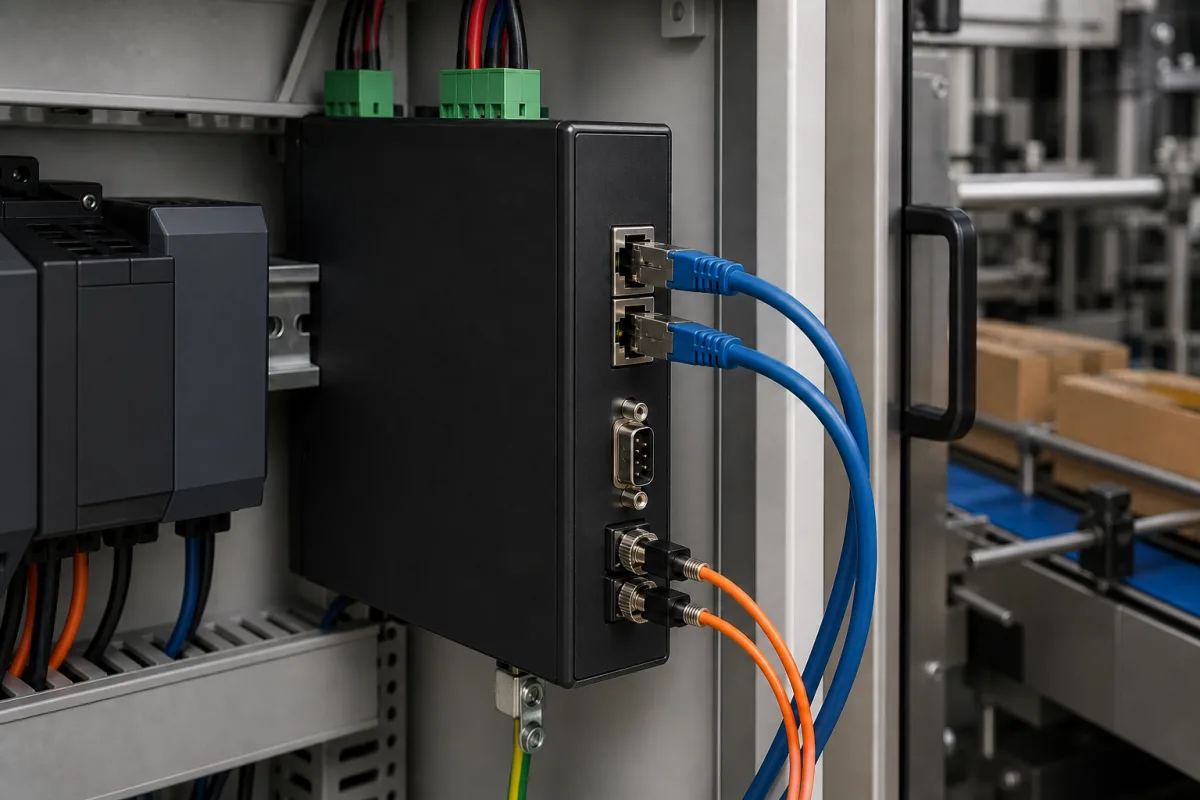
Communication gateway: serial device server for RS-232/422/485 to Ethernet or fiber
Serial-to-Ethernet and serial-to-fiber communication gateways (serial device servers) · RS-232/422/485 ports, virtual COM and TCP modes, copper or fiber uplink, isolation and surge ratings
A communication gateway of this kind, sold as a serial device server, connects instruments, meters, PLCs and barcode readers with RS-232, RS-422 or RS-485 ports to an Ethernet network or a fiber link, carrying their data over TCP/IP so a PC or controller can reach them as a network socket or as a virtual COM port. Ask three things first: how many serial ports and which electrical standard each device uses, which operating mode the host software needs, and whether the uplink must be copper or fiber with isolation from the plant.
Serial device servers and serial-to-Ethernet or serial-to-fiber gateways that carry RS-232/422/485 traffic over TCP/IP, specified by serial ports and baud rate, operating modes, uplink medium, isolation and environment. Protocol converters between fieldbuses and industrial Ethernet protocols (Modbus to PROFINET, EtherCAT or EtherNet/IP) are covered on the Fieldbus gateway (protocol converter) page. IIoT edge gateways that push data to MQTT or cloud platforms, Ethernet switches and media converters without a serial port are outside this page.
CNFX editorial research · Sources checked October 12, 2026 · 3 sources
Check the serial side: ports, baud rate and RS-485 limits
Texas Instruments' RS-485 design guide lists the key features of the standard as a balanced interface, a −7 V to +12 V bus common-mode range, up to 32 unit loads, a 10 Mbps maximum data rate at 40 ft and a 4000 ft maximum cable length at 100 kbps. A unit load is about 12 kΩ; transceivers with 1/8 unit load allow up to 256 on a bus, and because failsafe biasing can add up to 20 unit loads, the guide calculates a maximum of 96 such devices when biasing is used. [1]
The same guide gives a rule of thumb that line length in metres times data rate in bit/s should stay below 10⁷, and notes that for 22 AWG, 120 Ω twisted pair the cable resistance reduces the signal by 6 dB at about 1200 m. [1] Editorial calculation: by that rule, 9600 bit/s allows up to about 1040 m and 115.2 kbit/s about 87 m; the guide calls the rule conservative compared with its cable-length graph.
On the gateway side, Advantech's EKI-1521/1522/1524 serial device servers offer 1, 2 or 4 ports, each software-selectable as RS-232, RS-422 or 2- or 4-wire RS-485 on DB9 connectors (terminal blocks on CI-DE models), at 50 bps to 921.6 kbps with automatic RS-485 direction control and built-in 15 kV ESD protection on all serial signals. [2] ICP DAS's PDS-220FT has one 5-wire RS-232 port and one RS-485/422 port up to 115200 bps, with 1 kΩ bias resistors, ±4 kV ESD protection and up to 254 node addresses. [3]
Give the supplier the number of serial devices and ports, the standard (RS-232, RS-422, 2- or 4-wire RS-485), baud rate and framing, cable length and type on each segment, how many devices share each RS-485 bus, the host software and operating mode, uplink medium and distance, supply voltage, temperature range, isolation needed and hazardous-area approvals.
02
Choose operating modes and a copper or fiber uplink
Advantech's datasheet lists COM port redirection (virtual COM), TCP/UDP server (polling), TCP/UDP client (event handling) and pair (peer-to-peer) modes; up to 5 hosts can access one serial port and up to 16 hosts can be reached in TCP client mode. Its two 10/100 Mbps RJ45 ports have separate MAC addresses for LAN redundancy and 2.25 kV DC magnetic isolation, and CI models add 2 kV serial-to-Ethernet and serial-to-power isolation and 1.5 kV Ethernet-to-power isolation. [2]
Where the link must cross a noisy plant or areas with different earth potentials, ICP DAS's PDS-220FT replaces the copper port with one 100Base-FX multi-mode fiber port on an ST connector, rated for 2 km, and also supports Modbus TCP to Modbus RTU/ASCII gateway operation. ICP DAS cites immunity to electrical noise from motors, relays and welders, and safe use near high-voltage equipment, as reasons for fiber. [3]
Editorial note: virtual COM mode lets existing software open the remote port as if it were local, while TCP server or client modes need software that opens a network socket. Ask the supplier which mode your host software supports, and test the response timing of polled devices over the network before committing a whole line.
03
Two published serial device servers side by side: copper redundancy versus a fiber port
The two reviewed models answer different site problems: the EKI-1521 doubles the copper network port and adds isolation in its CI version, while the PDS-220FT trades copper for a 2 km fiber link and adds a Modbus gateway function.
Item
Advantech EKI-1521 (CI/I versions)
ICP DAS PDS-220FT
Serial ports
1 × RS-232/422/485, DB9; terminal block on CI-DE. [2]
CE, FCC Class A, UL/cUL Class I Div 2, ATEX Zone 2. [2]
Not stated on the reviewed page.
04
Data a serial gateway quotation depends on: RS-485 segments, host mode and uplink
The serial side decides the model more than the network side: count the devices on each RS-485 segment against the 32-unit-load limit and check cable length against baud rate before choosing ports. [1]
Field
Published values
Ask the supplier for
Number of Channels
1, 2 or 4 ports (EKI-152x); 2 ports (PDS-220FT). [2][3]
Ports and standard on each.
Protocol Support
Operating modes listed above; Modbus gateway on PDS-220FT only. [2][3]
Paste it into your enquiry below or into an email to a maker, then replace every bracket.
Serial devices: [count; RS-232/422/485; baud rate; framing; addresses]
RS-485 buses: [devices per bus; cable type and length; termination]
Host: [software; virtual COM or TCP mode; number of hosts]
Uplink: [RJ45 or fiber; fiber type, connector and distance; redundancy]
Power and site: [supply; temperature; isolation; hazardous area]
Documents: [datasheet; certificates; configuration tool]
Explore company information and manufacturing capabilities, then discuss the scope of your project with a relevant supplier.
Share this page
Compiled and source-reviewed by the CNFX editorial team.
Each manufacturer above links to the page on that company's own website where the product is listed, with the date we checked it. How we source and review
· Page last updated 13 October 2026
Buyer questions
How many devices can share one RS-485 line?
The standard sets 32 unit loads; TI notes that 1/8-unit-load transceivers allow up to 256, or 96 when failsafe biasing adds 20 unit loads. [1]
What is virtual COM mode?
COM port redirection: Advantech describes standard serial calls being transparently redirected to the device server so existing serial software keeps working. [2]
Why use a fiber uplink?
ICP DAS cites immunity to noise from motors, relays and welders and safe use near high-voltage equipment; its PDS-220FT fiber port is rated for 2 km on multi-mode fiber. [3]
Sources and what still needs a direct check
Sources checked 2026-10-12. Texas Instruments explains the RS-485 standard as an interface-chip maker; Advantech and ICP DAS describe their own serial device servers. Your devices' manuals and the gateway datasheet for the exact model govern.