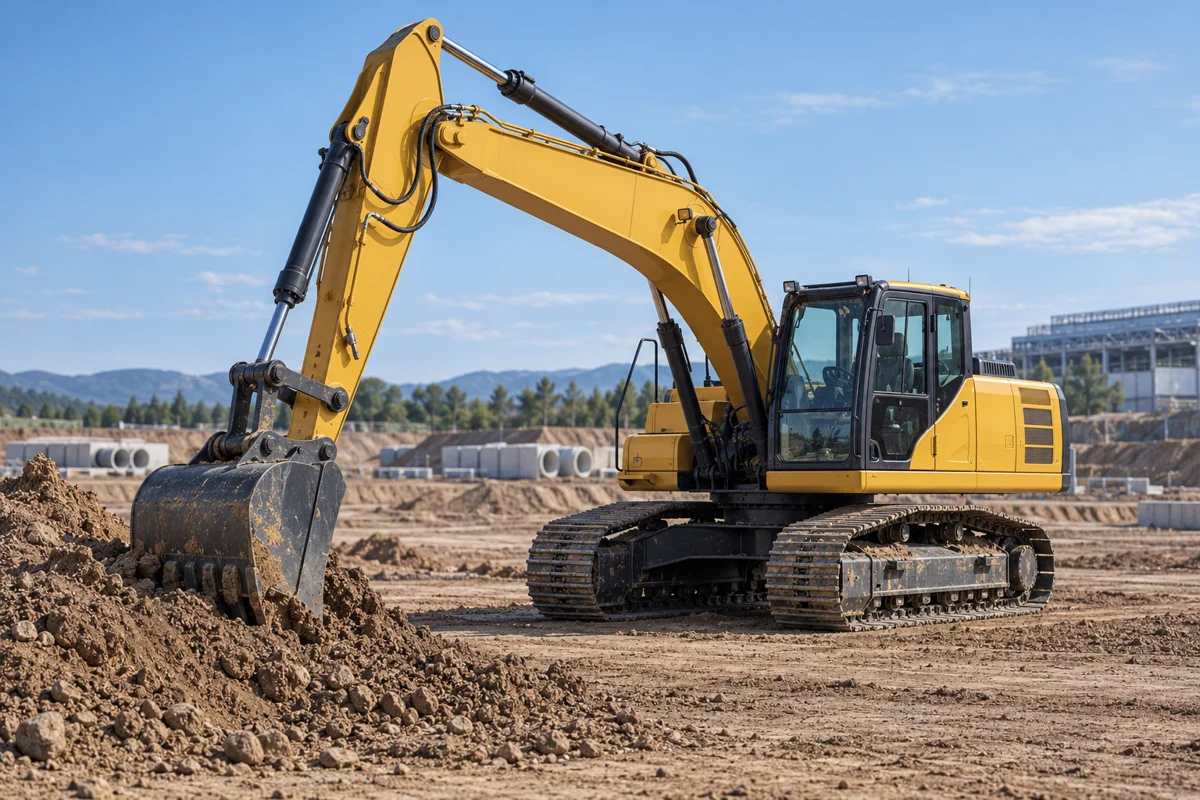
Choose the excavator as a complete working configuration: bucket, boom and stick, undercarriage, hydraulics and site access. This guide checks SANY’s published SY245H data, preserves Caterpillar’s bucket-first selection method, and identifies unresolved details in the linked lifting chart.
This construction-equipment entry focuses on a medium crawler hydraulic excavator. The related SY305C LC listed at 32.3 t is a larger comparison, outside a strict 20–30 t range. The manufacturer records distinguish complete machines, component makers and machining equipment; a construction application does not prove excavator manufacture.
CNFX editorial research · Sources checked October 10, 2026 · 6 sources
These are SANY’s current website entries, not independently tested delivered-machine results. The SY305C LC comparison is 32.3 t, outside a strict 20–30 t band. The linked sample gives 147 kW at 2100 rpm; it labels 277 L “Hydraulic oil”, while the website labels 239 L “Hydraulic Tank”. Those different labels do not establish identical capacity definitions. Obtain the exact supplied configuration, power-rating basis and issued fluid-fill schedule. [1][5]
02
Follow power from the engine to the working tool
The SY245H sample identifies a diesel engine, main pump and main valve, with coordinated engine/pump/valve control. Hydraulic actuators move the working equipment; the upper structure slews while the tracked undercarriage carries and moves the machine. The table maps those functions, not manufacturing quantities or a serial-number parts bill. [5]
Assembly
Function in this configuration
Construction evidence and what remains unknown
Engine
Supplies mechanical input to the hydraulic system.
SANY names D06FRC, 6.373 L and 147 kW; the sample shows 2100 rpm. Its rating is not explicitly established here as net flywheel power. Block alloy, engine serial and delivered emission configuration need the issued build record. [1][5]
Main hydraulic pump
Supplies pressurised flow for working and drive functions.
The linked sample names a customised K7V125 pump. A model label does not give the supplied hydraulic-flow map or establish every production revision. Request the exact part code and performance data. [5]
Main valve, lines and hoses
Route and regulate flow to commanded movements.
The sample names a customised KMX15RB/b45217a-v valve and describes coordinated control. Hose sizes, working-pressure settings and seal specifications are not a verified bill here. [5]
Working cylinders
Move the boom, stick and bucket linkage.
The sample discusses oil cylinders and their attachment points. Bore/stroke, rod material, seal kits and actual assembly quantities must come from the supplied machine drawing and parts book. [5]
Boom, stick, joints and linkage
Position the bucket and transmit digging loads.
The website gives a 5.9 m boom and 2.95 m stick. The sample describes a box boom and high-strength steel plates, without a verified alloy grade, weld procedure or complete joint bill. [1][5]
Bucket and ground-engaging tools
Excavate and contain the chosen material.
The reference website lists 1.3 m³. Actual bucket weight, teeth, cutting-edge specification and material-density approval are not supplied by that volume. [1][2]
Upper carriage, swing support and counterweight
Carry the front equipment and allow rotation relative to the undercarriage.
The sample lists 10.6 rpm slewing and a 4700 kg counterweight in the unresolved lift-chart configuration. Confirm the delivered counterweight and swing/structural assemblies rather than treat a load-chart label as build proof. [5]
Tracked undercarriage and final drives
Support, propel and steer the crawler machine.
Website: nine track rollers and two carrier rollers each side. The sample lists a 600 mm track shoe and final-drive oil quantities. This is a crawler drive reference, not evidence of a truck-style transmission; track, motor and reduction-unit part codes remain required. [1][5]
Cab and operator controls
Provide the operator’s working position and movement commands.
The sample describes a frame-type cab, armrests, handle/control features and a battery main switch. These statements do not establish a tested protective-structure certificate or the exact electrical/controller build. [5]
Cooling and filtration
Control temperatures and maintain the required fluid/air cleanliness.
The sample shows water/oil radiators, an intercooler, fuel cooler and filter service access. Obtain model-specific fluid grades, filter codes and service intervals; comparative life/maintenance claims are not adopted as guarantees. [5]
Reference functions above do not identify interchangeable spares. Match serial range, drawings, seals and attachment interfaces before ordering; generic material names cannot replace component-grade documents.
03
Pick the bucket first, then the machine
Caterpillar's first rule: start with the loose density of the heaviest material you move, include the weight of ground-engaging tools, size the bucket, then choose the excavator that handles that bucket and load [2].
Find the loose density
Use the heaviest material on your jobs, in its loose (excavated) state.
Estimate material mass, then add the attachment
With an assumed fully filled 1.3 m³ volume and loose density of 1.8 t/m³, material alone is 2.34 t (about 2.3 t). This is arithmetic, not a payload approval: actual fill, bucket, teeth and any coupler change the load. [2]
Get the manufacturer’s bucket/configuration approval
The linked SANY sample offers 2.5 m and 2.95 m sticks with bucket/material-density symbols. Request the exact approved bucket, stick and material combination and clarify the legend; an attachment mass or lift-chart cell alone is not a digging-cycle approval. [5]
Mind trench width
For trenching inside cave-in protection, bucket width is critical; a bucket that does not fit causes extra excavation and backfill [2].
A heaped bucket volume is not a mass rating. Do not treat a hypothetical density calculation as a tested SANY job or as permission to lift a suspended load.
04
Choose the stick for reach or force
Caterpillar's second rule sets out the trade-off [2].
Specify the hydraulic kit with the machine
Ask the supplier to identify auxiliary circuits, flow, pressure, return requirements and controls for the actual attachment. Caterpillar recommends matching the hydraulic setup before selecting tools; its guidance does not establish which kit is fitted to the offered SANY machine. [2]
Look for a long roller frame option, extra rollers and the right counterweight for balance [2]
Attachments
Hammers, rippers, compactors, thumbs and pulverizers need the matching hydraulic circuit and controls; a quick coupler helps frequent changes [2]
05
Read the lift chart before lifting
Caterpillar’s explanation limits rated hoist load by 75% of tipping load, 87% of hydraulic capacity and the structural limit. These principles explain chart reading; they are not a SANY load approval. [3] ISO 10567:2007 covers calculating and verifying excavator lift capacity and was confirmed in 2025. Only its public abstract has been read. [4]
Locate the load correctly
Read the lifting radius from swing centre to the vertical load line and the lift-point height above ground. Use the supplied configuration’s chart; a blank cell supplies no permission for that position. [3]
Confirm the chart’s model identity
In the SY245H-linked sample, PDF page 9 (printed pages 15/16), lifting footnote 4 names SY265C and SY245C. This unresolved model reference prevents treating its numerical cells as verified SY245H ratings. [5]
Resolve the standard reference
Footnote 1 prints ISO10560 and SAEJ1097, while the ISO excavator lift-capacity catalogue is ISO 10567:2007. Ask SANY for a corrected, configuration-matched chart; do not silently repair the number or claim certification. [5][4]
Apply the actual deductions and direction
The sample distinguishes longitudinal and transverse capacities; its lifting point is the stick’s front support hole and excludes bucket weight. It says additional accessories must be deducted. Confirm the issued chart, approved lifting point and all attachment/rigging deductions before planning a lift. [5]
Bucket/arm digging force in kN is not a lifted mass in kg. Do not convert 175 kN into a lifting-capacity claim. An identified model, chart conditions and an approved task-specific lifting plan are still needed.
06
Attach a configuration and test basis to every requested value
Request an issued specification sheet and operating instructions for the offered configuration. Use the fields below to distinguish rated values, test conditions and information that still requires a model-specific document.
Field
What the value must describe
Operating weight, kg or t
Identify boom/stick, bucket or tool, shoe width, counterweight and fluid/operator assumptions. The website’s 25.5 t is a published configuration value, not the shipping mass of every option. [1][5]
Engine power, kW at rpm
The sample lists rated 147 kW at 2100 rpm. Ask for the rating standard and net/gross basis; net flywheel power is not established by this published line. [5]
Bucket capacity, m³
Identify bucket type, capacity definition, actual weight, width, teeth and permitted material density. Volume does not establish payload or suspended-load capacity. [2][5]
Lift capacity, kg at radius/height/direction
Request a corrected chart for the exact machine and equipment. The linked chart’s model references and standard number remain unresolved; no single maximum is established here. [5][3]
Hydraulic operating pressure, MPa
Identify circuit, pressure setting, operating mode and boost conditions from the actual hydraulic documentation. No complete verified pressure schedule is established from the references read.
Hydraulic flow, L/min
Obtain flow available to the specified auxiliary function, with pressure, engine speed and simultaneous-function conditions. Naming K7V125 or a main-pump total does not specify the attachment’s usable flow. [5][2]
Travel speed, km/h
The sample publishes high/low 5.4/3.4 km/h. Obtain the applicable test/ground conditions and loaded-operation limits; do not read the maximum as a jobsite safe-speed instruction. [5]
Gradeability, % and degrees
The sample lists 70% (35°), a gradient description. This line does not establish an allowed side slope, lifting slope or unrestricted operating angle; obtain the manual’s actual conditions. [5]
Swing speed, rpm
The sample gives 10.6 rpm. It is rotational speed, not a lifting rating or permission to swing a suspended load; clearance and the job’s exclusion area need separate planning. [5][6]
Cab noise, dB(A)
Ask for measured operator-position sound pressure and the test method/conditions. The sample’s qualitative noise-reduction claim supplies no verified cab dB(A) value. [5]
Fuel capacity, L
SANY lists 475 L. Capacity alone cannot establish eight to ten hours of operation without fuel consumption and the actual duty cycle. [1]
Ambient operating temperature, °C
Ask for the supplied configuration’s temperature limits and specified oils, coolant and cold-start equipment. A radiator description supplies no universal operating range. [5]
Engine emission configuration
Match engine serial/type and after-treatment with documentation for the destination market. The undated linked sample refers to national III filtration/emission requirements; it does not prove compliance for every current export destination. [5]
Transport dimensions, ground pressure and digging reach also belong in the issued configuration sheet. The linked sample publishes 10290 × 3190 × 3255 mm transport dimensions, 52.5 kPa ground pressure and 6705 mm maximum digging depth; confirm options and ground/support conditions before using them for access, transport or excavation planning. [5]
07
Buy the service documentation with the working configuration
SANY’s sample shows filter and radiator access, but supplies no complete operating or service manual here. A brochure comparison of service life or maintenance cost is not a schedule or a warranty for your machine. [5]
Keep a serial-specific build and parts record
Obtain machine/engine serials, installed attachment/coupler and hydraulic kit, manuals, fluid-fill schedule, filter/seal/track part codes and local support arrangements. Record which lift chart and working-range drawing apply.
Establish inspections from the supplied instructions
UK HSE guidance calls for daily visual checks and regular inspection/service programmes based on manufacturer instructions and vehicle risks. Use it as a UK reference, not a universal legal statement or a substitute for the offered manual. [6]
Confirm clearance, visibility and attachment management
Discuss tail swing, obstructions, pedestrian separation, visibility aids and the chosen quick hitch with the site team. HSE identifies these as excavator-selection issues; a generic scene or bucket photo does not establish the offered machine’s safety equipment. [6]
Agree delivery inspection and demonstration conditions with the supplier. Preserve actual records rather than convert brochure percentages or an unrecorded demonstration into a measured production result.
08
Copy this RFQ and fill in the brackets
Paste it into your enquiry below or into an email to a maker, then replace every bracket.
Machine/configuration and quantity: crawler excavator [ ], [ ]
Job/material: [ ], loose density [t/m³], ground and access conditions [ ]
Bucket/tool: capacity basis [m³], width [mm], actual weight incl GET/coupler [kg], manufacturer-approved combination [ ]
Front/undercarriage: boom [m], stick [m], track shoe [mm], counterweight [kg], transport dimensions/mass [ ]
Hydraulics: attachment [ ], circuit/usable flow/pressure/return/control requirements [ ]
Lifting, if intended: load and deductions [kg], radius/height/direction [ ]; corrected model/configuration chart and approved lifting points
Engine: rating standard/net-gross/rpm [ ], emission configuration/documents for destination [ ]
Site: travel/grade/manual limits, tail swing, visibility and exclusion arrangements [ ]
Handover: serial-specific build/parts/manuals, fluid quantities/grades, filter and seal kits, inspections/service and local support [ ]
Destination, inspection/demo agreement and delivery date: [ ]
SANY publishes complete excavators. The other companies below supply components such as castings and machined parts, hydraulics, filters, seals, brakes or electrical products; those parts do not make them complete-machine builders or SANY-approved replacement sources.
SANY Group
Changsha, Hunan (group global headquarters), CN
SANY publishes SY245H and other complete excavator ranges, plus cranes, concrete and road machinery. Specify the model, destination and attachment configuration; the unresolved linked lift chart must be corrected before its load cells are used.
RMC’s construction-machinery page lists cast/machined housings, flanges, bushings, brackets, boom-cylinder and hydraulic-tank components. These are custom metal-part offerings, not a complete excavator listing or proof of an approved SY245H spare.
FONHO lists air, oil, fuel and hydraulic filters and related heavy-equipment filtration. Brand and cross-reference numbers identify requested applications; they do not establish original SANY manufacture or interchangeability without a matched part specification.
Andeli publishes electrical protection, switching, drives and power products. Construction machinery appears as an application; no complete crawler-excavator model is established by this product catalogue.
Guangdong Zhongxiang New Materials Co., Ltd. (ZYX Rubber)
Guangzhou, Guangdong, CN
ZYX Rubber lists custom extruded/moulded rubber, seals, bonded parts and plastics. Its construction/equipment market coverage is component supply, not excavator manufacture. Confirm dimensions, compound and service conditions for each requested part.
GRH lists gear pumps/motors, valves, flow dividers, orbital motors and power packs, with excavators as an application. These component families do not confirm the K7V125/KMX15RB build or a complete machine.
HCIC describes hydraulic cylinders, power units and components for excavators and other machinery, alongside distinct vehicle-loading systems. Match actual cylinder drawings and interfaces; the listed range is not a SY245H spare-parts approval or crawler-excavator offer.
Dandong Foundry identifies grey/ductile iron and steel castings and machining, including construction-machine spare-part examples. A casting capability does not establish a complete excavator, its cab rating or the supplied machine’s material grades.
SAIVS lists casting, forging and CNC-machined components such as housings and shafts. These are part-manufacturing services; complete crawler-excavator manufacture and a matched SANY replacement are not established by the catalogue.
Poocca’s own company page describes manufacturing, service and supply of hydraulic pumps, motors, valves and accessories for construction machinery. Catalogue references to other brands do not verify an authorised OEM relationship or the reference excavator’s exact hydraulic assembly.
ALLMAX lists commercial-vehicle and construction-machinery friction parts, including 9C0566/9C0567 and 2v9135 brake-pad entries. This is brake-component scope; no fit to the reference crawler or complete excavator manufacture is established.
Explore company information and manufacturing capabilities, then discuss the scope of your project with a relevant supplier.
Share this page
Compiled and source-reviewed by the CNFX editorial team.
Each manufacturer above links to the page on that company's own website where the product is listed, with the date we checked it. How we source and review
· Page last updated 13 October 2026
Buyer questions
How do I size an excavator?
Start with the bucket: material loose density and bucket load, then pick the machine that carries it. Check stick length and lift chart next. [2]
What limits an excavator's rated lift?
Caterpillar describes limits of 75% of tipping load, 87% of hydraulic capacity and the structural limit. Use the issued chart for the actual machine, position and configuration; these percentages alone do not establish a SANY load rating. [3][5]
Short or long stick?
Short sticks give more digging force; long sticks more reach but less force. [2]
What are the SANY SY245H main specs?
25.5 t, 147 kW, 1.3 m³ bucket, 175 kN bucket and 120 kN arm digging force. [1]
Sources and what still needs a direct check
Sources checked 2026-10-10. SANY’s live website and the sample it currently links are read separately: website quantities do not automatically resolve differently labelled sample values. The lift-table model/standard references remain open. Caterpillar explains selection and lift-chart principles; its guidance is not a SANY rating. ISO’s public abstract supports scope and current status only. HSE provides UK site and inspection guidance.