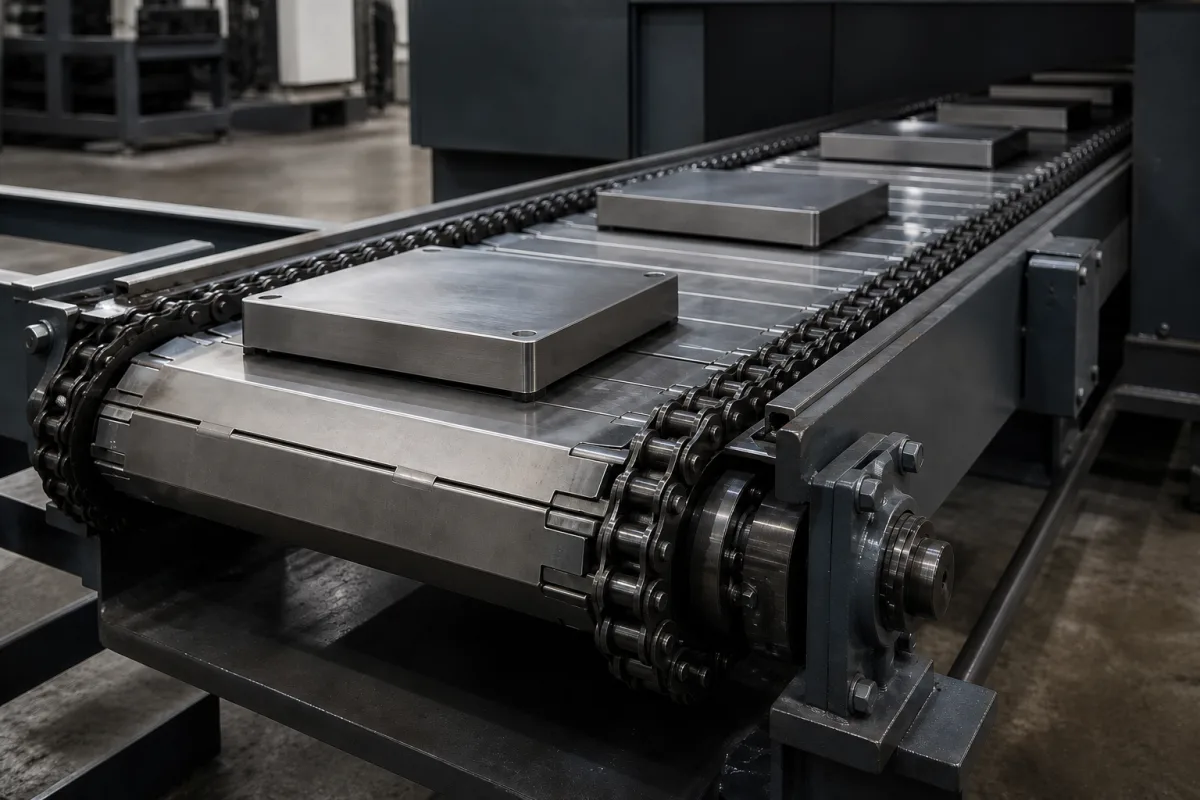
Conveyor chain · Chain pull and safety factor, pitch and sprocket teeth against speed, elongation limits for replacement
Conveyor chain is the roller or bush chain, fitted with attachments and slats or plates, that carries and pulls the load along a conveyor; plastic slat-top chains do the same job for light packaged goods. Ask three things first: what chain pull the conveyor will create and what safety factor the operating conditions need, whether the pitch and sprocket teeth suit the chain speed, and how much elongation and wear the supplier allows before replacement.
Steel roller and bush conveyor chains with attachments for slat, apron and similar conveyors, and plastic slat-top chains. Complete conveyor systems, conveyor belts, drive (transmission) roller chains, cable drag chains and lifting chains are outside this page.
CNFX editorial research · Sources checked October 12, 2026 · 4 sources
Size the chain from the chain pull and a safety factor
Renold's conveyor chain designer guide states that it specifies minimum breaking load, and that “As a general rule, Renold suggest that for most applications a factor of safety of 8 is used”: working load equals breaking load divided by 8. That factor keeps pin and bush bearing pressure at up to 24 N/mm², which gives acceptable life in a clean, well-lubricated conveyor; in anything else the factor should be increased. Its Table 1 raises it to 18 for an unlubricated chain in abrasive conditions, and to 16 for an unlubricated chain at 200–300 °C. [1]
Renold's worked example is a slat conveyor like the one pictured: 36 m between sprocket centres, 50 boxes of 36 kg, slats of 15 kg/m, two chains, 0.45 m/s on 8-tooth sprockets, clean and well lubricated. For chain rolling with material carried, chain pull is 9.81 × µc × [(2.05 × chain-and-slat mass per metre × length) + load mass]. A preliminary pull of 5907 N with a factor of 8 calls for 23628 N minimum breaking load across the two strands, so two 152.4 mm pitch chains of 33000 N were chosen. The final pull is 5005 N, a factor of safety of 13.19, and the headshaft power 2.25 kW, which Renold notes is not the motor size: starting and gearing losses must be added. [1]
Renold's Table 2 gives the rolling friction coefficient µc for a BS27/BS33 chain with 31.8 mm rollers as 0.15 with regular lubrication, 0.18 occasional and 0.20 with none; in the same example the load per roller gave a bearing pressure of 0.23 N/mm², against an allowable 1.2 N/mm² for sintered steel rollers. [1]
Editorial calculation: in Renold's formula the friction coefficient multiplies the whole pull, so running the same example dry (µc 0.20 instead of 0.15) would raise the final pull by a third, from 5005 N to about 6673 N.
U.S. Tsubaki's attachment chain selection guide uses a different correction from Renold's single safety factor. It estimates chain tension, multiplies it by a chain speed coefficient K1 and requires the product to stay within the chain's maximum allowable load; its Table III sets K1 at 1.0 for 0–50 ft/min, 1.2 for 50–100, 1.4 for 100–160, 1.6 for 160–230, 2.2 for 230–300, 2.8 for 300–360 and 3.2 for 360–400 ft/min. Its Table II gives a sliding friction coefficient of 0.3 dry and 0.2 lubricated. The guide adds that chain must always engage at least 3 sprocket teeth, that take-up stroke should be the sprocket centre distance × 0.02 plus a catenary sag allowance, that rolling chain is the choice for conveyors over 35 ft long or faster than 70 ft/min, and that standard chain runs without special selection between 15 °F and 140 °F. [4]
Editorial calculation: Renold's 0.45 m/s slat conveyor runs at about 88.6 ft/min (0.45 × 196.85), which falls in Tsubaki's 50–100 ft/min band with K1 = 1.2; its 36 m sprocket centres call for a take-up stroke of about 36 × 0.02 = 0.72 m plus sag allowance under Tsubaki's rule. The two makers' methods are not interchangeable, so ask the supplier which one its rating uses. [4][1]
Give the supplier the conveyor layout and centre distance, load per metre and total, slat or attachment mass, chain speed, number of strands, sprocket teeth, lubrication, cleanliness and temperature, and whether the chain rolls or slides on its track.
02
Match pitch and sprocket teeth to chain speed
Renold explains that because chain wraps a sprocket as a polygon, chain speed varies cyclically: 7.6% on an 8-tooth sprocket, 4.9% on 10 teeth and 3.4% on 12. Each cycle ends with an impact of the roller into the tooth root, which grows with speed and with larger pitches on fewer teeth, so its Table 15 limits speed by pitch and tooth count. [1]
Renold's Table 15 gives maximum recommended speeds of 0.55 m/s for 152.4 mm pitch on 8 teeth, 0.86 m/s on 10 teeth and 1.2 m/s on 12 teeth; a 50.5 mm pitch reaches 0.95, 1.5 and 2.2 m/s on the same sprockets. The 0.45 m/s slat conveyor example sits under the 0.55 m/s limit for its 8-tooth sprockets. [1]
Plastic slat-top chain is quoted differently. Changshuo's 820 single-hinge chain has a 38.1 mm pitch, POM plates rated −40 to 90 °C and stainless steel pins, and lists maximum speeds of 90 m/min lubricated and 60 m/min dry. Its summary states a 2250 N working load, while its parameter table gives 1230 N at 21 °C for the 63.5 mm wide plate; ask which figure applies to your width and temperature. [3]
03
Agree when the chain must be replaced
Renold's installation and maintenance guide measures elongation over a counted length of X pitches: percentage extension = [M − (X × P)] × 100 ÷ (X × P), where M is the measured length, X the number of pitches and P the pitch. For BS 27 kN and 33 kN chains the allowable extension is 50.8 ÷ P percent. [2]
Editorial calculation: for the 152.4 mm pitch chain in the slat conveyor example, 50.8 ÷ 152.4 = 0.33%; ten pitches measure 1524 mm new, so the chain is due for replacement once they exceed about 1529.1 mm.
The same guide says roller wear can limit life on long conveyors where rollers carry the load along a track, and the chain should be replaced when link plates are near to or rubbing on the track. On conveyors where chain runs on its plate edges, wear should not exceed half the original plate depth above the bush. It lists weekly lubrication checks and an annual check for elongation, side-plate wear and sprocket wear. [2]
04
Compare what suppliers offer
Suppliers linked to this page list conveyor chains; each card links to the page reviewed.
Listings include steel short-pitch, double-pitch, metric (ISO M series) and engineering conveyor chains with attachments, timber and sugar-mill chains, and plastic slat-top and free-flow chains. Ask each supplier which chain standard and series it builds to, the minimum breaking load and the roller material.
05
Trace the chain parts
This is a functional reference built from the sources cited; it is not one maker's specification.
Fill the specification fields with values for your conveyor
A conveyor chain quotation needs values for your conveyor. The table explains each field, gives published values where a reviewed source states them, and says what to obtain from the supplier.
Explore company information and manufacturing capabilities, then discuss the scope of your project with a relevant supplier.
Share this page
Compiled and source-reviewed by the CNFX editorial team.
Published product pages show what a company offers, not tested performance. Confirm the legal seller, factory and scope for your order. How we source and review
· Page last updated 13 October 2026
Buyer questions
What safety factor does conveyor chain need?
Renold's designer guide uses 8 for clean, well-lubricated conditions and raises it to as much as 18 for an unlubricated chain in abrasive conditions. [1]
How fast can a conveyor chain run?
It depends on pitch and sprocket teeth; Renold recommends at most 0.55 m/s for 152.4 mm pitch on 8 teeth and 1.2 m/s on 12 teeth. [1]
When should conveyor chain be replaced?
Renold allows 50.8 ÷ P percent extension for BS 27/33 kN chain, which is about 0.33% at 152.4 mm pitch (editorial calculation), or when worn rollers let plates touch the track. [2]
How long should the take-up on a chain conveyor be?
U.S. Tsubaki's selection guide gives take-up stroke as sprocket centre distance × 0.02 plus a catenary sag allowance, about 0.72 m plus sag for 36 m centres (editorial calculation). [4]
Sources and what still needs a direct check
Sources checked 2026-10-12. Renold and U.S. Tsubaki are chain makers; Renold's designer guide and maintenance guide and Tsubaki's attachment chain selection guide give each maker's own selection method and limits. Changshuo is a maker describing one plastic chain.