Industry-Verified Manufacturing Data (2026)

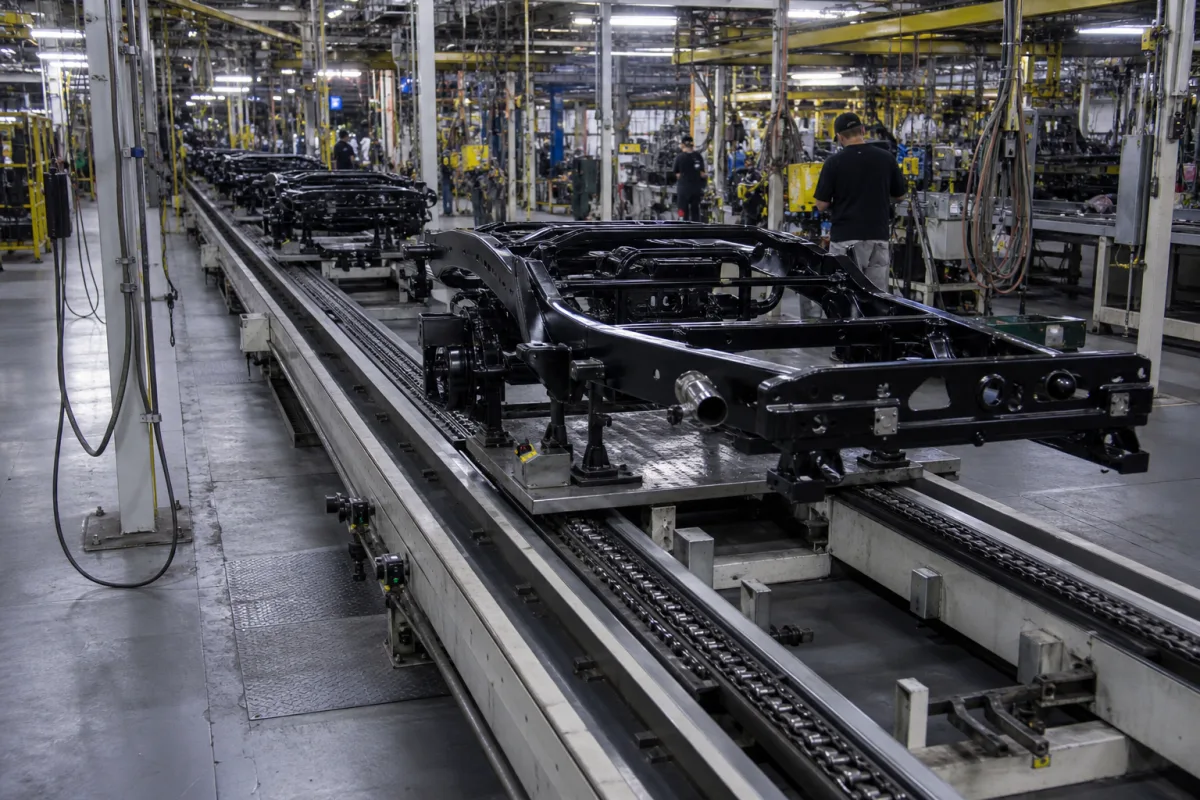
Chassis Frame Conveyor

Based on aggregated insights from multiple verified factory profiles within the CNFX directory, the standard Chassis Frame Conveyor used in the Motor Vehicle Manufacturing sector typically supports operational capacities ranging from standard industrial configurations to heavy-duty production requirements.

Technical Definition & Core Assembly

A canonical Chassis Frame Conveyor is characterized by the integration of Drive Motor and Conveyor Chain/Belt. In industrial production environments, manufacturers listed on CNFX commonly emphasize Carbon steel construction to support stable, high-cycle operation across diverse manufacturing scenarios.

A specialized conveyor system designed to transport chassis frames through various assembly stations in an automotive manufacturing line.

Product Specifications

Technical details and manufacturing context for Chassis Frame Conveyor

Definition
The Chassis Frame Conveyor is a critical component of the Automotive Modular Chassis Assembly System, responsible for the precise movement, positioning, and transfer of vehicle chassis frames between different assembly, welding, inspection, and finishing stations. It ensures continuous workflow, maintains proper alignment for robotic operations, and supports the modular assembly process by handling frames of varying sizes and weights with high precision and reliability.
Working Principle
The conveyor typically operates using motor-driven chains, belts, or roller systems that move chassis frames along a predetermined path. It incorporates sensors and programmable logic controllers (PLCs) to control speed, positioning, and synchronization with other assembly line components. Frames are often secured on pallets or fixtures that travel along the conveyor track, with stops or transfers occurring at designated workstations for assembly operations.
Common Materials
Carbon steel, Stainless steel, Aluminum alloy, High-strength polymers
Technical Parameters
  • Conveyor width and height dimensions to accommodate standard chassis frame sizes (mm) Standard Spec
Components / BOM
  • Drive Motor
    Provides mechanical power to move the conveyor system
    Material: Steel housing with copper windings
  • Conveyor Chain/Belt
    Transports chassis frames along the assembly line path
    Material: High-strength steel or reinforced polymer
  • Frame Fixture/Pallet
    Secures and supports the chassis frame during transport
    Material: Steel or aluminum alloy
  • Positioning Sensors
    Detects frame position and triggers station operations
    Material: Stainless steel housing with electronic components
  • Control Panel
    Houses PLC and interface for conveyor operation control
    Material: Steel enclosure with electronic components
Engineering Reasoning
0.5-2.0 m/s linear velocity, 500-2000 kg load capacity, 20-40°C ambient temperature
Structural yield at 250 MPa stress, bearing fatigue limit at 10^7 cycles, motor thermal cutoff at 150°C winding temperature
Design Rationale: High-cycle fatigue from cyclic loading at 0.5 Hz frequency, thermal expansion mismatch between steel frame (α=12×10^-6/°C) and aluminum guides (α=23×10^-6/°C)
Risk Mitigation (FMEA)
Trigger Misalignment exceeding 0.5 mm/m over 10 m span
Mode: Chain derailment and drive sprocket tooth shearing
Strategy: Laser alignment system with 0.1 mm resolution and automatic tension adjustment
Trigger Accumulated metal particulate contamination exceeding 5 g/m^2 on guide rails
Mode: Increased friction coefficient from 0.15 to >0.35 causing motor overload
Strategy: Integrated air knife cleaning at 3 bar pressure with HEPA filtration

Industry Taxonomies & Aliases

Commonly used trade names and technical identifiers for Chassis Frame Conveyor.

Industrial Ecosystem & Supply Chain DNA

Complementary Systems
Downstream Applications
Specialized Tooling

Application Fit & Sizing Matrix

Operational Limits
pressure: N/A (mechanical system, not pressurized)
other spec: Max Load Capacity: 5000 kg per chassis frame, Speed Range: 0.1-2.0 m/min, Frame Length Range: 3-12 meters
temperature: 0°C to 50°C (operating environment)
Media Compatibility
✓ Automotive chassis frames (steel/aluminum) ✓ Automotive sub-assemblies (axles, suspension components) ✓ Heavy industrial components (machinery bases, structural frames)
Unsuitable: Corrosive chemical processing environments (acid baths, plating lines)
Sizing Data Required
  • Chassis frame dimensions (length, width, weight)
  • Required throughput (units per hour)
  • Assembly station layout and transfer requirements

Reliability & Engineering Risk Analysis

Failure Mode & Root Cause
Fatigue cracking
Cause: Cyclic loading from conveyor start-stop cycles and material weight variations leading to stress concentration at weld joints or structural discontinuities
Corrosion-induced structural weakening
Cause: Exposure to moisture, chemicals, or environmental contaminants without proper protective coatings, accelerated by abrasive material spillage
Maintenance Indicators
  • Visible cracks or deformation in frame welds or structural members
  • Abnormal vibration or audible creaking/groaning during operation indicating loose connections or structural compromise
Engineering Tips
  • Implement regular non-destructive testing (ultrasonic or magnetic particle inspection) at high-stress areas to detect early-stage cracks before propagation
  • Establish a preventive coating maintenance program with proper surface preparation and application of corrosion-resistant coatings, combined with spillage containment systems

Compliance & Manufacturing Standards

Reference Standards
ISO 9001:2015 - Quality management systems ANSI/ASME B20.1 - Safety standards for conveyors and related equipment DIN 15207-1 - Continuous conveyors - Safety requirements
Manufacturing Precision
  • Frame alignment: +/- 1.5mm per 3 meters
  • Mounting hole positions: +/- 0.5mm
Quality Inspection
  • Non-destructive testing (NDT) for weld integrity
  • Load testing to 150% of rated capacity

Factories Producing Chassis Frame Conveyor

Verified manufacturers with capability to produce this product in China

✓ 98% Supplier Capability Match Found

P Procurement Specialist from Singapore Feb 04, 2026
★★★★★
"Impressive build quality. Especially the technical reliability is very stable during long-term operation."
Technical Specifications Verified
T Technical Director from Germany Feb 01, 2026
★★★★★
"As a professional in the Motor Vehicle Manufacturing sector, I confirm this Chassis Frame Conveyor meets all ISO standards."
Technical Specifications Verified
P Project Engineer from Brazil Jan 29, 2026
★★★★★
"Standard OEM quality for Motor Vehicle Manufacturing applications. The Chassis Frame Conveyor arrived with full certification."
Technical Specifications Verified
Verification Protocol

“Feedback is collected from verified sourcing managers during RFQ (Request for Quote) and factory evaluation processes on CNFX. These reports represent historical performance data and technical audit summaries from our B2B manufacturing network.”

18 sourcing managers are analyzing this specification now. Last inquiry for Chassis Frame Conveyor from Brazil (34m ago).

Supply Chain Compatible Machinery & Devices

Automotive Wireless Power Transfer System

Wireless charging system for electric vehicles using electromagnetic induction.

Explore Specs →
Automotive Solid-State Battery Pack

High-energy-density solid-state battery system for electric vehicles

Explore Specs →
Automotive Active Grille Shutter System

Aerodynamic system with motorized shutters for vehicle thermal and efficiency management.

Explore Specs →
Automotive Active Suspension Damping System

Electronically controlled suspension system for vehicle stability and comfort.

Explore Specs →

Frequently Asked Questions

What materials are used in the construction of the chassis frame conveyor?

The conveyor is constructed using durable materials including carbon steel for structural components, stainless steel for corrosion resistance, aluminum alloy for lightweight sections, and high-strength polymers for wear-resistant parts.

How does the conveyor system ensure precise positioning of chassis frames?

The system utilizes positioning sensors integrated with the control panel to ensure accurate alignment at each assembly station, working in conjunction with specialized frame fixtures or pallets for secure transport.

What are the main components included in the chassis frame conveyor system?

Key components include a control panel for system operation, conveyor chain or belt for movement, drive motor for power, frame fixtures or pallets for chassis support, and positioning sensors for accurate station alignment.

Can I contact factories directly on CNFX?

CNFX is an open directory, not a transaction platform. Each factory profile provides direct contact information and production details to help you initiate direct inquiries with Chinese suppliers.

Get Quote for Chassis Frame Conveyor

Request technical pricing, lead times, or customized specifications for Chassis Frame Conveyor directly from verified manufacturing units.

Your business information is encrypted and only shared with verified Chassis Frame Conveyor suppliers.

Thank you! Your message has been sent. We'll respond within 1–3 business days.

Need to Manufacture Chassis Frame Conveyor?

Connect with verified factories specializing in this product category

Add Your Factory Contact Us
Previous Product
Chassis Assembly Station
Next Product
Clutch Assembly