Machine cabling · Inner size, fill rules, separators, bend radius and strain relief
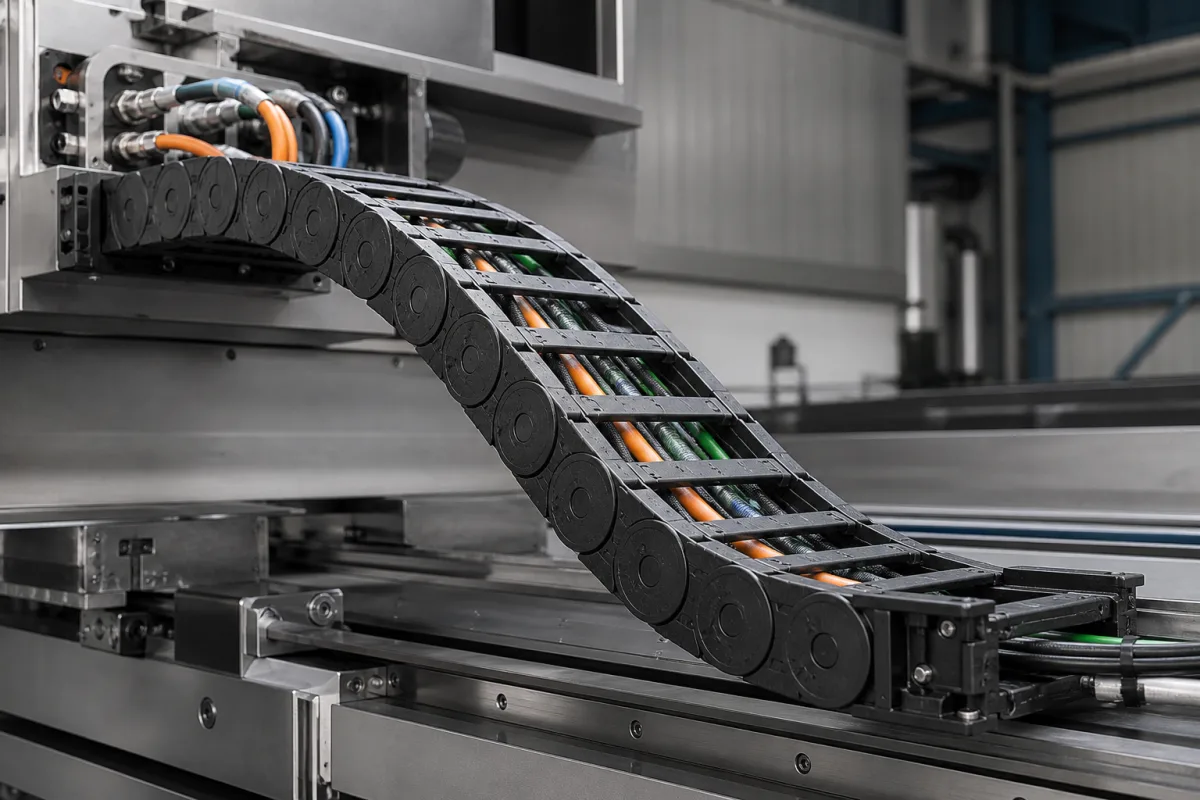
A drag chain, or cable carrier, guides cables and hoses that move with a machine axis. Ask three things first: which cables and hoses it must carry and their diameters and bend radii, the travel length, speed and cycle count, and how the chain will be supported and mounted.
Plastic and steel cable drag chains (energy chains, cable carriers) with separators, mounting brackets and guide troughs. Drag-chain conveyors, drag-chain extractors and the cables themselves are outside this page.
CNFX editorial research · Sources checked October 12, 2026 · 4 sources
Fill the chain with the right clearance and separation
igus, a cable carrier maker, gives clearance allowances around lines in the chain by type: flat electrical cables 10%, pneumatic hoses 5–10%, hydraulic hoses 20% and media hoses 15–20%. Its filling rule says that when the diameters of two lines add up to more than 1.2 times the chain's inner height they need no separation, but when they add up to 1.2 times the inner height or less a separator or shelf must be fitted, because lines must never lie unguided on top of one another or tangle. [1]
igus also states that at high speeds and frequent load changes, with guide values of over 0.5 m/s and more than 10,000 cycles a year, cables must not be laid on top of each other without horizontal separation. [1]
Editorial calculation: in a chain with 25 mm inner height, a 12 mm cable and a 14 mm hose add up to 26 mm, which is not more than 1.2 × 25 = 30 mm, so they need a separator. A 20 mm hydraulic hose with 20% clearance needs about 20 × 1.2 = 24 mm of space. [1]
Give the supplier a list of every cable and hose with outer diameter, minimum bend radius and weight, the travel length, speed, acceleration and cycles per year, the mounting orientation, the environment (chips, coolant, temperature) and whether a guide trough is needed.
02
Set the bend radius, strain relief and fixing
igus says the chain's bend radius depends on the thickest or stiffest cable or hose in the fill and should follow the cable or hose maker's recommendation; choosing a larger radius than the minimum extends service life. Round electrical cables should be laid straight without twisting, and strain relief is needed at the ends. [1]
Murrplastik's MP 45.1/45.2 plastic energy chain data sheet lists radii of 75–300 mm, inner widths of 50–250 mm with plastic crossbars and a 67 mm pitch; travel up to 80 m gliding, 60 m hanging vertically and 4 m standing vertically, 1.0 m unsupported when rotated 90°; speeds up to 5 m/s gliding and 20 m/s self-supporting; accelerations up to 15 m/s² gliding and 50 m/s² self-supporting; polyamide material for −30 to 120 °C with UL 94 HB fire classification and a gliding friction factor of 0.3. It offers damping elements that cut noise by up to 10 dB(A), integrated strain relief at the chain bracket, separators and steel or aluminium guide channels. [2]
Tsubaki Kabelschlepp's Q100 steel-and-aluminium-stay carrier has a 30 mm pitch, 72 mm inner height, inner widths of 70–600 mm and bending radii of 180–600 mm; it lists unsupported travel up to 7.8 m at up to 20 m/s and 70 m/s², and gliding travel up to 95 m at up to 3 m/s and 2–3 m/s², with additional load up to 12 kg/m and an intrinsic weight of 3.25 kg/m. It states that a gliding carrier has to run in a channel with glide shoes. [3]
Editorial calculation: for the Q100 at its maximum 12 kg/m additional load, the carrier and cables weigh about 3.25 + 12 = 15.25 kg per metre; and the MP 45 gliding speed limit of 5 m/s is a quarter of its 20 m/s self-supporting limit, so long gliding travels run slower. [3][2]
Ask the supplier for the chain's unsupported length at your fill weight, whether a guide trough or glide shoes are needed for long travels, and how separators and strain-relief brackets are fitted.
03
Plastic, steel and three-dimensional drag chains on the linked makers' sites
Yacai lists plastic and steel cable drag chains and drag link chains; Tongflex lists cable and steel drag chains alongside bellows covers and chip conveyors; KWLID lists cable drag chains, three-dimensional drag chains and machine shields; SEIK lists cable drag chains; Komay lists drag chains alongside crane conductor rails and festoon systems.
04
Compare unsupported span by carrier series, not only link height
Dynatect's Gortrac listing of steel cable carriers gives a maximum unsupported span for each series with its link height and inner height. Spans run from up to 6.5 ft (1.9 m) for the SA model with a 1 inch link height and 22 mm inner height to up to 40 ft (12.2 m) for the XL10 model with a 250 mm link height. Carriers sharing a 2 inch link height differ: up to 3.1 m for the SC series, 4.2 m for the MA series and 4.8 m for the heavy-duty MRC series. [4]
Editorial note: these are maximum figures as listed. Ask the supplier for the unsupported span at your cable and hose weight per metre, and what support or guide trough it proposes beyond that span.
Gortrac steel series
Link height; inner height
Max unsupported span
SA model
1 in; 22 mm
6.5 ft (1.9 m)
SC series
51 mm; 16–19 mm
10.4 ft (3.1 m)
MA series
2 in; 38–44 mm
14 ft (4.2 m)
MRC series
51 mm; 27–32 mm
16 ft (4.8 m)
LRC series
102 mm; 70–75 mm
24 ft (7.3 m)
XL6 model
150 mm; 98–106 mm
30 ft (9.1 m)
XL10 model
250 mm; 206–211 mm
40 ft (12.2 m)
05
Links, crossbars, separators, end brackets, strain relief and guide trough
igus sets rules for two of these rows: a separator or shelf where two lines add up to no more than 1.2 times the inner height, and strain relief at the chain ends. [1]
Inner height and width, bend radius, speed, temperature, load per metre and flammability for a chain order
Inner height carries the 1.2 × fill rule; the example values come from Murrplastik's MP 45 and Tsubaki Kabelschlepp's Q100, whose intrinsic weight of 3.25 kg/m is the only chain-weight figure on this page. [1][2][3]
Field
What it means and published values
Ask the supplier for
Inner height (mm)
Sets the 1.2 × height separation rule. [1] E.g. 72 mm (Q100). [3]
Send the cable list, motion and mounting data together
Paste it into your enquiry below or into an email to a maker, then replace every bracket.
Lines: [each cable and hose: OD, minimum bend radius, weight]
Motion: [travel length; speed; acceleration; cycles per year]
Mounting: [horizontal, vertical or side-mounted; unsupported or with trough]
Environment: [chips; coolant; temperature]
Chain: [plastic or steel; open or closed; separators]
Ends: [brackets; strain relief]
8 companies list this product among what they make. Company figures are quoted from each
company's own website; every card states where the relationship came from.
Wuxi Yacai Precision Machinery Co., Ltd
Manufacturing site to be confirmed for the order
Lists plastic and steel cable drag chains and drag link chains.
Explore company information and manufacturing capabilities, then discuss the scope of your project with a relevant supplier.
Share this page
Compiled and source-reviewed by the CNFX editorial team.
Each manufacturer above links to the page on that company's own website where the product is listed, with the date we checked it. How we source and review
· Page last updated 13 October 2026
Buyer questions
How much space do cables need in a drag chain?
igus gives clearance of 10% for flat electrical cables, 5–10% for pneumatic hoses, 20% for hydraulic hoses and 15–20% for media hoses. [1]
When do cables in a drag chain need separators?
When two line diameters add up to 1.2 times the inner height or less; and lines stacked on top of each other need horizontal separation at igus's guide values of over 0.5 m/s and more than 10,000 cycles a year. [1]
What sets the drag chain bend radius?
The thickest or stiffest cable or hose; follow its maker's minimum radius, and a larger radius extends life. [1]
How far can a cable drag chain travel?
The MP 45 and Q100 data give about 1–8 m unsupported and up to 80–95 m gliding in a guide channel, at lower speeds and accelerations when gliding. [2][3]
How far can a steel drag chain span without support?
Dynatect lists maximum unsupported spans for its Gortrac steel carriers from 1.9 m for a 1 inch link to 12.2 m for a 250 mm link; ask for the span at your fill weight. [4]
Sources and what still needs a direct check
Sources checked 2026-10-12. igus is a cable carrier and cable maker; its filling rules are its own design guidance. Murrplastik's MP 45 data sheet, Tsubaki Kabelschlepp's Q100 data and Dynatect's Gortrac listing give their own carriers' figures. Supplier pages describe their own offers.