Machine-tool chip handling · Chip form and material, coolant filtration level, hinge belt construction and options
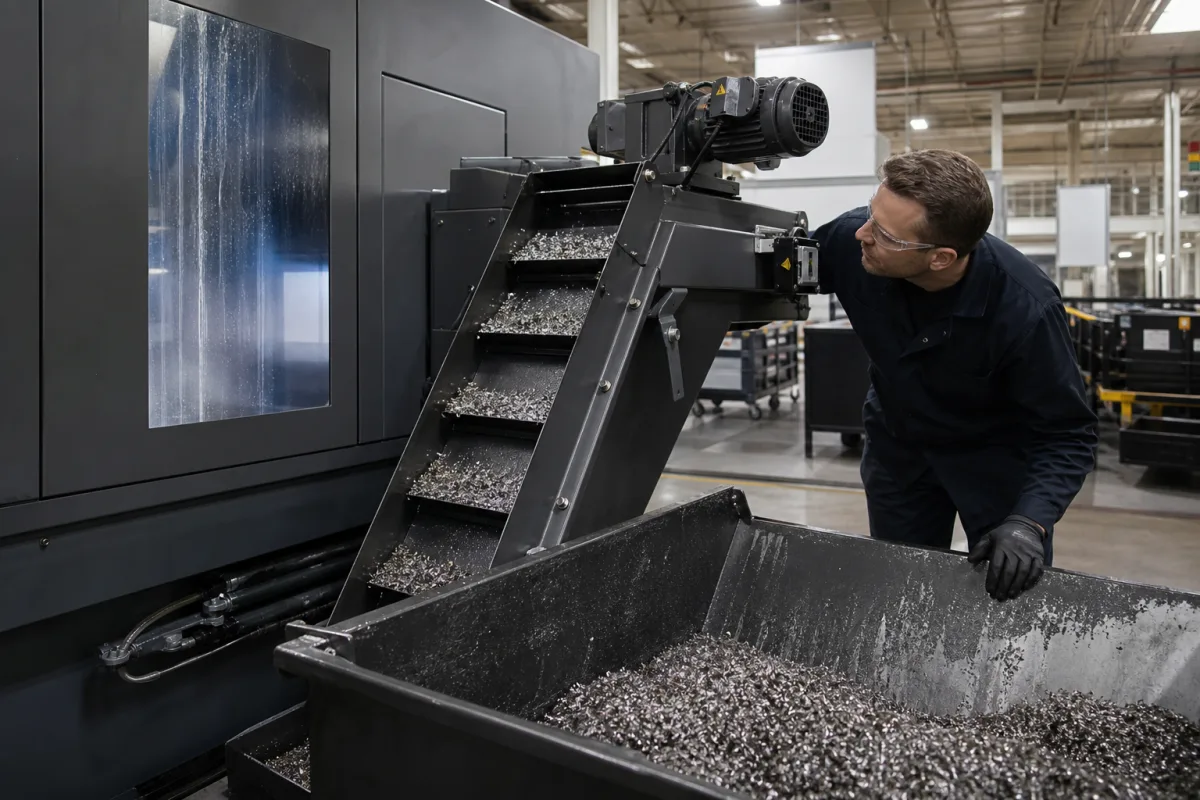
A chip conveyor sits in or beside the coolant tank of a lathe or machining centre, collects the chips that fall from the cut, drains the coolant back to the tank and lifts the chips up an incline into a cart or a central system. Ask three things first: which chip forms and materials it is rated for, how clean the coolant leaving it must be, and how the belt or scraper is built for your chip load.
Chip conveyors for machine tools: hinge (hinged steel) belt, scraper and drag, magnetic and screw types, including separator conveyors with built-in coolant filtration. Central plant scrap conveyors, chip wringers, shredders and briquetters, and stand-alone coolant filters are outside this page.
CNFX editorial research · Sources checked October 12, 2026 · 7 sources
Mayfran's conveyor selection guide rates each conveyor against the material and chip form, assuming water-soluble coolant and defining short chips as those under 2 in (Editorial calculation: about 51 mm) that do not ball up. Its plain hinge belt conveyor is rated Good for short and nested steel chips and for long aluminium strings, but only Fair for grinding sludge, cast-iron chips and short aluminium chips, and is not recommended for composite fines. [1]
The same guide rates a drag conveyor Good for short steel and brass chips but not recommended for nested steel chips or long strings of cast iron or aluminium; it rates the magnetic MagSep conveyor Best for short cast or ductile iron chips and Better for steel grinding sludge, and not recommended for non-ferrous chips. [1]
PRAB, another conveyor maker, frames the choice the same way: chip size and form, the material (aluminium, steel, cast iron, titanium), how wet the chips are and the throughput volume determine belt style, trough geometry and drive sizing. [6] Its chip conveyor guide describes magnetic conveyors for fine ferrous chips and grinding fines, and steel belt or drag chain conveyors for high-volume, abrasive, multi-shift work. [7]
Editorial note: send the supplier photographs or samples of the actual chips from your heaviest cut, not only the material grade, because the same steel can produce short broken chips or long tangled strings.
Give the supplier the machine model and coolant tank drawing, workpiece materials, chip forms and volume per shift, coolant type and flow, required coolant cleanliness, discharge height and direction, cart or central system connection, supply voltage and frequency, and the control interface to the machine.
02
Decide how clean the coolant must return
In Mayfran's guide, a plain hinge belt conveyor has no rated filtration; the CleanSweep-RM screen box cleans coolant to 250 micron nominal and the CleanSweep G2 to 150 micron; the CS1 and ConSep drum-filter conveyors to 50 micron; and the MagSep removes 98% of ferrous chips by weight with magnets. [1]
Mayfran's brochure describes the ConSep drum filter media as permanent and self-cleaning with a backwash spray; in the single-belt ConSep 2000 II a steel belt protects the drum and an auger at the discharge handles small chips and fines. It recommends adding an AT-Cleaner side-stream cyclone, rated for 10 micron coolant cleanliness, for dedicated cast or ductile iron work. [2]
Mayfran says a chip conveyor can extend tank cleanout from daily to weekly or even quarterly. [5] Its optional variable speed drive lets the conveyor run at the minimum speed that removes chips, which reduces coolant losses. [2] PRAB adds that tight-seal construction and drainage at the infeed reduce coolant carried out with the chips, and describes drier chips as "generally under roughly 2–5% retained moisture". [7]
03
Specify the belt and its options
Mayfran's hinge belt product sheet describes a general purpose conveyor in three sizes, with the drive chain separate from the belt, interlocking side wings that seal each side so material cannot lodge in the chain, and bushings locked into the roller block to reduce wear between bushing and pin. Large chips are carried on the belt and lifted to the discharge hopper. [3]
Mayfran's belt guide lists plain belts for dry work and for wet work within the plain belt's coolant rating, perforated belts for higher coolant flow, and dimpled belts, which it says are “primarily used in the stamping industry”. Options include formed or special cleats for large chip loads, side bar bumpers to keep long belts centred, impact shoes with a load bar for conveyors wider than 24 in (Editorial calculation: about 610 mm), and top plate reinforcement where larger objects can fall in. [4]
Mayfran offers a hard-turn package with hardened conveyor designs for hard or abrasive materials, and 2-1/2 in pitch (Editorial calculation: about 64 mm) Chip-Tote conveyors for heavy-duty work. [2] Editorial note: the belt guide is a maker's comparison with unnamed competitors; use it as a checklist of construction questions, not as test data.
04
Hinged belt, magnetic and screw conveyors sold with drag chains and way covers
The suppliers reviewed also make cable drag chains, way covers and other machine-tool accessories; ask each which conveyor types it builds, the belt pitch and the filtration it can add.
05
Hinge belt, drive chain, side wings, filtration element and discharge hopper
Chip volume, conveyor speed, width, motor and wear materials for a chip-conveyor order
Capacity, length and width follow from your machine's coolant tank and heaviest cut; the 2 in short-chip limit and the 24 in impact-shoe width are Mayfran's own figures.
Field
What it means and published values
Ask the supplier for
Conveying Capacity (kg/h)
Chip volume per hour from your heaviest cut.
Rated capacity for your chips.
Conveyor Speed (m/min)
Variable speed can run at minimum effective speed. [2]
3 companies list this product among what they make. Company figures are quoted from each
company's own website; every card states where the relationship came from.
Explore company information and manufacturing capabilities, then discuss the scope of your project with a relevant supplier.
Share this page
Compiled and source-reviewed by the CNFX editorial team.
Each manufacturer above links to the page on that company's own website where the product is listed, with the date we checked it. How we source and review
· Page last updated 13 October 2026
Buyer questions
Which chip conveyor suits cast iron chips?
In Mayfran's guide a plain hinge belt is only Fair for short cast-iron chips; its magnetic MagSep and ConSep Flex conveyors are rated Best. [1]
How clean is coolant after a chip conveyor?
It depends on the type: Mayfran lists no rated filtration for a plain hinge belt, 250 or 150 micron for screen boxes and 50 micron for drum filters. [1]
When is a perforated belt used?
Mayfran uses perforated belts for higher coolant flow and plain belts for dry work or flow within the plain belt's rating. [4]
Sources and what still needs a direct check
Sources checked 2026-10-12. Mayfran and PRAB are chip conveyor makers describing their own products and selection practice; ratings in Mayfran's guide apply to its own models.