Industry-Verified Manufacturing Data (2026)

Elevator Bucket Conveyor

Based on aggregated insights from multiple verified factory profiles within the CNFX directory, the standard Elevator Bucket Conveyor used in the Machinery and Equipment Manufacturing sector typically supports operational capacities ranging from standard industrial configurations to heavy-duty production requirements.

Technical Definition & Core Assembly

A canonical Elevator Bucket Conveyor is characterized by the integration of Bucket and Traction Element (Chain/Belt). In industrial production environments, manufacturers listed on CNFX commonly emphasize Abrasion-resistant steel (e.g., AR400, Hardox) construction to support stable, high-cycle operation across diverse manufacturing scenarios.

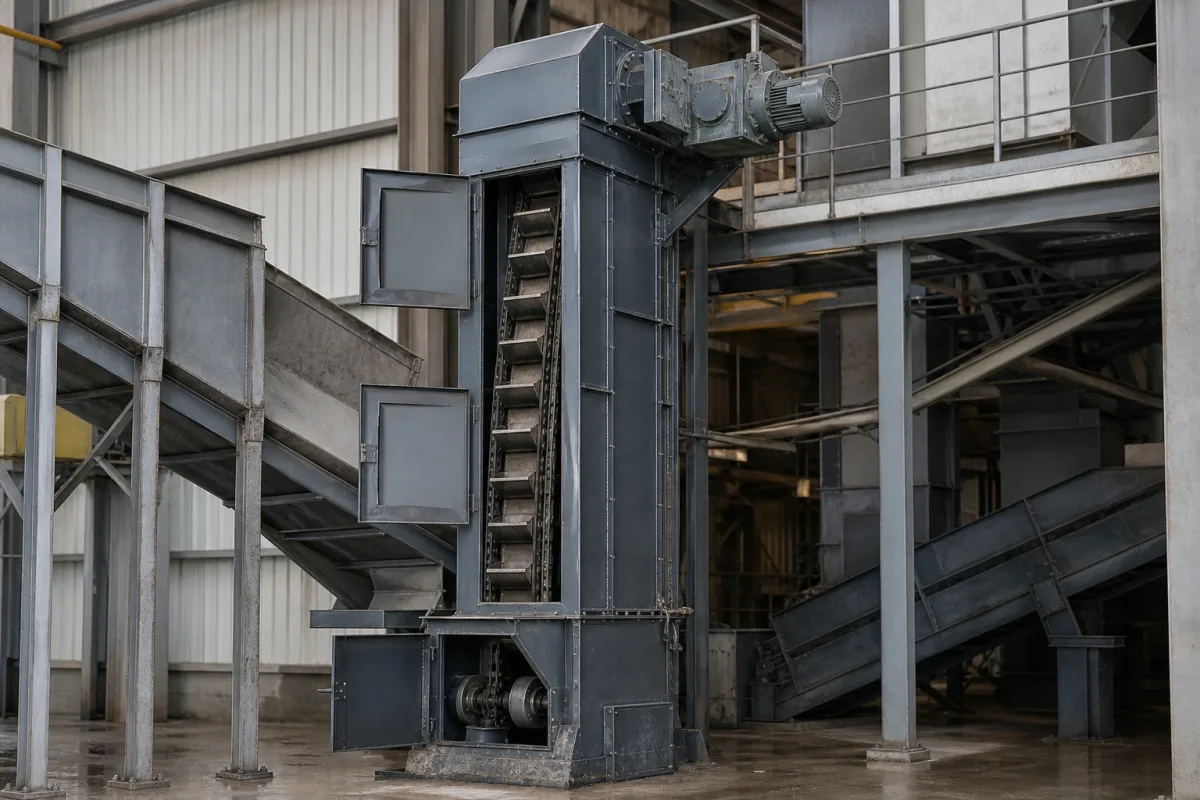
A vertical conveying component that uses buckets attached to a chain or belt to lift abrasive materials within a recycling system.
Product Specifications

Technical details and manufacturing context for Elevator Bucket Conveyor

Definition
The Elevator Bucket Conveyor is a critical component of the Abrasive Recycling System, specifically designed for the vertical transportation of spent abrasive media (such as steel grit, garnet, or aluminum oxide) from collection points to processing or storage stages. It efficiently handles abrasive, granular materials that require elevation against gravity within the closed-loop recycling circuit.
Working Principle
The conveyor operates by mounting a series of buckets (cups) onto a circulating chain or belt. As the drive mechanism rotates, the buckets scoop material from an inlet boot (loading zone) at the lower section. They carry the material vertically upward. At the designated discharge point (typically the head section), the buckets tip or pass over a sprocket/pulley, allowing the material to be emptied via gravity into the next stage of the recycling process (e.g., a separator, classifier, or storage hopper).
Common Materials
Abrasion-resistant steel (e.g., AR400, Hardox), High-strength alloy steel chain, Reinforced rubber belt (if belt-type)
Technical Parameters
  • Bucket width and projection; determines material handling capacity and footprint. (mm) Per Request
Components / BOM
  • Bucket
    Scoops, carries, and discharges the abrasive material.
    Material: Abrasion-resistant steel
  • Traction Element (Chain/Belt)
    Provides the continuous loop to which buckets are attached and transmits drive force.
    Material: Alloy steel chain or reinforced rubber belt with steel cords
  • Head Section
    Houses the drive sprocket/pulley and is the primary discharge point for the elevated material.
    Material: Carbon steel plate
  • Boot Section
    The loading zone where material is fed into the buckets; often includes a tensioning device for the traction element.
    Material: Carbon steel plate
  • Casing (Leg)
    Encloses the vertical path of the buckets, containing dust and preventing material spillage.
    Material: Carbon steel plate
Engineering Reasoning
0.5-2.5 m/s bucket speed, 0.1-1.0 MPa chain tension, 20-80°C material temperature
Chain tensile stress exceeding 450 MPa yield strength, bucket impact force exceeding 15 kN, abrasive wear depth exceeding 8 mm
Design Rationale: Stress concentration at bucket attachment points exceeding material fatigue limit (S-N curve at 10^6 cycles: 250 MPa), abrasive particle erosion exceeding 0.1 mm/year wear rate at 3 m/s impact velocity
Risk Mitigation (FMEA)
Trigger Chain misalignment exceeding 0.5 mm/m due to bearing wear
Mode: Asymmetric loading causing chain fatigue fracture at 10^5 cycles
Strategy: Laser-aligned sprocket mounting with 0.1 mm tolerance and tapered roller bearings
Trigger Material bridging creating 150% overload at bucket discharge
Mode: Bucket deformation exceeding 5 mm permanent strain at attachment welds
Strategy: Active vibration monitoring with 50 Hz accelerometers and automated flow control valves

Industry Taxonomies & Aliases

Commonly used trade names and technical identifiers for Elevator Bucket Conveyor.

Applied To / Applications

This component is essential for the following industrial systems and equipment:

Industrial Ecosystem & Supply Chain DNA

Complementary Systems
Downstream Applications
Specialized Tooling

Application Fit & Sizing Matrix

Operational Limits
pressure: Atmospheric to 0.5 bar
flow rate: Up to 500 m³/h
temperature: -20°C to 120°C
slurry concentration: Up to 70% solids by weight
Media Compatibility
✓ Recycled glass cullet ✓ Crushed construction debris ✓ Plastic flakes
Unsuitable: Highly corrosive chemical slurries
Sizing Data Required
  • Material bulk density (kg/m³)
  • Required throughput capacity (tons/hour)
  • Lift height (meters)

Reliability & Engineering Risk Analysis

Failure Mode & Root Cause
Bearing seizure due to material ingress
Cause: Contamination from conveyed material (e.g., dust, fines) penetrating seals, leading to lubrication breakdown and overheating
Bucket detachment or structural failure
Cause: Fatigue cracking from cyclic loading and impact forces, exacerbated by material buildup causing imbalance and excessive stress
Maintenance Indicators
  • Unusual grinding or scraping noises from the head or tail sections during operation
  • Visible material spillage along the conveyor path or excessive vibration observed in the casing
Engineering Tips
  • Implement a strict lubrication schedule with high-temperature, contaminant-resistant grease, and upgrade to labyrinth or magnetic seals to prevent ingress
  • Regularly inspect and clean buckets to prevent material buildup, and use non-destructive testing (e.g., ultrasonic) on welds and fasteners to detect early fatigue cracks

Compliance & Manufacturing Standards

Reference Standards
ISO 5049-1:1994 Continuous mechanical handling equipment - Safety requirements for belt conveyors ANSI/CEMA 350-2015 Screw Conveyors for Bulk Materials DIN 15237:2004 Continuous conveyors - Safety requirements
Manufacturing Precision
  • Bore diameter tolerance: +/-0.05mm
  • Bucket alignment tolerance: 0.2mm per meter of conveyor length
Quality Inspection
  • Dimensional inspection with coordinate measuring machine (CMM)
  • Non-destructive testing (NDT) - Magnetic particle inspection for weld integrity

Factories Producing Elevator Bucket Conveyor

Verified manufacturers with capability to produce this product in China

✓ 92% Supplier Capability Match Found

P Procurement Specialist from United States Feb 12, 2026
★★★★★
"Testing the Elevator Bucket Conveyor now; the technical reliability results are within 1% of the laboratory datasheet."
Technical Specifications Verified
T Technical Director from United Arab Emirates Feb 09, 2026
★★★★★
"Impressive build quality. Especially the technical reliability is very stable during long-term operation."
Technical Specifications Verified
P Project Engineer from Australia Feb 06, 2026
★★★★★
"As a professional in the Machinery and Equipment Manufacturing sector, I confirm this Elevator Bucket Conveyor meets all ISO standards."
Technical Specifications Verified
Verification Protocol

“Feedback is collected from verified sourcing managers during RFQ (Request for Quote) and factory evaluation processes on CNFX. These reports represent historical performance data and technical audit summaries from our B2B manufacturing network.”

10 sourcing managers are analyzing this specification now. Last inquiry for Elevator Bucket Conveyor from Turkey (1h ago).

Supply Chain Compatible Machinery & Devices

Automated Assembly Line System

Integrated production system for sequential component assembly operations

Explore Specs →
Automated Powder Coating System

Integrated industrial system for applying dry powder coatings to metal substrates.

Explore Specs →
Centrifugal Pump Impeller

Rotating component that transfers energy to fluid in centrifugal pumps.

Explore Specs →
High-Precision CNC Laser Cutting Machine

Computer-controlled industrial machine using focused laser beams to cut sheet metal with micron-level accuracy.

Explore Specs →

Frequently Asked Questions

What materials are best for elevator bucket conveyors handling abrasive recycling materials?

For abrasive materials in recycling systems, we recommend abrasion-resistant steel buckets (AR400 or Hardox grades) paired with high-strength alloy steel chains or reinforced rubber belts for optimal durability and minimal wear.

How does an elevator bucket conveyor differ from other vertical conveying systems?

Elevator bucket conveyors use attached buckets on a continuous chain or belt to vertically lift materials, making them ideal for handling abrasive, granular, or powdered substances in recycling applications where gentle handling and containment are crucial.

What maintenance is required for elevator bucket conveyors in heavy-duty recycling operations?

Regular inspection of bucket attachments, chain/belt tension, and abrasion-resistant components is essential. Lubricate chains periodically and check for material buildup in the boot and head sections to ensure efficient operation and prevent downtime.

Can I contact factories directly on CNFX?

CNFX is an open directory, not a transaction platform. Each factory profile provides direct contact information and production details to help you initiate direct inquiries with Chinese suppliers.

Get Quote for Elevator Bucket Conveyor

Request technical pricing, lead times, or customized specifications for Elevator Bucket Conveyor directly from verified manufacturing units.

Your business information is encrypted and only shared with verified Elevator Bucket Conveyor suppliers.

Thank you! Your message has been sent. We'll respond within 1–3 business days.

Need to Manufacture Elevator Bucket Conveyor?

Connect with verified factories specializing in this product category

Add Your Factory Contact Us
Previous Product
Elevation Pivot Joint
Next Product
Elevator Casing