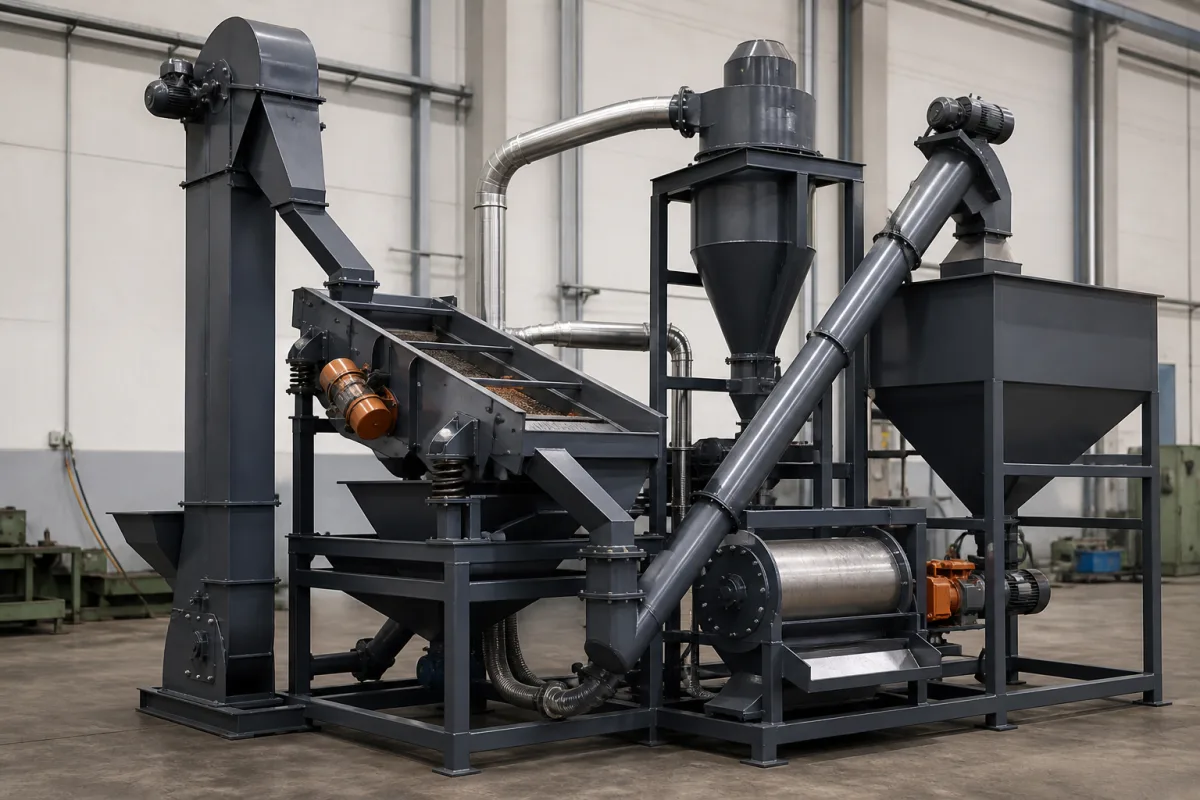
Steel grit recycling plant for air-nozzle blasting: magnetic drum separation, air-wash cleaning and less lead-paint waste
The free-standing plant that takes spent steel grit back from air-nozzle blasting — vacuum or floor recovery, a scalping screen, a magnetic drum and an air-wash curtain — so the grit goes back to the blast pot and only paint, rust and dust leave as waste
In nozzle blasting of bridges, tanks and blast rooms the grit does not stay inside a machine: it lands on the floor or in a containment with the old coating, and has to be picked up and cleaned before it can be blasted again. The plant pictured does that outside any blast machine: a bucket elevator lifts the spent mix to a vibrating screen, a magnetic drum keeps the steel grit, a cyclone and air wash take out dust and fines, and a screw conveyor and hopper return clean grit to the blast pots.
Stand-alone recovery and recycling plants for steel grit and steel shot used in compressed-air (nozzle) blasting: vacuum or floor collection, scalping screens, magnetic drum separators, air-wash separators, grit drying and return to storage hoppers and blast pots. Centrifugal wheel blast machines with built-in separators are covered on the Wheel shot blasting machines page, the shafts and bearings of blast wheels on the Wheel drive shaft and bearings page, and shipyard plate preheat-blast-prime lines on the Hull plate preservation line page. Recycling of non-magnetic mineral abrasives such as garnet is outside this page.
CNFX editorial research · Sources checked October 13, 2026 · 5 sources
Scalping screen and two magnetic drums: separating steel grit from paint chips and rust
US patent 5,657,876 (PCT Inc.) describes a mobile recovery unit for bridge blasting whose separation train matches the plant pictured, and its order of steps is the point to check on any offer. A rotary scalper made of perforated steel mesh passes material smaller than 3/16 inch and rejects larger waste; the remaining mix is fed tangentially onto a rotating non-magnetic drum with a fixed magnet inside, which carries the magnetically attractable grit past a divider into a first outlet. [1]
Material that the upper drum does not pick up falls onto a second drum with its own magnet. That drum splits it into substantially pure waste, sent to the waste auger, and a mixed fraction of grit and waste that is lifted back to the scalper for another pass, so grit lost on the first drum gets a second chance. The divider can be moved to change its radial gap to the upper drum without touching it, which is the adjustment that trades grit recovery against carry-over of waste. [1]
Collection in that design is by vacuum: a positive-displacement blower of 1,800 CFM able to draw up to 27 inches of mercury, with at least 20 and preferably 25 inches of mercury named for continuous operation, so that the hose does not clog when the material flow is heavy. [1] Editorial calculation: 1,800 CFM is about 51 m³/min, 27 inHg about 91 kPa of vacuum, and the 3/16 inch scalper opening about 4.8 mm.
The magnetic step only works because steel grit is ferromagnetic. Ronald C. Benson's patent US 8,920,210 B2 puts the density of steel grit at 265 lb per cubic foot, roughly 2.5 times that of sand or coal slag, and says the particles can be recycled up to 50 or more times with non-metallic particles removed on each pass through the recycling machine. [2] Editorial calculation: 265 lb/ft³ is about 4,240 kg/m³.
Stage in the plant pictured
What the cited designs specify
Scalping screen
Perforated rotary scalper; rejects waste over 3/16 inch [1]
Splits pure waste from a mixed fraction returned to the scalper [1]
Air wash
Curtain of falling grit; feed walls at about 60°, diverting walls at about 45° [3]
Drying (wet recovery)
Rotary drum with heated air between about 200 °F and 700 °F [2]
Ask for the scalper opening, the number of magnetic drums and whether the mixed fraction is recirculated, and how the divider gap is set and locked.
02
Air-wash curtain and moisture: removing fines without blowing the grit away
After the magnetic drums the grit falls through an air wash, where a cross-flow of air carries dust and fines away while the heavier grit drops through; in US 5,657,876 an auxiliary blower feeds this air wash through a plenum. [1]
James W. Cerny's patent US 11,400,490 B2 is about the shape of that curtain. It describes angled feed walls set at about 60 degrees that form the grit into a curtain over a cascade edge, and diverting walls at about 45 degrees at the edge ends to stop fines accumulating, and states that the apparatus has been shown to reduce the contaminants remaining in reclaimed abrasive by as much as 30 percent. The patent identifies the conventional baffle structure as the cause of recurring maintenance issues. [3]
The air speed has a ceiling. Benson's patent states that the capture velocity of steel grit is approximately 9,000 feet per minute and that air below that speed may be used in its drying drum. [2] Editorial calculation: 9,000 ft/min is about 46 m/s.
Moisture is the other limit. The same patent says rain mixed into recovered grit makes it heavier and sticky, so it no longer flows at its angle of repose of approximately 30 to 40 degrees, and describes drying it in a rotary drum with heated air between approximately 200 °F and 700 °F and filters rated for 250 °F or higher. [2]
Ask for the air-wash airflow and how it is adjusted, the dust collector filter area, and whether the plant can dry wet grit or needs dry feed.
03
How much paint waste recycling removes: FHWA and Missouri DOT figures
On lead-paint removal from steel bridges the case for a recycling plant is the waste volume.
The FHWA final report FHWA-RD-94-100 (February 1995, prepared by S.G. Pinney and Associates) on lead-containing paint removal, containment and disposal, as abstracted by the Transportation Research Board, found recyclable steel abrasive cost-competitive and reducing debris by approximately 90 % compared with expendable abrasive. It also found that meeting environmental and worker-health regulations had raised the cost of the average project by a factor of two or three. [4]
FHWA's Focus newsletter of January 2002 reported Missouri DOT's results after it bought two abrasive recycler blasters in 1996: machines with vacuum washers and magnetic separators that reduce blast residue by an estimated 80 percent, so that an average bridge produced 6 to 10 drums of residue for smelting instead of 50. [5] Editorial calculation: 6 to 10 drums out of 50 is a reduction of 80 to 88 %.
US 5,657,876 gives the reason in the same setting: when grit is not separated from lead dust and other site waste, a high quantity of hazardous waste remains for disposal. [1]
Ask for the grit loss per cycle the plant is guaranteed to, and what fraction of the separated waste leaves the plant per tonne of grit blasted.
04
Information for a steel grit recycling plant
Paste it into your enquiry below or into an email to a maker, then replace every bracket.
Abrasive: [steel grit or shot; size; tonnes per hour to be recovered]
Collection: [vacuum hose length and lift, or floor recovery to a bucket elevator]
Separation: [scalper opening; number of magnetic drums; air-wash adjustment]
Waste: [coating type, e.g. lead paint; waste handling and dust collector]
Site: [mobile or fixed; power supply; wet or dry recovery]
Explore company information and manufacturing capabilities, then discuss the scope of your project with a relevant supplier.
Share this page
Compiled and source-reviewed by the CNFX editorial team.
Each manufacturer above links to the page on that company's own website where the product is listed, with the date we checked it. How we source and review
· Page last updated 13 October 2026
Buyer questions
How does a grit recycling plant separate steel grit from paint waste?
In US 5,657,876 a rotary scalper rejects material over 3/16 inch, then two magnetic drums keep the steel grit and send non-magnetic waste out, with a mixed fraction returned for another pass. [1]
How many times can steel grit be recycled?
Patent US 8,920,210 B2 states steel grit can be recycled up to 50 or more times, with non-metallic particles removed on each pass. [2]
How much waste does recycling steel grit save on lead-paint jobs?
FHWA found recyclable steel abrasive reduced debris by about 90 % against expendable abrasive; Missouri DOT went from about 50 drums of residue per bridge to 6–10. [4][5]
Why does wet grit cause problems in a recycling plant?
Patent US 8,920,210 B2 says moisture makes steel grit sticky so it stops flowing at its 30–40 degree angle of repose; it describes drying it with heated air. [2]
Sources and what still needs a direct check
Sources checked 2026-10-13. The separation train and vacuum collection come from a PCT Inc. patent for bridge blasting; air-wash curtain design and grit drying from two individual inventors' US patents; waste reduction from FHWA's lead-paint removal report and its Focus newsletter.