Teach Pendant
View system integration details
This page explains how Enabling Device (Deadman Switch) is classified within Machinery and Equipment Manufacturing. Technical values and manufacturer relationships are research references; confirm the current specification and supplier evidence for each order.
A safety-critical three-position switch on a teach pendant that must be continuously engaged to enable robot movement.
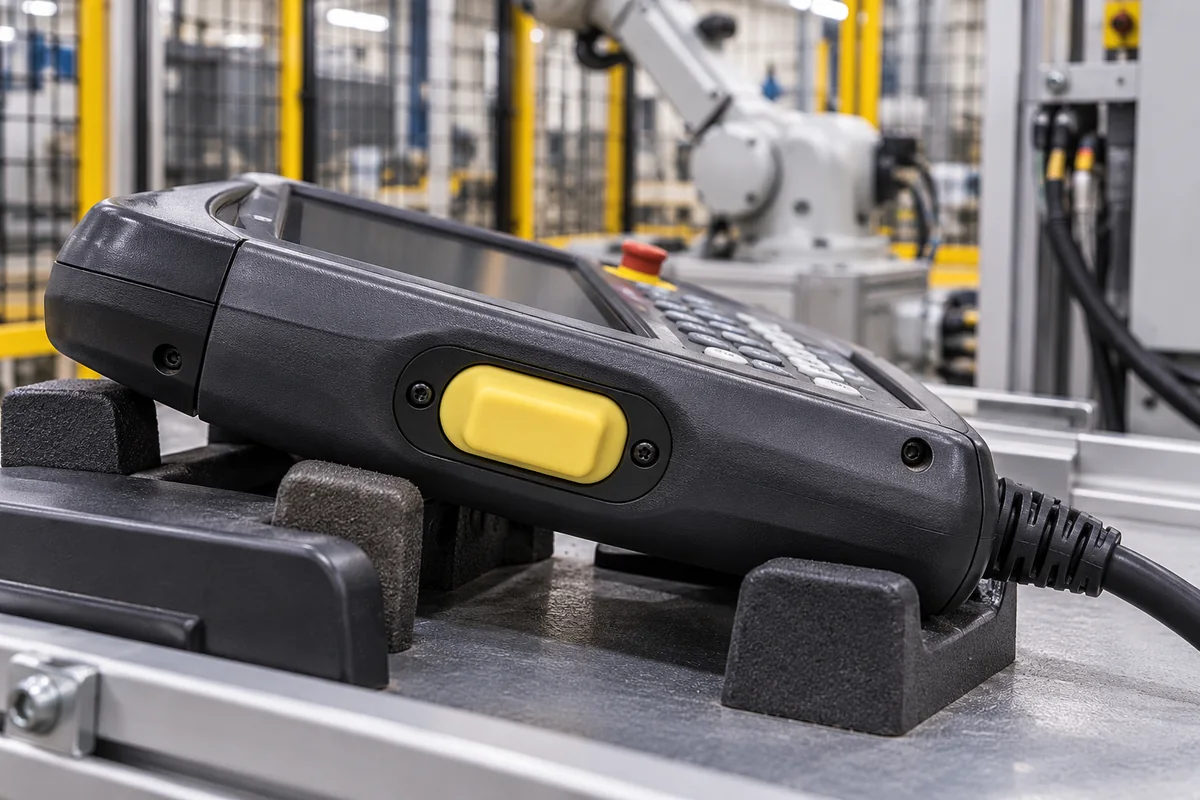
Technical details and manufacturing context for Enabling Device (Deadman Switch)
| Parameter | Typical range | Notes & selection driver |
|---|---|---|
| Contact Rating | 24 ±10% V DC, 0.5 A | Maximum switching capacityIEC 60947-5-1 |
| Mechanical Life | ≥1,000,000 cycles | Minimum operations without failureIEC 60947-5-1 |
| Electrical Life | ≥500,000 cycles | At rated loadIEC 60947-5-1 |
| Operating Force | 5–15 N | Force to engage and holdIEC 60947-5-1 |
| Contact Resistance | ≤100 mΩ | Initial valueIEC 61984 |
| Insulation Resistance | ≥100 MΩ | At 500 V DCIEC 60255-5 |
| Dielectric Strength | 1000 V AC | For 1 minuteIEC 60255-5 |
| Operating Temperature | -25–70 °C | Continuous operationIEC 60068-2-1/2 |
| Storage Temperature | -40–85 °C | Non-operatingIEC 60068-2-1/2 |
| Ingress Protection | IP54–IP65 | Against dust and waterIEC 60529 |
| Housing Material | PA66+30%GF | Flame retardant V-0UL 94 |
| Weight | ≤200 g | Lightweight for pendant |
Ranges are indicative industry figures for RFQ preparation, not a supplier commitment. Confirm every value and standard with the legal manufacturer before ordering.
| pressure: | Not applicable (electrical switch) |
| other spec: | IP65 ingress protection, 10 million mechanical cycles, 24V DC operating voltage |
| temperature: | -20°C to +70°C |
Indicative industry ranges for design and RFQ preparation. Confirm the exact figures and applicable standard with the manufacturer before specifying.
Quoted from the published standard.
A practical evidence checklist for RFQ preparation and supplier evaluation.
Compare the published product scope and source details, then include your specifications and quantity in an enquiry.
Manufacturer profiles associated with Enabling Device (Deadman Switch).
Explore company information and manufacturing capabilities, then discuss the scope of your project with a relevant supplier.
Ask for use case, specification boundaries, supplier type, and RFQ preparation information for this product.
The enabling device is a safety component that must be held in the middle position to allow robot movement. If released or pressed fully, it triggers a protective stop, preventing accidental motion and ensuring operator safety during programming or maintenance.
The switch has three positions: released (motion disabled), middle (motion enabled), and fully pressed (motion disabled as a safety override). This design ensures that the operator must consciously maintain the correct pressure to keep the robot operational.
Key parameters include contact rating (24 V DC, 0.5 A), mechanical life (≥1,000,000 cycles), electrical life (≥500,000 cycles), contact resistance (≤100 mΩ), insulation resistance (≥100 MΩ at 500 V DC), and dielectric strength (1000 V AC for 1 minute). Always confirm these with the manufacturer for your specific model.
The device references standards such as IEC 60947-5-1 for switching elements, IEC 61984 for connectors, IEC 60255-5 for insulation, IEC 60068-2-1/2 for temperature, IEC 60529 for ingress protection, and UL 94 for flammability. These are verification references, not proof of certification.
This component is essential for the following industrial systems and equipment:
Commonly used trade names and technical identifiers for Enabling Device (Deadman Switch).
Editorial classification, named public sources where available, and source-reviewed manufacturer records.
Compare manufacturer profiles with relevant product and process capability.