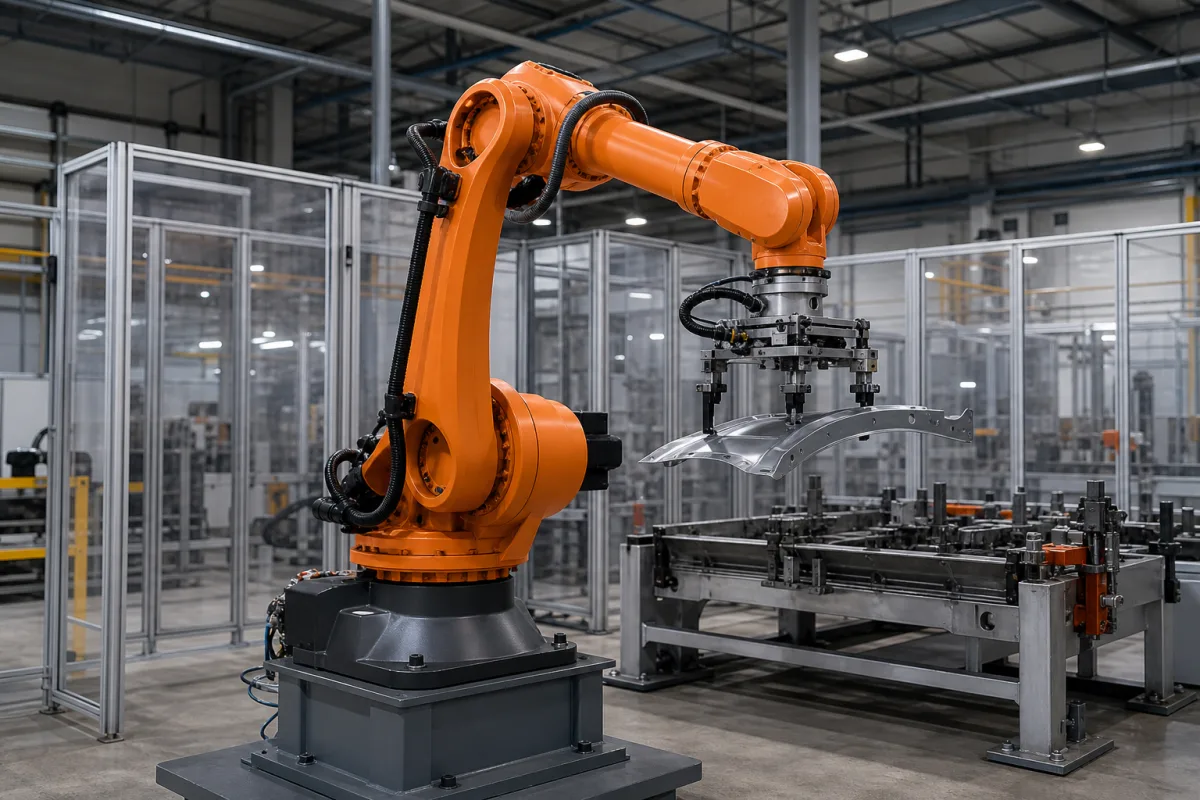
Industrial robot arm for press tending and stamped-part transfer
Robot arms for sheet-metal stamping lines · press pitch and strokes per minute, 3- to 6-axis joint stamping robots, and the press guarding that stays in force
This page covers the robot arm that loads blanks into a press, takes the stamped part out and passes it to the next press or a stack. Its sizing starts from the press line, not from the robot: the distance between press centres (pitch), the stroke rate the line must hold, the part size and gripper weight, and the press tonnage the robot is built to serve. Ask three things first: what press pitch and strokes per minute the arm achieves with your tooling, how many axes it has and why, and how the press stays guarded for people once the robot is in place.
Robot arms built or configured for sheet-metal press tending and stamping-line part transfer: six-axis press-tending robots and 3-, 4- and 5-axis joint stamping robots, with their gripper tooling interfaces and press-line integration. Industrial robot arms as a product family, including SCARA, Cartesian and parallel structures, are covered on the Industrial robotic arm page; six-axis arms selected by wrist load and working envelope are covered on the Robotic manipulator page. Coil feeders, crossbar transfer systems built into presses, and welding robots are outside this page.
CNFX editorial research · Sources checked October 12, 2026 · 5 sources
Yaskawa's Motoman EPH4000D press-tending robot is a six-axis, floor-mounted articulated arm with a 200 kg payload, 3,505 mm horizontal reach and 2,629 mm vertical reach; the datasheet states that this reach lets it tend presses with pitches of up to 9 m and that it can reach 12 strokes per minute at a press pitch of 6.5 m. [1]
The same datasheet lists an optional Parallel Link Tool that extends reach by 1,650 mm while reducing interference between the arm and the die, aluminium castings to reduce inertia, fans on more axes to limit heat in high-duty press tending, ±0.5 mm repeatability and a robot mass of 3,050 kg. [1]
Fuxin sizes its joint stamping robots by press tonnage instead. Its 3100 mm model (QF-DL-3180) is offered in 3-, 4- and 5-axis configurations for multi-press lines and single presses with multi-mold set-ups of 1,600 t and below, handles parts up to 2,000 × 2,000 mm, carries 80 kg and reaches 1,050–3,100 mm. [2] Its 1400 mm model is listed for presses of 350 t and below with a 10 kg payload. [3]
Editorial calculation: 12 strokes per minute leaves 60 ÷ 12 = 5 seconds for each press-to-press transfer, including gripping, the move across the 6.5 m pitch and release, so ask the supplier for the stroke rate measured with your gripper and part weight, not the bare-arm figure. [1]
Give the supplier the press line layout (number of presses, pitch, bed sizes, tonnage, shut height), stroke rate required, part size and weight, gripper type and weight, die change frequency, the transfer path (press to press, press to stack, turnover), available floor or shelf space, and the guarding concept for the line.
02
Keep the press guarded for people when a robot loads it
OSHA's mechanical power press rule (29 CFR 1910.217) requires, where a presence-sensing device protects the point of operation, a safety distance from the sensing field to the point of operation greater than Ds = 63 inches/second × Ts, where Ts is the press stopping time measured at about 90° of crankshaft rotation; guards must cover every other area of entry not protected by the device. [5]
The same rule allows muting of the sensing device during the upstroke of the slide for parts ejection, circuit checking and feeding, requires that a brake monitor, where paragraph (c)(5) calls for one, prevents the next stroke if stopping time deteriorates beyond the safety distance in use, and asks employers reporting point-of-operation injuries to state the type of feeding (manual, semiautomatic, automatic or other). [5]
Editorial calculation: for a press with a measured stopping time of 0.25 s, Ds = 63 × 0.25 = 15.75 inches (about 400 mm); the stopping time here is an assumed example, so use the measured value for your press. [5]
Editorial note: ask the integrator to show how operators reach the die area for die changes and part checks with the robot installed, which openings are guarded by fences and which by sensing devices, and how the robot's stop is linked to the press control.
03
Choose between 3- to 5-axis stamping robots and six-axis press-tending arms
Fuxin builds its stamping robots with 3, 4 or 5 axes for press-to-press moves, while Yaskawa's press-tending arm has six; the rows give each model's published figures.
Fuxin's page gives two different accuracy figures for the 3100 mm model; ask which one is the ISO pose repeatability and under what load it was measured. [2] For automotive stamping, Fuxin claims a service life of 8–10 years, a longest recorded life of 16 million cycles, and compatibility with hydraulic presses, gear presses and pneumatic punches. [4]
Model
Axes and mounting
Published figures
Fuxin 1400 mm joint stamping robot
3, 4 or 5 axes
10 kg; presses 350 t and below; ±0.1 mm repeatability. [3]
Fuxin 3100 mm joint stamping robot (QF-DL-3180)
3, 4 or 5 axes
80 kg; reach 1,050–3,100 mm; presses 1,600 t and below; pose repeatability ±0.2 mm in the table, grabbing accuracy ±0.1 mm in the feature list; about 1,500 kg. [2]
Yaskawa Motoman EPH4000D
6 axes, floor-mounted
200 kg; 3,505 mm horizontal reach; ±0.5 mm; 3,050 kg; press pitch up to 9 m. [1]
04
Payload, reach, axis and power data for a stamping-robot quotation
Fill each field for your press line; where a reviewed model publishes a value it is shown for comparison.
Field
Published value or meaning
Ask the supplier for
Rated Payload (kg)
10 kg (Fuxin 1400 mm), 80 kg (Fuxin 3100 mm), 200 kg (EPH4000D). [3][2][1]
Payload including gripper.
Reach (m)
3.1 m maximum, 1.05 m minimum (Fuxin 3100 mm); 3.505 m horizontal (EPH4000D). [2][1]
Reach drawing over your press line.
Repeatability (mm)
±0.2 mm (Fuxin 3100 mm table); ±0.5 mm (EPH4000D). [2][1]
Companies listing robot arms for stamping and metal-working cells
Fuxin lists joint stamping robots by reach and press tonnage; Qingdao Jiujin lists an anthropomorphic arm alongside gantry loaders for CNC machines; Shandong Jiaxin lists robot arms next to its cutting machines.
Fuxin Intelligent
Manufacturing site to be confirmed for the order
Lists intelligent joint stamping robots from 1200 mm to 3100 mm reach in 3-, 4- and 5-axis configurations for press tending, with swing-arm stamping manipulators and feeders.
Explore company information and manufacturing capabilities, then discuss the scope of your project with a relevant supplier.
Share this page
Compiled and source-reviewed by the CNFX editorial team.
Each manufacturer above links to the page on that company's own website where the product is listed, with the date we checked it. How we source and review
· Page last updated 13 October 2026
Buyer questions
How far apart can presses be for one robot to tend?
Yaskawa states its EPH4000D can work with press pitches up to 9 m and reach 12 strokes per minute at 6.5 m. [1]
Why do some stamping robots have only 3 or 4 axes?
Fuxin offers its joint stamping robots in 3-, 4- and 5-axis configurations for press-to-press transfer; a six-axis arm such as the EPH4000D adds orientation freedom. [2][1]
Does a robot-fed press still need a safety distance?
Where a presence-sensing device guards the point of operation, OSHA 29 CFR 1910.217 requires Ds greater than 63 in/s × the press stopping time. [5]
Sources and what still needs a direct check
Sources checked 2026-10-12. Yaskawa's datasheet (hosted by the US integrator robots.com) and Fuxin's product pages describe their own robots; OSHA's 29 CFR 1910.217 is the US federal rule for mechanical power presses.