Safety relay modules · Response time in the stopping chain, contact ratings under inductive load, durability, OFF-delay, fault monitoring
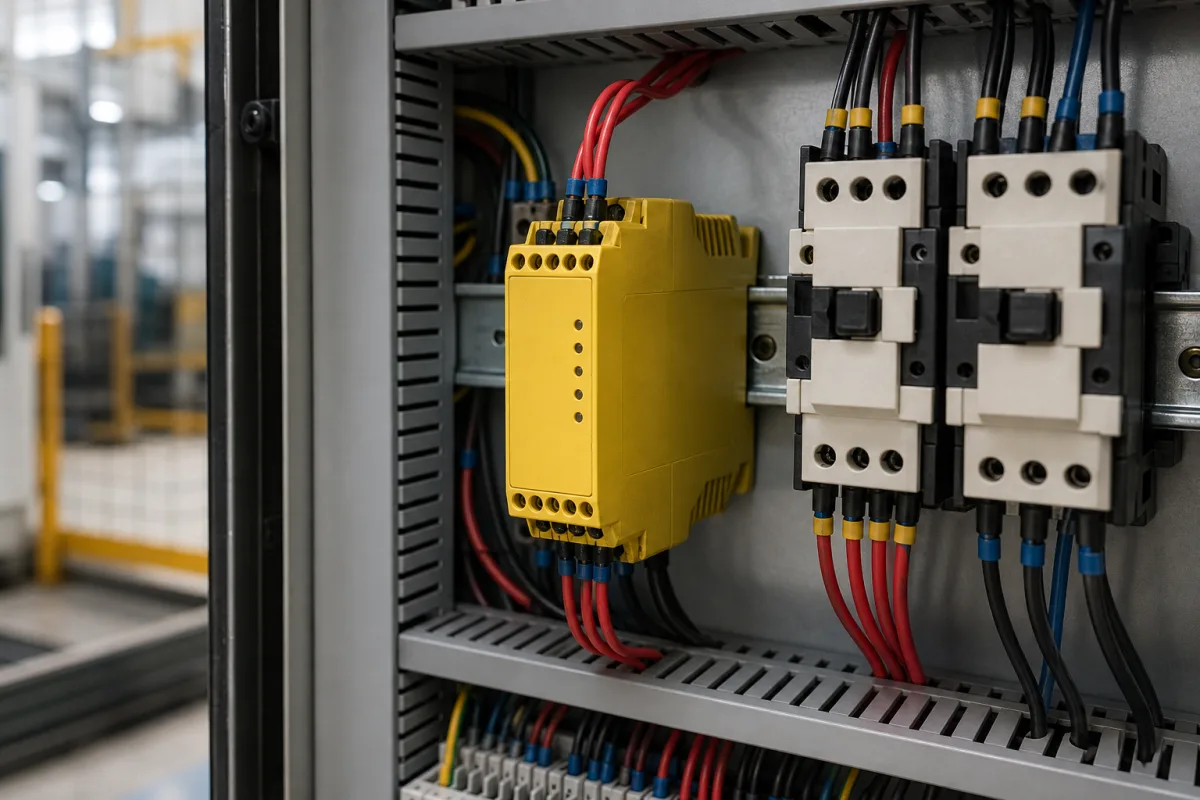
A safety relay module monitors safety inputs such as emergency stops, gate switches and light curtains and opens its safety contacts to remove power from contactors or drives when a demand or fault occurs, as in the cabinet pictured where a safety relay sits beside the contactors it controls. Ask three things first: how quickly the module opens its outputs and how that adds to the machine's stopping time, what loads its contacts can switch and for how many operations, and how it detects faults and resets.
Electromechanical safety relay modules and safety relay units for emergency stop, guard and light-curtain monitoring, including OFF-delay versions. Programmable safety controllers, safety PLCs, light curtains themselves and standard control relays are outside this page.
CNFX editorial research · Sources checked October 12, 2026 · 5 sources
Check response time and how it adds to stopping time
Omron's G9SE safety relay unit specifications give a response time (ON to OFF) of 15 ms maximum, the time for the safety main contact to open after the safety input turns off, including bounce, and an operating time (OFF to ON) of 100 ms maximum after the safety inputs and feedback/reset input turn on, rising to 500 ms during its non-regular self-diagnosis of the output circuit. The reset input must be held at least 250 ms, and input cables may run up to 100 m. [1]
For mechanical power presses guarded by presence-sensing devices, US rule 29 CFR 1910.217(c)(3)(iii) requires a safety distance Ds = 63 inches/second × Ts, where Ts is the stopping time of the press measured at about 90° of crankshaft rotation. It also requires the device to be built so that a failure does not prevent normal stopping but does prevent a successive stroke until corrected, with the failure indicated. [2]
Editorial calculation: every 15 ms the relay takes to open adds 63 × 0.015 ≈ 0.95 in (about 24 mm) to the distance the sensing field must sit from the point of operation, because the stopping time is measured through the whole chain from sensor to stopped slide. Measure the stopping time with the actual relay and contactors fitted.
Give the supplier the safety functions to be monitored (emergency stop, guard, light curtain, two-hand control), number of input channels and type, required performance level or SIL from your risk assessment, the loads to be switched (contactor coils, drive enables) with voltage and current, any OFF-delay needed for controlled stopping, reset type, supply voltage and mounting space.
02
Check contact ratings, durability and OFF-delay
The G9SE family offers two or four normally open (DPST-NO or 4PST-NO) instantaneous safety outputs, or two instantaneous plus two OFF-delayed outputs adjustable in 16 steps up to 5 s (T05) or 30 s (T30), plus a PNP auxiliary output rated 100 mA. Contacts are rated 250 V AC 5 A and 30 V DC 5 A resistive, but for inductive loads under IEC/EN 60947-5-1 only AC15 240 V AC 2 A and DC13 24 V DC 1.5 A, with a minimum load of 24 V DC 4 mA. [1]
Omron rates mechanical durability at 5,000,000 operations minimum and electrical durability at 50,000 operations minimum, requires an 8 A fuse to IEC 60127 for short-circuit protection (conditional short-circuit current 100 A), and specifies 24 V DC supply (−15% to +10%), 3 to 4 W consumption and −10 to 55 °C surrounding air. [1]
The relays inside a safety relay module that monitor their own contacts are covered by IEC 61810-3:2015, edition 1.0 of 2015-02-25 (22 pages, IEC TC 94 Electrical relays), which specifies special requirements and tests for elementary relays with forcibly guided, also called mechanically linked, contacts, in addition to the general requirements of IEC 61810-1. [4] BSI's summary of the identical BS EN 61810-3:2015 says it applies to relays built so that make (normally-open) contacts cannot assume the same state as break (normally-closed) contacts, for use in self-monitoring control systems such as safety-related control systems; it covers forcibly guided operation, changeover contacts, mechanical endurance, operating conditions, type tests and marking, and supersedes BS EN 50205:2002, with 01.01.2016 set as the latest national implementation date and 01.04.2018 as the latest withdrawal date for conflicting national standards. [5]
Editorial note: a supplier quoting EN 50205 for the internal relays is citing the 2002 standard that EN 61810-3:2015 replaced; ask which edition the relays were tested to and whether the module's feedback loop reads a normally-closed contact that is mechanically linked to the safety outputs. [5][1]
Editorial calculation: a machine whose guard is opened 100 times per shift on three shifts, 250 days a year, makes 75,000 operations a year, which would use up a 50,000-operation electrical rating in under a year if the relay switched the load directly; switching contactor coils instead of motor loads keeps contact duty light. The operating pattern is an assumed example.
03
Relay makers, light-curtain makers and the ISO 13849-1 basis
Listings include safety relay modules from a relay maker and from makers of safety light curtains and laser scanners who offer them as companion controllers. Ask each supplier for the certified performance level and category or SIL, response and operating times, contact ratings under AC15 and DC13, durability, and the fuse required.
The design standard that safety relay certificates refer to is ISO 13849-1, Safety of machinery — Safety-related parts of control systems — Part 1: General principles for design. Edition 4 (ISO 13849-1:2023, approved 26 April 2023, 152 pages, replacing the 2015 edition) gives a methodology for designing and integrating safety-related parts of control systems that perform safety functions, including software, for high-demand and continuous modes in any technology; low-demand mode falls under the IEC 61508 series. It does not set the safety functions or required performance levels (PLr) for particular applications, which come from the risk assessment or a type-C machine standard, and it does not give design requirements for individual components. [3]
Editorial note: a relay's certified PL and category cover the relay only; the performance level of the whole safety function also depends on the input devices, the output contactors and their wiring and diagnostics, so ask the supplier for the values needed to calculate the complete function. [3]
04
Inputs, guided contacts, feedback loop and fuse
The feedback and reset row is where forcibly guided contacts matter: the module can detect a welded safety output only because its monitoring contact cannot share that output's state.
Utilisation categories, endurance and certified PL per module
Every published value in this table comes from Omron's G9SE; another maker's module will differ, so ask the supplier you are quoting for the same rows.
Explore company information and manufacturing capabilities, then discuss the scope of your project with a relevant supplier.
Share this page
Compiled and source-reviewed by the CNFX editorial team.
Each manufacturer above links to the page on that company's own website where the product is listed, with the date we checked it. How we source and review
· Page last updated 13 October 2026
Buyer questions
How fast does a safety relay open?
Omron specifies 15 ms maximum for its G9SE from the safety input turning off to the safety contact opening, including bounce. [1]
What load can safety relay contacts switch?
For inductive loads Omron's G9SE is rated AC15 240 V 2 A and DC13 24 V 1.5 A, below its 5 A resistive rating. [1]
How does stopping time affect safety distance?
For US power presses, 29 CFR 1910.217 sets Ds = 63 inches per second × stopping time. [2]
Does ISO 13849-1 tell me which performance level my machine needs?
No. ISO 13849-1:2023 gives the design methodology but does not set the safety functions or required performance levels for particular applications; these come from the risk assessment or a machine-specific standard. [3]
What standard covers the forcibly guided relays inside a safety relay module?
IEC 61810-3:2015 (EN 61810-3:2015), which superseded EN 50205:2002; BSI says it covers relays whose normally-open contacts cannot assume the same state as their normally-closed contacts. [4][5]
Sources and what still needs a direct check
Sources checked 2026-10-12. Omron is a safety relay maker; its specifications apply to the G9SE family. 29 CFR 1910.217 is a US workplace safety regulation for mechanical power presses. The ISO 13849-1 and IEC 61810-3 entries are standard abstracts from standards bodies (SIS, IEC and BSI); the full texts are sold separately.