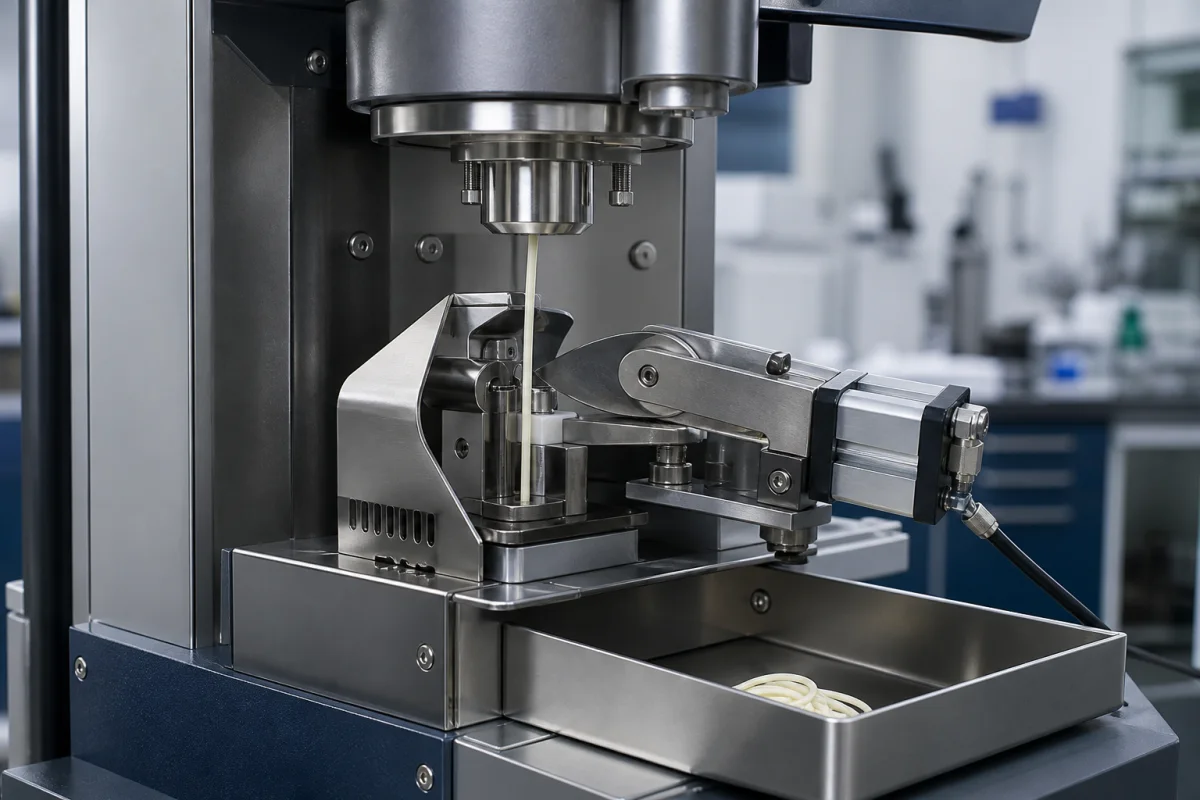
Extrudate cutter for Procedure A melt flow testing: timed cut-offs from 6 minutes down to 15 seconds, and manual, motorized or automatic knives
The knife under the die of a melt flow indexer · when Procedure A needs one, how short the cut intervals get, and how manual, motorized and automatic cutters differ on three instrument lines
In a mass-based melt flow test the result is only as good as the timing of the cuts: the operator, or a knife driven by the instrument, severs the strand at the die at the start and end of each interval, and the pieces are weighed. A cutter is the device that does this under the die, swinging or sliding a blade across the die face on a timer and dropping the cut pieces into a tray. Whether a laboratory needs one, and of which kind, depends on how often it runs Procedure A and how fast its resins flow.
Extrudate cutting devices fitted under the die of extrusion plastometers: manual cut-off knives, motorized cutters and automatic sample cutters that cut the strand at programmed times for Procedure A (mass) and A/B testing, with their timing, interlocks and model availability. Choosing the complete melt flow indexer, its loads, temperature control and displacement system is covered on the Melt flow index tester (extrusion plastometer) page. Pelletizer knives and strand cutters on production extruders are covered on the Polymer pelletizing strand cutter page, and cutters for food extruders on the Cutting mechanism for food extruders page.
CNFX editorial research · Sources checked October 13, 2026 · 4 sources
Why Procedure A needs a cutter: cut intervals from 6 minutes to 15 seconds and a 0.15 to 50 g/10 min ceiling
ZwickRoell, explaining ASTM D1238, sets out the conditions under which the strand is cut in Procedure A:
ZwickRoell also notes a difference between the two standards: ASTM D1238 specifies the intervals closely for each MFR value, while ISO 1133-1 leaves it “largely up to the operator” to choose suitable intervals. [1]
Editorial calculation: the MFR in g/10 min is the cut mass scaled to 600 seconds, so a cut taken over 15 s that weighs 0.75 g gives 600 × 0.75 ÷ 15 = 30 g/10 min. A timing error of 0.1 s between the programmed and the actual cut is 0.7% of a 15 s interval but under 0.03% of a 6 minute interval (0.1 ÷ 360). On these figures the cut timing weighs more on fast-flowing resins at the 15 s end of the interval range than on slow ones. Dynisco states a timer accuracy of 0.001 s on the LMI5500. [1][2]
Condition
Value in ASTM D1238 Procedure A
What is cut and weighed
The extrudate is cut at constant time intervals and its mass is determined with an analytical balance [1]
Give the MFR range of the resins to be tested, the standard (ASTM D1238 or ISO 1133-1) and the number of Procedure A tests per shift; ask whether the cutter is triggered by the instrument's own timer.
02
Manual knife, motorized cutter or automatic sample cutter: what Dynisco and Instron fit, and when Procedure B makes the knife unnecessary
Instrument makers sell the cutter as an option or a built-in feature, and the drive differs by model:
The image above shows this arrangement: a stainless knife arm under the die, driven by a compact cylinder at the side, with the cut strand coiling in a collection tray below.
A cutter is not needed for every melt flow test. In Procedure B the instrument measures piston travel instead of weighing cuts, over 6.35 mm for MFR values up to 10 g/10 min and over 25.4 mm above that; ZwickRoell lists the elimination of mechanical cutting as a significant advantage of the method, and gives its range as 0.5 to about 1500 g/10 min. [1] Dynisco's cutter still has a use on a Procedure B instrument, because it cuts the purge strand at the end of the pre-heat time. [2] A laboratory that also wants melt density from combined A and B results needs both the encoder and a cutter. [1][2]
Cuts at the defined cut times of Method A and Method A/B, and also at the end of the pre-heat melt time in any method; the datasheet also lists increased access to the die for cutting, with a mirror to view the die and cutting area [2]
Removes the delay between programmed and actual cut time; the operator no longer removes samples with a palette knife; cutting is disabled while the cutter door is open [3]
Instron CEAST MF20
Optional, manual or motorized extrudate cutter [4]
Say which instrument model the cutter is for, whether it must cut in Method A, A/B and at end of pre-heat, whether a door interlock is required, and how the cut pieces will be collected and transferred to the balance.
03
For a cutter enquiry, state
Paste it into your enquiry below or into an email to a maker, then replace every bracket.
Explore company information and manufacturing capabilities, then discuss the scope of your project with a relevant supplier.
Share this page
Compiled and source-reviewed by the CNFX editorial team.
Each manufacturer above links to the page on that company's own website where the product is listed, with the date we checked it. How we source and review
· Page last updated 13 October 2026
Buyer questions
How often is the strand cut in ASTM D1238 Procedure A?
ZwickRoell gives cut intervals from 6 minutes for low flow rates to 15 seconds for flow rates above 25 g/10 min. [1]
Why is Procedure A limited to about 50 g/10 min?
ZwickRoell attributes the 0.15 to 50 g/10 min range of Procedure A to the requirement to cut the extrudate at regular intervals. [1]
What does an automatic sample cutter do on a melt flow indexer?
On Dynisco's LMI5500 it cuts at the defined cut times of Method A and A/B and at the end of the pre-heat; Dynisco said the LMI5000 autocutter removed the delay between programmed and actual cut time and is disabled when the cutter door is open. [2][3]
Sources and what still needs a direct check
Sources checked 2026-10-13. Four sources from three instrument makers: ZwickRoell's explanation of ASTM D1238 test methods, Dynisco's LMI5500 datasheet and its 2016 LMI5000 autocutter announcement in Plastics Machinery Manufacturing, and Instron's Italian-language CEAST MF series brochure.