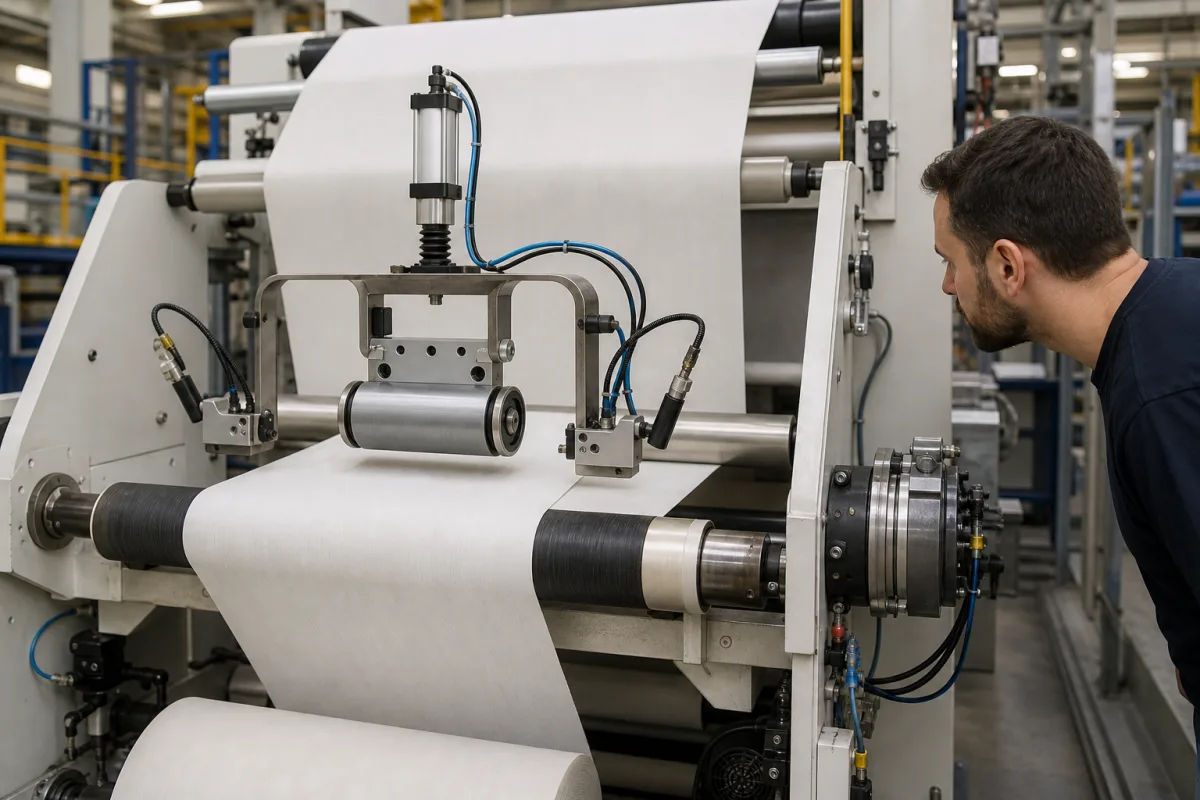
Fabric tension control on textile machines: jigger dyeing and rotating take-down units
Textile machines · jigger dyeing and rotating take-down units, wet and stretch fabrics, roll diameter and rotating frames
Fabric tension control here means the closed loop inside a textile machine that keeps a woven or knitted fabric at a set tension while it is wound through a dye bath or drawn off by a take-down unit. Before asking for prices, establish three things: where the tension is sensed (load cell or spring position), which motors or brakes are trimmed to correct it, and how the loop copes with a growing roll or a frame that rotates.
Tension control built into textile fabric machines, shown here through jigger dyeing machines (fabric wound back and forth between two rolls through a liquor bath) and take-down units for yarn-formed fabric mounted on a rotary support, where the fabric is wet, stretchy or carried on a rotating frame. General load-cell and dancer tension control on unwind and rewind stands for film, paper and other webs is covered on the Web tension control: follow the force and the feedback page.
CNFX editorial research · Sources checked October 12, 2026 · 3 sources
On EFI's Mezzera jigger, tension is set in the PLC to suit the fabric; a load cell on the back roller, positioned under the liquor, measures the tension applied to the fabric in real time, and the PLC compares set and measured values and corrects any difference by synchronising the two AC motors through their inverters. [1]
EFI lists working widths of 1803 to 3607 mm, mechanical speeds of 30 to 150 m/min and roll batch diameters of 305 to 1397 mm. Each of the two motors has its own AC vector inverter, and a high-resolution encoder keeps the speed accurate as the diameter of the fabric roll changes. EFI states that the compensation lets delicate fabrics, bi-stretch included, run at the same tension throughout the cycle. [1]
Editorial calculation: at a fixed fabric tension, the torque on a winding roll equals tension times roll radius, so between the 305 mm and 1397 mm batch diameters EFI lists the torque each motor must supply, and the roll speed needed for a constant fabric speed, change by a factor of 1397 / 305 ≈ 4.6. [1] Ask how the drive holds tension at both ends of that range for your batch length.
EFI fits a central equaliser swingarm for delicate, tension-sensitive fabrics and an oscillating equaliser for medium to heavy fabrics. [1] Otto-Pricken, another jigger builder, names constant fabric tension and speed alongside temperature, time, filling levels and dosing as factors for washing, bleaching and dyeing, and builds jiggers with roller widths of up to 4,000 mm. [3]
Give the supplier the fabric type and weight, stretch content, batch length and roll diameter, width, speed, required tension or tension range, liquor temperature, and whether the sensor must work submerged.
02
Control fabric tension on a rotating take-down unit
A European patent granted to Orizio Paolo S.p.A. describes a tensioning unit for yarn-formed fabrics in which a tensioning roller is pressed against the fabric by a thrust spring preloaded with an adjustment knob; a linear position transducer tied to the spring reports its position, and the speed of a non-ventilated induction motor driving the take-up rollers is raised or lowered to keep the fabric tension constant as fabric speed changes. [2]
Because the unit is mounted on a rotary support, the patent places the operator panel in a fixed cubicle and links it to an identical electronic card on the rotating unit through a serial line with infrared optical coupling; power reaches the motor through a three-way collector with rotating brushes. [2]
The patent's example embodiment uses a motor with a 90 mm flange and an ultra-flat inverter delivering up to 7 A, designed for 0.37 kW (0.75 kW in an enlarged version), with an output frequency programmable from 0 to 1300 Hz; the electronics are fed through a 220 V/17 V inlet transformer. [2] The patent also explains why tension stability matters downstream: with continuous-filament chemical fibres, it says high tension during winding can cause molecular changes that alter dyeability and appear on the fabric as bars of colour. [2] The patent does not name the type of knitting or weaving machine the unit is fitted to.
Editorial note: these figures describe one patented embodiment, not a catalogue rating. For a take-down unit, ask the machine builder for the sensing method, motor and drive rating, and how signals and power cross the rotating joint.
03
Compare where fabric tension is measured and corrected
The two machine types in the sources sense and correct tension differently; this summary is drawn from those sources.
Supplier listings below may cover tension controllers sold for other web industries too; ask each to confirm a reference on the same fabric process you run.
Machine
Sensing
Correction
Source
Jigger dyeing machine
Load cell on back roller under the liquor.
PLC trims two AC motors via vector inverters; encoder compensates roll diameter.
Explore company information and manufacturing capabilities, then discuss the scope of your project with a relevant supplier.
Share this page
Compiled and source-reviewed by the CNFX editorial team.
Each manufacturer above links to the page on that company's own website where the product is listed, with the date we checked it. How we source and review
· Page last updated 13 October 2026
Buyer questions
Where is tension measured on a jigger dyeing machine?
On EFI's Mezzera jigger, a load cell on the back roller under the liquor measures it and the PLC trims both inverter-driven motors. [1]
Why does roll diameter matter for fabric tension?
Torque equals tension times radius; across EFI's 305 to 1397 mm batch diameters that is a 4.6-fold change by editorial calculation. [1]
How can tension be sensed on a take-down unit that rotates?
An Orizio patent uses a spring-loaded tensioning roller with a linear potentiometer and an infrared serial link to the fixed cubicle. [2]
Sources and what still needs a direct check
Sources checked 2026-10-12. EFI and Otto-Pricken are jigger builders describing their own machines; the Orizio patent is a granted European patent describing one take-down design for yarn-formed fabrics.